
 Worksheets
Protein Synthesis Review- Mrs. D
Total questions: 45
Worksheet time: 51mins
What does rRNA do during protein synthesis?
ribosome where translation occurs
carries the genetic information
carries the amino acid
transcribes the DNA into RNA and leaves the nucleus
What does mRNA do during protein synthesis?
ribosome where translation occurs
carries the genetic information
carries the amino acid
transcribes the DNA into RNA and leaves the nucleus
What does tRNA do during protein synthesis?
ribosome where translation occurs
carries the genetic information
carries the amino acid
transcribes the DNA into RNA and leaves the nucleus
What is the function of DNA?
ribosome where translation occurs
is your genetic information
carries the amino acid
transcribes the DNA into RNA and leaves the nucleus
What is the shape of DNA called?
triple helix
trouble helix
double helix
double helical
Transcription occurs where?
Mitochondria
Nucleus
Ribosome
Chloroplast
Translation occurs where?
Mitochondria
Nucleus
Ribosome
Chloroplast
At the end of Transcription you have?
tRNA
mRNA
rRNA
Amino acids
At the end of Translation you have?
tRNA
mRNA
rRNA
Amino acids
What makes up the sides of DNA and RNA?
sugar and nucleic acids
sugar and uracil
sugar and adenine
sugar and phosphate
What are the four bases of DNA?
What are the four bases of RNA?
DNA to DNA matching: CGA TAA
GCT ATT
DNA to RNA matching: ACT GAT
UGA CUA
What amino acid is made from CAU?
What amino acid is made from ACU?
What amino acid is made from GAU?
Which letters could have produced the amino acid Cysteine?
UGC
AAG
GAC
GAT
Which letters could have produced the amino acid Leucine?
GUA
CTA
CUA
AGU
Which letters could have produced the amino acid Cysteine?
AGT
UGU
GGA
CGC
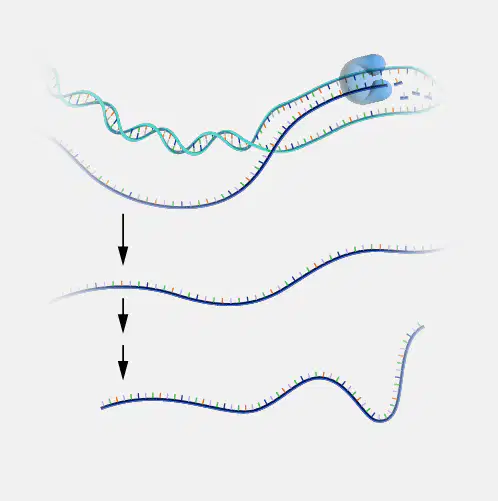
Which step is this in protein synthesis? How would I know?
Transcription, because tRNA is present in the ribosome
Translation, because DNA is involved
Termination, because DNA is involved
Transcription, because DNA is involved

Which step is this in protein synthesis? How would I know?
Translation, because tRNA is present in the ribosome
Translation, because DNA is involved
Termination, because DNA is involved
Transcription, because DNA is involved
If I have 37 Guanines in a gene of DNA, how many cytosine should be present?
Know way of knowing the correct answer
47
24
37
What is the function of RNA?

Which organelle is the location where protein is made?
Ribosome
Nucleus
Cytoplasm
Nucleotide

Transcription is a process that in eukaryotic cells takes place in the:
Nucleus
Cytoplasm
Golgi Apparatus
Rough E.R.
What is the role of mRNA in protein synthesis?
It carries amino acids to the ribosome.
It carries the genetic code from DNA to the ribosome.
Which type of RNA forms the structure of ribosomes?
mRNA
tRNA
rRNA
snRNA

A small section of RNA that transports amino acids
to the ribosome for synthesis into proteins.
tRNA
mRNA
rRNA
DNA

The job of tRNA is to
copy the genetic code from DNA
bring amino acids to the ribosome
bring the code from the DNA to the ribosome
synthesize amino acids

Which of the following bases is not found in DNA?
Adenine
Thymine
Uracil
Cytosine
What are the four nitrogenous bases in DNA?
Adenine, Guanine, Cytosine, Thymine
Adenine, Guanine, Cytosine, Uracil
Adenine, Guanine, Uracil, Thymine
Adenine, Uracil, Cytosine, Thymine
GAG-CTC-GAC-AGA
Mutant
GAG CTC-CAC-AGA
DNA molecule segment is : TTA CGC
The mutated DNA segment is TTC GC. This is an example of ___ mutation.
RNA is double stranded.
True
False
RNA is read in chunks of three, called...
antelope
Original: ATC CAT
Mutation: ATC GCA T
What mutation occurred?
DNA is a double helix.
True
False
Mrs. Dobler is cool.
True
False
Which organelle is the location where protein is made?
Ribosome
Nucleus
Cytoplasm
Nucleotide
Which sugar is found in DNA
Which sugar is found in RNA
What are the three types of RNA?
mRNA
tRNA
sRNA
gRNA
tRNA
rRNA
mRNA
tRNA
rRNA
mRNA
aRNA
gRNA

