wayground logo

Free Printable Worksheets

Font size

S
M
L
XL
Worksheets

Year 7 Science Semester 2 Exam Revision

Total questions: 67

Worksheet time: 54mins

Name
Class
Date
1.
What will cause an object to move?
a)
Applied forces
b)
Balanced forces
c)
Unbalanced forces
2.
Balanced or Unbalanced?
a)
Balanced 
b)
Unbalanced
3.
What pulls a ball back to earth?
a)
Gas
b)
Gravity
c)
Friction
d)
Molecules
4.

Match the following forces to their definitions.

a)

Push

1.

Force moving away from the body

b)

Pull

2.

Force moving towards the body

c)

Friction

3.

Opposing force between two surfaces that are touching

d)

Gravity

4.

Force that pulls things down towards the ground

5.
Which of the following is an example of friction that is helpful?
a)
Brakes used on a bike
b)
Tires from a car on the road
c)
Tread on the bottom of your shoes
d)
All are examples that are helpful
6.
Which of the following is an example of friction that is harmful?
a)
Pencil marking on paper
b)
Engine parts wearing out
c)
sand placed on ice in the winter
d)
Using an eraser to erase marks
7.
For a lever to be a first class lever the fulcrum needs to be ..
a)
between the load and the effort
b)
on one side and the load and effort on the other side 
c)
on the same side as the load arm. 
8.

A bottle opener is a .....

a)

Pulley

b)

Lever

c)

Inclines plane

9.
A good example of a second class lever is the ...
a)
Can-opener
b)
Wheelbarrow 
c)
hammer 
d)
tongs 
10.
Third class levers are said to be speed multipliers. 
examples of third class levers include all of the below except .....
a)
a door handle 
b)
baseball bat 
c)
tennis rachet 
d)
golf club 
11.
Simple machines (crow bar, ramp, axe, screw, crane) do which of the following?
a)
Reduce the mass of an object that needs to be moved
b)
Reduce the distance an object needs to be moved
c)
Reduce the amount of time needed to move an object over a distance
d)
Reduce the force needed to move an object over a distance
12.

A first class lever has a

a)

Load - Pivot - Effort

b)

Pivot - Load - Effort

c)

Pivot - Effort - Load

13.

A second class lever has a

a)

Load - Pivot - Effort

b)

Pivot - Load - Effort

c)

Pivot - Effort - Load

14.

A third class lever has a

a)

Load - Pivot - Effort

b)

Pivot - Load - Effort

c)

Pivot - Effort - Load

15.

A see-saw is an example of a

a)

first class lever

b)

second class lever

c)

third class lever

16.

A wheel barrow is an example of a

a)

first class lever

b)

second class lever

c)

third class lever

17.
3. Which type of lever is this?
a)
First Class Lever
b)
Second Class Lever
c)
Third Class Lever
18.
6. What kind of lever is this?
a)
First Class Lever
b)
Second Class Lever
c)
Third Class Lever
19.

What class lever does this picture show?

a)

1st

b)

2nd

c)

3rd

20.

Name the missing force.

a)

Gravitational Force

b)

Normal Force

c)

Friction Force

d)

Applied Force

21.

Name the missing force.

a)

Normal Force

b)

Push/Pull Force

c)

Friction Force

d)

Tension Force

22.

Name the missing force.

a)

Normal Force

b)

Friction Force

c)

Gravitational Force

d)

Push/Pull Force

23.

The force that keeps objects on top of surfaces instead of letting them sink into the surface is known as:

a)

Normal Force

b)

Gravitational Force

c)

Friction Force

d)

Air resistance

24.
A mixtures is a combination of two or more____________ in which no new kinds of matter are formed.
a)
 subtances
b)
parts
c)
leaves
d)
pebbles
25.
Lemonade is a special mixture called a 
a)
substance
b)
solution
c)
plasma
d)
ingredient
26.
A solution is a mixture of one or more substances _________ evenly into another substance.
a)
dissolved
b)
evaporated
c)
carried
d)
split
27.
Coffee is a 
a)
solution
b)
mixture
28.

To separate a mixture of salt and water what separation tool/method is used?

a)

Filter

b)

Sieve

c)

Magnet

d)

Evaporation

29.

If you spilled nails in a sandbox, what separation tool/method could you use to clean out the sandbox so it would be safe for children to play in?

a)

Filter

b)

Screen

c)

Magnet

d)

Evaporation

30.

Which of the following is a method of separating solutions?

a)

hand seperation

b)

filtering

c)

screening

d)

evaporation

31.

This type of paper allows liquid to pass through it. What tool is it?

a)

sieve

b)

filter

32.

If I pour sand and water onto a filter, what will happen?

a)

water and sand will go through the filter

b)

sand will get caught in the filter, water will pass through

c)

both sand and water will get caught in the filter

33.

If I have a mixture of peanuts and nails, which would be the BEST tool to separate them?

a)

filter

b)

magnet

c)

sieve

d)

by hand

34.
A liquid made up of a solvent with a solute dissolved in it
a)
solution
b)
soluble
c)
solidified
d)
solar
35.
A ________ is something that dissolves in a liquid (solvent)
a)
solute
b)
salt
c)
sugar
d)
solution
36.
Any liquid that dissolves another substance or substances 
a)
solvent
b)
solute
c)
solution
d)
substance
37.
A cloudy liquid that contains insoluble particles
a)
suspension
b)
solvent
c)
solute
d)
salt
38.
Describing a solution with a large amount of solute 
a)
concentrated
b)
saturated
c)
unsaturated 
d)
filled
39.
Describing a solution with a small amount of solute 
a)
saturated 
b)
unconcentrated
c)
concentrated 
d)
dilute
40.
How would you separate a mixture of sand and salt? 
a)
Mix them with water and let the water evaporate
b)
Mix them with water, pour the mixture through a sieve, then let the water evaporate
c)
Heat the sand and salt mixture for 5 minutes, then let it cool
d)
I would not do any of these because none of these options would work
41.
Which mixture could you separate by adding water and then pouring through a coffee filter?
a)
sand and salt, because the salt would dissolve and the sand would not
b)
baking soda and salt, because they both dissolve
c)
sugar and salt, because they both dissolve
d)
iron fillings and sand, because neither one dissolves
42.

Which item would be classified as an "abiotic factor" in an ecosystem?

a)

Bird

b)

Fungi

c)

Ant

d)

Rock

43.

What would be a hawkbill's habitat?

a)

Who it lives with

b)

Where it lives

c)

What it eats

d)

When it migrates

44.

Which of the following is an example of a hawksbill interacting with an abiotic factor?

a)

Hawksbill digs a nest in the sand

b)

Hawksbill eats a sea sponge

c)

Hawksbill mates with another hawksbill

d)

Hawksbill gets attacked by a shark

45.

Select ALL of the biotic factors below

a)

Air

b)

Earthworm

c)

Grass

d)

Rock

e)

Water

46.

Match the image to its biotic/abiotic description

a)
1.

Abiotic

b)
2.

Biotic

c)
3.

Abiotic

d)
4.

Biotic

e)

5.

Biotic

47.

What is a Food Chain?

a)

The reduction of energy from organism to organism.

b)

The transfer of energy from organism to organism.

c)

The hunting of animals.

d)

The death of wild animals.

48.

What is a food web?

a)

Multiple organisms linked together.

b)

A group of wild animals.

c)

Multiple food chains linked together.

d)

A group of dead animals.

49.

What is a producer?

a)

An organism that makes its own food.

b)

An organism that depends on other organisms to produce its food.

c)

An organism that eats other animals.

d)

An organism that produces plants.

50.

What is a consumer?

a)

An organism that can't make its own food.

b)

An organism that is eaten by another animal in the food chain.

c)

An organism that eats other animals in the food chain.

d)

An organism that is at the bottom of the food chain.

51.

What is the ultimate source of energy for all food webs?

a)

The primary producer.

b)

The sun.

c)

The apex predator.

d)

The primary consumer.

52.

Each organism that gets its energy from producers are called?

a)

Primary Consumers

b)

Primary Producers

c)

Secondary Consumers

d)

Primary Decomposers

53.

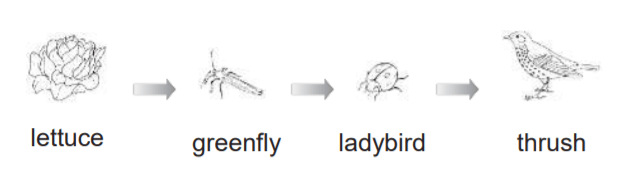
The arrows in this diagram represent...

a)

producers eating

b)

sunlight shining on the animals

c)

the movement of energy

d)

the matter of the animals

54.

Who is the producer?

a)

lettuce

b)

greenfly

c)

ladybird

d)

thrush

55.

What does a primary consumer eat?

a)

tertiary consumers

b)

secondary consumers

c)

producers

d)

decomposers

56.
An organism that lives by breaking apart dead organic matter into simpler parts is...
a)
scavenger
b)
consumer
c)
decomposer
d)
carnivore
57.
What are animals called in a food chain?
a)
Producers
b)
Consumers
c)
Decomposers
d)
Plants
58.
What is the role of a producer?
a)
Use sunlight to make food
b)
Gain energy from eating other organisms
c)
Keep other species from overpopulating
d)
Breaking down dead stuff 
59.
Which of these organisms would receive energy from the snake?
a)
Plant
b)
Rabbit
c)
Mouse
d)
Hawk
60.
Which type of consumer eats plants only?
a)
Herbivores
b)
Omnivores
c)
Carnivores
d)
Scavengers
61.
Which type of consumer eats meat only?
a)
Producers
b)
Herbivores
c)
Carnivores
d)
Omnivores
62.
Which type of consumer eats meat and plants?
a)
Herbivores
b)
Carnivores
c)
Omnivores
d)
Plants
63.
Which type of consumer is always a first consumer?
a)
Herbivore
b)
Omnivore
c)
Carnivore
d)
Producer
64.
Which is the correct food chain order?
a)
Plant-->1st Consumer--> 2nd Consumer 
b)
Plant <-- 1st Consumer <-- 2nd Consumer
c)
2nd consumer     --> 1st consumer  --> Plant
d)
1st Consumer      --> 2nd consumer --> Plant
65.
Which of these is true about this food web?
a)
The Owl gets its energy from the producer.
b)
The Lion gets its energy only from a wild cat.
c)
The Kite gets its energy from the goat.
d)
The Mouse is most likely to die, several ways.
66.
Organisms that breaks down and absorbs nutrients from dead organisms 
a)
consumer
b)
trophic level
c)
decomposer
d)
species
67.
A food web is composed of many...
a)
food webs
b)
food chains
c)
fast-food chains
d)
bike chains