wayground logo

Free Printable Worksheets

Font size

S
M
L
XL
Worksheets

2nd Quarter Midterm Physical Science and Chemistry

Total questions: 71

Worksheet time: 1hrs 3mins

Name
Class
Date
1.

What is the charge of a proton?

a)

Negative

b)

Positive

c)

Neutral

2.

What is the charge of a neutron?

a)

Negative

b)

Positive

c)

Neutral

3.

Subatomic particles with a negative charge

a)

Electrons

b)

Neutrons

c)

Protons

d)

Quarks

4.
Value representing the number of protons in an element
a)
Atomic Mass
b)
Mass Number
c)
Valence Electrons
d)
Atomic Number
5.
Which two subatomic particles make up the nucleus of an atom?
a)
Protons and Electrons
b)
Neutrons and Electrons
c)
Electrons and Protons
d)
Protons and Neutrons
6.
Where are the Electrons found in the structure of an atom?
a)
In the nucleus
b)
In spaces around the nucleus
7.

What is the mass number?

a)

the number of protons in the nucleus

b)

the number of protons and neutrons in the nucleus

c)

the number of neutrons in the nucleus

d)

the number of protons and electrons in the atom
8.
In order for an atom to be neutral what has to be true?
a)
The atom has more protons than neutrons
b)
The atom has more neutrons than protons
c)
The atom has the same number of protons and neutrons
d)
The atom has the same number of protons and electrons
9.
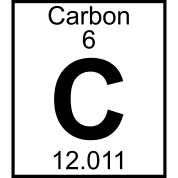
What does the C represent?
a)
atomic mass
b)
atomic number
c)
element name
d)
chemical symbol 
10.

What does the 6 represent?

a)

Atomic mass

b)

atomic number

c)

chemical symbol

d)

element name

11.
How is the number of neutrons in the nucleus of an atom calculated?
a)
Add the number of e- and p+ together
b)
Subtract the number of e- from p+
c)
Subtract the number of p+ from the mass number
d)
Add the mass number to the number of e-
12.
If an atom has 12 positively charged subatomic particles, which of the following must it also have to be considered a neutral atom?
a)
12 neutrons
b)
12 electrons
c)
12 protons
d)
24 protons and neutrons
13.

An atom has 10 protons, 15 neutrons and 10 electrons what is its mass number.

a)

20

b)

10

c)

35

d)

25

14.
The atomic number of an element that has 9 protons, 9 electrons, and 10 neutrons is _____.
a)
9
b)
10
c)
19
d)
28
15.
An element with a mass number of 11 and an atomic number of 5 has how many neutrons?
a)
11
b)
5
c)
6
d)
16
16.
Where is most of the mass in an atom located?
a)
in the nucleus
b)
in the protons
c)
in the neutrons
d)
in the electrons
17.
An atom has an atomic number of 15 and a mass number of 31. How many protons are there in the atom?
a)
15
b)
31
c)
16
d)
47
18.

Which of the following determines the identity of an element?

a)

number of protons

b)

atomic mass

c)

number of neutrons

d)

number of shells

19.
What is the atomic number of the atom pictured? 
a)
9
b)
10
c)
18
d)
19
20.

How many protons does indium have?

a)

49

b)

66

c)

114

d)

115

21.
How many protons does nitrogen have?
a)
14.01
b)
14
c)
7
d)
15
22.
How many neutrons are in lithium-7?
a)
7
b)
6.94
c)
3
d)
4
23.
How many electrons are in helium-4?
a)
2
b)
4
c)
3
d)
0
24.
What is the mass number of an aluminum isotope that contains 13 neutrons?
a)
13
b)
26
c)
27
d)
26.98
25.
How many neutrons are in carbon-14?
a)
14
b)
6
c)
7
d)
8
26.
How many electrons does Neon have?
a)
10
b)
20
c)
20.18
d)
0
27.

What is the name of group number 1?

a)

halogens

b)

noble gases

c)

alkali metals

d)

alkaline earth metals

28.

What is the name of group number 2?

a)

transition metals

b)

halogens

c)

metaloids

d)

alkaline earth metals

29.

A row on the Periodic Table of Elements

a)

family

b)

period

c)

row

d)

isotope

30.
___________ is the only metal that is a liquid at room temperature.
a)
Platinum
b)
Water
c)
Tin
d)
Mercury
31.

Which element is found in group 2, period 6?

a)

Oxygen (O)

b)

Barium (Ba)

c)

Selenium (Se)

d)

Carbon (C)

32.

Ions are ________

a)

atoms with an electric charge

b)

atoms with different number of protons

c)

atoms with different number of neutrons

33.

Metals form positive ions which are also known as (a)  

34.

Non-metals form negative ions which are also known as (a)  

35.

Ions have the same number of protons but different number of _________________

a)

neutrons

b)

electrons

c)

protons

d)

toes

36.

Isotopes have the same number of protons but different number of _________________

a)

neutrons

b)

protons

c)

electrons

d)

eyes

37.

______________ electrons are found in the outermost energy level of an atom.

a)

neutral

b)

valence

c)

purple

d)

proton

38.

How many valence electrons does Hydrogen (H) have?

a)

1

b)

2

c)

3

d)

4

39.

How many valence electrons do Group 2 atoms have?

a)

1

b)

2

c)

3

d)

4

40.

Atoms in Group 16 will (a)   2 electrons to form a -2 charge

41.

How many valence electrons are needed to fulfill the octet rule?

a)

2

b)

4

c)

6

d)

8

42.
How are covalent bonds formed?
a)
Sharing of electrons
b)
Transfer of electrons
43.
How are ionic bonds formed?
a)
Transfer of electrons
b)
Sharing of electrons
44.
What is a valence electron?
a)
The sum of neutrons and protons.
b)
The # of electrons in the last shell.
c)
A type of bond.
d)
A popular compound.
45.
This picture shows a...
a)
Ionic Bond
b)
Covalent Bond
c)
Both bonds
d)
Neither bond
46.
This picture shows a...
a)
Ionic Bond
b)
Covalent Bond
c)
Both bonds
d)
Neither bond
47.

Atoms in a water molecule are held together by what type of bond?

a)

Ionic

b)

hydrogen

c)

covalent

d)

none

48.

Why do all bonds form?

a)

so the number of protons equals the number of electrons

b)

so an atom can become unstable

c)

to fill the outermost energy level

49.
Covalent bonds are between...
a)
Metal and Non-metal
b)
Non-metal and Non-metal
c)
Metal and Metal
50.
Ionic bonds are between...
a)
Metal and Non-metal
b)
Non-metal and Non-metal
c)
Metal and Metal
51.
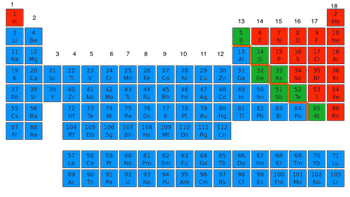
Where are the nonmetals located on the periodic table? 
a)
Blue
b)
Red
c)
Green
52.
Where are metals located on the periodic table?
a)
Blue
b)
Green
c)
Red
53.
Which of the following is an ionic bond?
a)
H3N
b)
CaCl2
c)
NO2
d)
SCl
54.

What do atoms that form positive ions tend to do?

a)

lose electrons

b)

gain electrons

c)

lose protons

d)

gain protons

55.
Atoms that gain electrons become...
a)
negatively charged
b)
positively charged
c)
remain neutrally charged
d)
21
56.
If an oxygen atom has 8 protons (+) and 10 electrons (-), what is it's charge?
a)
O10-
b)
O8+
c)
O2-
d)
O10+
57.
If an atom gains two electrons what charge will it have?
a)
-2
b)
-1
c)
+1
d)
+2
58.

Which of the following is NOT a covalent bond?

a)

K2S

b)

H2O

c)

I2

d)

CO2

59.
What is the name for an ion with a negative charge?
a)
cation
b)
anion
c)
onion
d)
union
60.

What happens when two oppositely charged ions are pushed together?

a)

they will repel (move apart)

b)

they will be attracted to each other (move together)

61.

For nonmetals, its easier to _____ electrons to have a full outer shell.

a)

gain

b)

lose

c)

share

62.

Which two elements would NOT form an ionic bond?

a)

calcium and lithium

b)

calcium and oxygen

c)

lithium and oxygen

d)

calcium and carbon

63.

A sodium ion has a charge of

a)

-1

b)

-2

c)

+1

d)

+2

64.

Chemical bonds always involve

a)

ions

b)

protons

c)

metals

d)

electrons

65.

True or False: An oxygen atom has eight valence electrons

a)

True

b)

False

66.

Which of the following models is an example of a covalent compound?

a)
NaCl
b)
KCl
c)
H2O
d)
CaCO3
67.

When metals react with non-metals, they usually

a)

gain electrons and form anions

b)

lose electrons and form anions

c)

gain electrons and form cations

d)

lose electrons and form cations

68.

Pick the elements below that would most likely form an IONIC bond.

a)

Si and P

b)

As and He

c)

Fr and F

69.

The type of bond formed when K and Br bond.

a)

transition

b)

metallic

c)

covalent

d)

ionic

70.

How is the bond O2 different from the bond of NaF?

a)

O2 is ionic and NaF is covalent

b)

O2 is covalent and NaF is metallic

c)

O2 is covalent and NaF is ionic

71.

What is the charge on a beryllium ion?

a)

+2

b)

-2

c)

+1

d)

we don't know