
 Worksheets
KU Sailing Shore Sessions Test 1
Total questions: 26
Worksheet time: 22mins
Label the boat parts
Sheet
Bow
Rudder
Tiller
Boom
Hull
Mast
Centerboard
Jib
Mainsail
When standing in a boat looking towards the bow, the left side is the ___ side and the right side is the ___ side.
fore, aft
starboard, port
aft, fore
port, starboard
What start sequence is used for college sailing?
3 minutes
4 minutes
5 minutes
6 minutes
In general, a boat on the (a) tack will have right away over a boat on the (b) tack and a (c) boat will have right away over a (d) boat.
To be the windward boat means what?
You have right way
You are closest to the wind
You are furthest from the wind
You rule
What is your greatest enemy in sailing?
Wind shifts
The race committee
Your competitors
Yourself
Match the following parts of a sailboat to their function:
Lines for adjusting sail positions (in and out)
Sheets
Pulls the boom downward
Vang
Used to adjust the tension in the foot of a mainsail
Outhaul
Used to adjust the tension in the luff of a mainsail
Cunningham
Indicates the direction of the wind
Telltales
Shifting crew weight forward turns the bow to (a) and shifting the crew weight backwards turns the bow to (b) .
What is the point of roll tacking?
Give yourself right away during a tack
To look cool for pictures
Slow down a tack
Generate speed during a tack
How would you want your boat to look under each condition?
Heavy Air
Flat sails
Minimal heel
Slightly eased
Medium Air
Full Sails
Minimal heel
Main all the way
Light Air
Full Sails
Some heel
Main in some
Do you have right away during a tack?
Yes
No
What are the three types of wind shifts?
Consistent
Oscillating
Topographic
Persistent
Oscillating
Geographic
Persistent
Oscillating
Topographic
Consistent
Oscillating
Geographic
To get power in your sails, where do you want high pressure and where do you want low pressure on port tack?
High pressure
Low pressure
How many boat lengths behind a 420 will the wind be disturbed?
(a)
When boats are overlapped upon entering the three boat circle the (a) boat shall give the (b) boat mark room.
Label the parts of a sail
Luff
Leech
Head
Clew
Tack
Foot
What is a point of sail?
a desination
a boat's angle in relation to the wind
the leading or trailing edge of a sail
an essential bit of sailing knowledge
When the sails switch from one side of the boat to the other going upwind it is known as:
a tack
a gybe
When the sails switch from one side to the other going downwind this is known as:
a tack
a gybe
What is the best indicator of wind direction?
a wind arrow
the sensation of wind on a finger
the surface of the water
the movement of clouds overhead
What is "heeling"?
a sailboat leaning to one side
an alternate term for trimming the sails
an alternative term for easing the sails
making your dog walk right by your side
If your boat is "in irons"/"head to wind" what does that mean?
it's moored at the dock
you are directly facing the wind and cannot move
you are facing directly away from the wind
you are 90 degrees from the wind
What does is mean to "luff"?
leaning your body out of the boat
looking for wind direction
letting your sails flap in the wind
taking your sails down
The lines used to raise sails are called ___?
cleats
boom vangs
halyards
sheets
At what wind speed do white caps form?
12 to 14 knots
16 to 18 knots
24 to 28 knots
30 to 34 knots
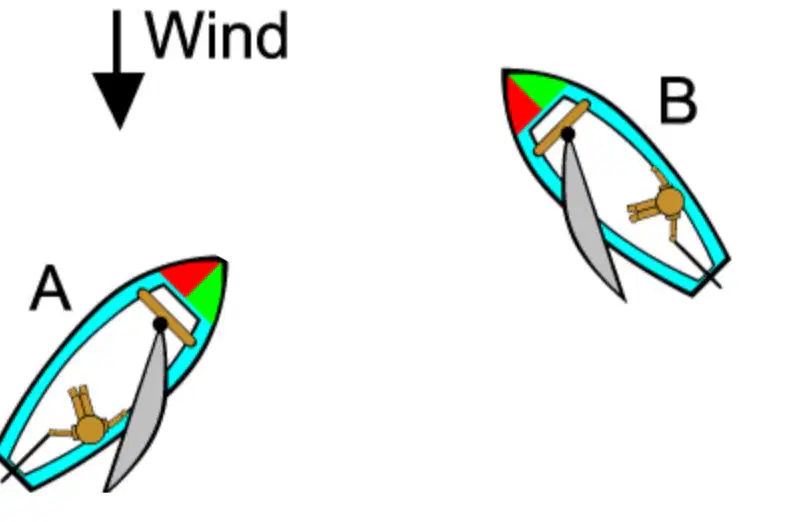
Assuming these boats on are a collision course, which boat has right of way?
A
B

