
 Worksheets
Quizizz Week #12
Total questions: 20
Worksheet time: 22mins
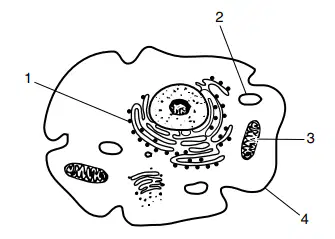
Identify #1
Ribosome
Vacuole
Mitochondria
Cell Membrane
Identify #3
Ribosome
Vacuole
Mitochondria
Cell Membrane
Identify #4
Ribosome
Vacuole
Mitochondria
Cell Membrane
Identify the function of #4
Protein Synthesis
Storage
Cellular Respiration
Controls what goes in and out of the cell
Identify the function of #3
Protein Synthesis
Storage
Cellular Respiration
Controls what goes in and out of the cell
Identify the function of #1
Protein Synthesis
Storage
Cellular Respiration
Controls what goes in and out of the cell

Which statement correctly describes the effect on the mass of one of the cubes after the 20-minute period?
In distilled water, the mass of the potato cube increased due to salt leaving the cells of the potato.
In distilled water, the mass of the potato cube increased due to water moving into the cells from high concentration to low concentration.
In the concentrated salt solution, the mass of the potato cube increased due to salt moving into the cells from low concentration to high concentration.
In the concentrated salt solution, the mass of the potato cube remained the same due to the cell wall preventing the movement of molecules into or out of the cells.

The process that occurs at Step 1 is
respiration
excretion
circulation
digestion
Cell structure X is a
cell membrane
ribosome
vacuole
mitochondrion
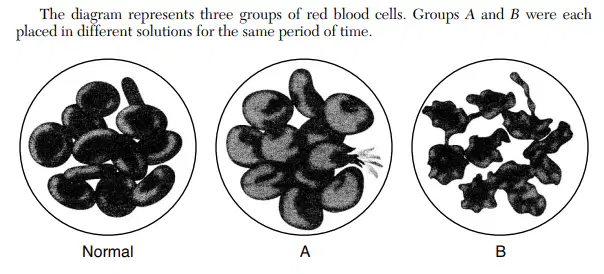
Identify which group of cells, A or B, had most likely been placed in distilled water and why?
A, because the cells shrank
B, because the cells shrank
A, because the cells got larger and burst
B, because the cells got larger and burst
Identify which group of cells, A or B, had most likely been placed in salt water and why?
A, because the cells shrank
B, because the cells shrank
A, because the cells got larger and burst
B, because the cells got larger and burst
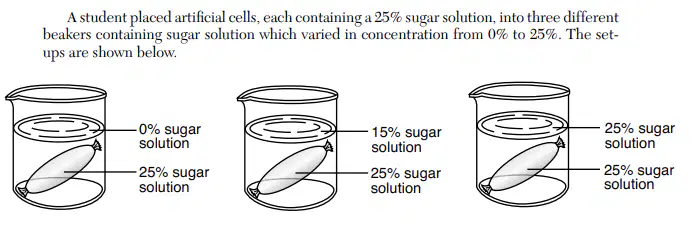
The student collected data on the mass of each artificial cell. The student predicted that the cell in the beaker with 25% sugar solution would have the greatest change in mass after 24 hours. Would his prediction be correct?
Yes, it would cause water to move into the "cell"
No, the "cell" and the water are in equilibrium
Yes, It would cause water to move out of the "cell"
No, Water would move out
The respiratory system of an elephant functions in a similar way to which organelle in a single celled organism?
cell membrane
chloroplast
nucleus
vacuole
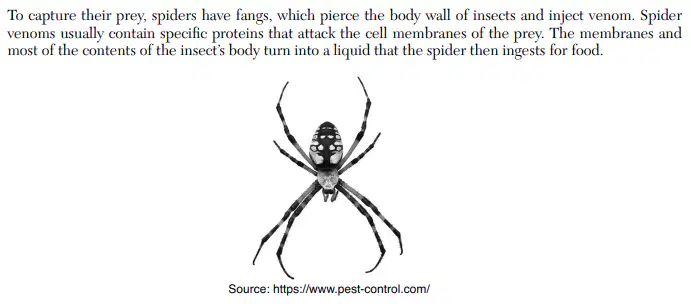
These specific venom proteins are most likely
ATP molecules
biological catalysts
DNA molecules
regulatory hormones
Protein synthesis is accomplished primarily by the interaction of which two cell structures?
vacuoles and mitochondria
nuclei and mitochondria
nuclei and ribosomes
ribosomes and vacuoles
In which cell structure is energy extracted from nutrients?
chloroplast
mitochondrion
ribosome
vacuole
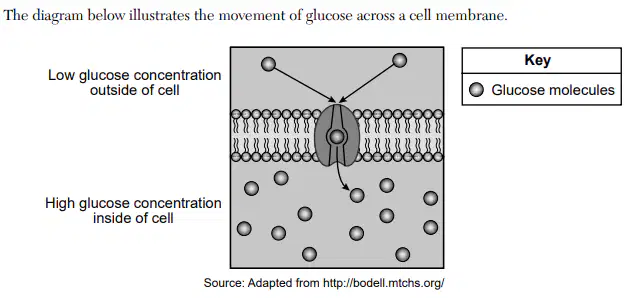
Which two processes are most directly represented in this diagram?
ATP synthesis and the diffusion of water
homeostasis and ATP synthesis
molecule transport and energy use
homeostasis and the diffusion of water
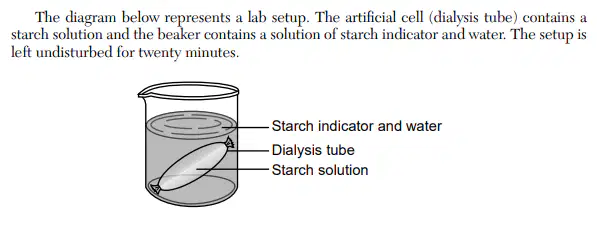
Identify one molecule, present in this setup, that will be able to pass through the dialysis tubing.
Starch
Glucose
Starch Indicator
Dialysis Tubing
How would we know that starch indicator diffused into the cell?
The "cell" turned amber
The "cell" turned black
The "cell" turned orange
The "cell" turned light blue
Certain seaweeds contain a greater concentration of iodine inside their cells than there is in the seawater surrounding them. The energy required to maintain this concentration difference is most closely associated with the action of
ribosomes
nuclei
mitochondria
vacuoles

