
 Worksheets
School Connect 4.0-Module 4 = Collaborating on Group Projects
Total questions: 25
Worksheet time: 15mins
According to Tuckman's Stages of Group Development,
there are 4 stages that all teams/groups go through.
True
False
(When talking about group projects):
In basketball, for instance, each player and the coach are
essential to reaching the team goal.
True
False
Tuckman's Stages of Group Development include:
Forming, Storming, Norming, Performing.
True
False
According to the Essentials of Collaborating Effectively,
we should not be open-minded to other's opinions.
True
False
Which is NOT a physical cue (reaction in your body) that indicates that you are angry?
Clinching your jaw
Tightness in your chest and shoulders
Nervous/Queasy
stomach
Smiling
Being aware of your feelings (both physical and emotional) help you to self-regulate.
True
False
When Agreeing to Disagree, it is respectful to fully consider the
other person's perspective through active listening.
True
False
Idea Generating is also called (a)
When working in a group in the Brainstorming stage, we do not have to
worry about the words we use or our non-verbals (eye rolls, etc.).
True
False
When working in groups and Brainstorming/Idea Building,
we should not take it personal if the group chooses to not use your ideas.
True
False
Which type of reaction is a Predictable way to Agree to Disagree?
Attacking the character of the person you disagree with
Name Calling
Stating the opposite opinion without facts to back it
Staying calm and not imitating the other person's behaviors
The way that we handle disagreements help other people
form opinions about you and your character.
True
False
Which is NOT a tip for Group Projects
Identify Strengths
Communicate
Identify Weaknesses
Share the Work Load
When working on a Group Project, your group should have a
"Plan B" in case things are not going as planned.
True
False
Each person in a Group Project brings his/her own skills/talents
to the mix to help complete the group task.
True
False
The following are all questions that need to be
answered during a Group Project, except which one?
WHAT
are you trying to accomplish?
HOW
will you do it?
WHO
is involved?
WHEN
will you finish?
SO WHAT
are your results?
How many steps does Coah Rudy tell us it takes for a "Win-Win Agreement"?
2
8
4
5
When negotiating a "Win-Win Agreement", it is always good to use a Venn Diagram
to help you to visualize the ideas that you and the other person agree on.
True
False
Having two possible options in a "Win-Win Agreement" gives NO room for compromise.
True
False
Which is a "Predictable" way to handle conflict (Agree to Disagree)?
Attack the tone of the person you disagree with
Name calling
Refuse to listen to the other person's opinion
Have a dialogue
If you act disrespectfully or in (a) ways during a disagreement, other people
will see you as immature or someone who does not want to be part of a team.
How you handle disagreements will help other people form opinions about you.
True
False
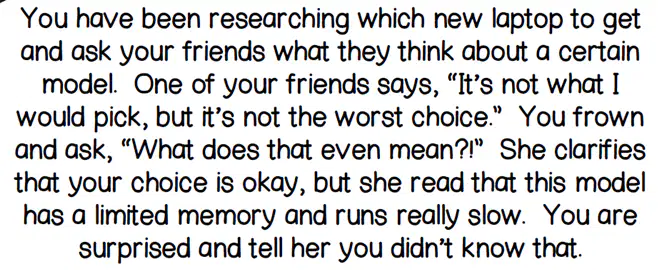
View the scenario to the left. Does this person disagree in a Predictable or Unpredictable manner?
Predictable
Unpredictable
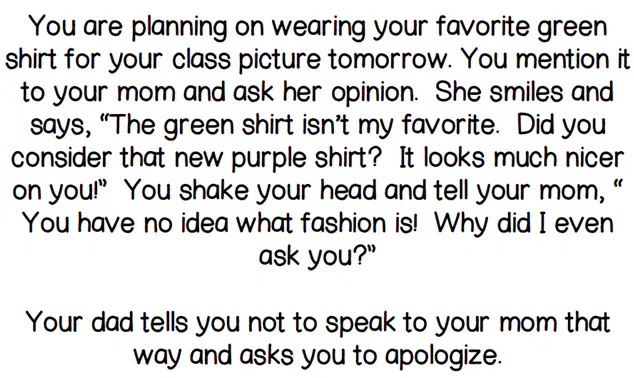
View the scenario to the left. Does the person in the disagreement respond in a Predictable or Unpredictable manner?
Predictable
Unpredictable
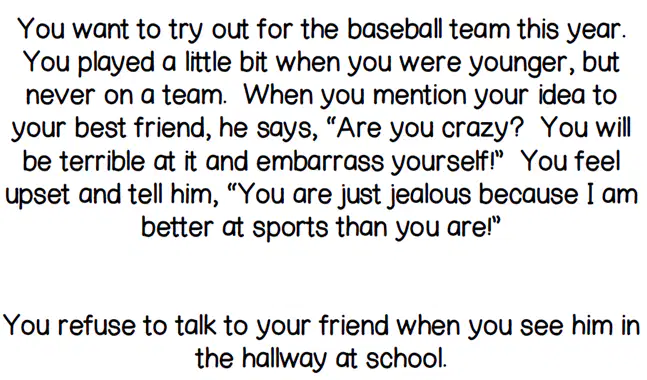
Look at the scenario to the left. Does the person disagree in a Predictable or Unpredictable manner?
Predictable
Unpredictable

