Wayground logo

Free Printable Worksheets

Font size

S
M
L
XL
Worksheets

Chapter 3 Review

Total questions: 41

Worksheet time: 33mins

Name
Class
Date
1.

Primary succession occurs in an area that has:

a)

Has Soil

b)

Has No Soil

c)

Has Some Soil

d)

none of these

2.

___ are the first organisms to colonize an area and begin the process of ecological succession.

a)

foundational organisms

b)

introductory organisms

c)

primary organisms

d)

pioneer species

3.

What is the main difference between primary and secondary ecological succession?

a)

Primary begins WITHOUT soil; Secondary begins WITH soil

b)

Primary is the first state and secondary is the second stage

c)

Primary builds plant community; secondary builds animal community.

d)

Primary begins WITH soil; Secondary begins WITHOUT soil

4.

What is an example of an area that is likely to undergo primary succession?

a)

Glaciers melt and leave exposed rock

b)

Plants die from drought and decompose

c)

Land is bulldozed and soil remains

5.

Which of the following is the correct order of ecological succession?

a)

grass - shrubs - lichens - trees

b)

lichens - shrubs - grasses - trees

c)

lichens - grasses - shrubs - trees

d)

grasses - lichens - shrubs - trees

6.

All of the following contribute directly to soil formation EXCEPT

a)

lichens

b)

decomposition of organisms

c)

volcanic eruptions

d)

erosion of rock by weather

7.

What is an increase of biodiversity over time, after a natural or man made disturbance?

a)

ecological recession

b)

climax recession

c)

ecological succession

d)

climax succession

8.

What is an example of a disturbance that could bring about secondary succession?

a)

Humans cut down many trees in a small region

b)

A volcanic eruption covers a village in lava.

9.

What is the term that describes a steady and stable community?

a)

peak community

b)

turf community

c)

climax community

d)

disturbed community

10.

What type of disturbance can be beneficial to ecosystems and communities?

a)

Volcanic Eruption

b)

Fire

c)

Invasive Species

d)

Flood

11.

Which is faster: Primary or Secondary Succession?

a)

Primary Succession

b)

Secondary Succession

c)

Both Take The Same Amount of Time

12.

Which of the following is NOT a pioneer species?

a)

Shrubs

b)

Lichen

c)

Mosses

d)

Fungi

13.

T or F: Succession increases biodiversity.

a)

True

b)

False

14.

The Final stage of ecological succession is...

a)

Mature Tree Growth

b)

Climax Community

c)

Pioneer Community

15.

Bare rock community must first undergo...

a)

Primary Succession

b)

Secondary Succession

c)

Climax

16.
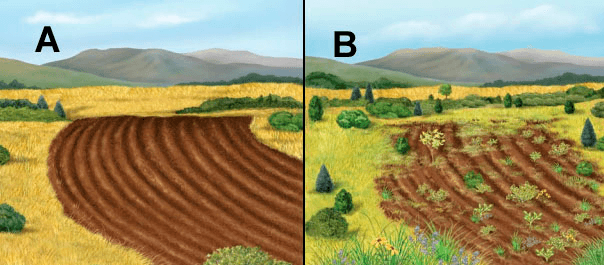
What type of succession is shown going from figure A to figure B?
a)
primary succession
b)
ecological succession
c)
secondary succession
d)
intermediate
17.
60 degrees latitude receives sunlight that is
a)
more direct & intense than 0 degrees
b)
less direct & intense than 0 degrees
c)
the same as 30 degrees in intensity
d)
more direct & intense than 30 degrees
18.
The closer a biome is to the equator, the more we would expect it to be
a)
warmer & wetter
b)
warmer & drier
c)
cooler & wetter
d)
cooler & drier
19.
The farther a biome is from the equator, the more we would expect it to be 
a)
warmer & wetter
b)
warmer & drier
c)
cooler & wetter
d)
cooler & drier
20.
The tropical rain forest & tropical savanna biomes are similar in ___________, but ________________________________.
a)
temperature / the savannah doesn't receive enough rainfall to be a forest
b)
precipitation / the rain forest is hotter
c)
precipitation / the savanna is cooler
d)
temperature / the rain forest doesn't receive enough sunlight to be a savanna
21.
The tundra biome & the desert biome are both very dry, but
a)
the desert is always hot
b)
the desert has a wider temperature range
c)
the tundra has a wider temperature range
d)
they are also similar in temperature
22.
The tropical savanna & temperate grassland are both types of grasslands. What differentiates them is the fact that
a)
the savanna is hotter
b)
the savanna is cooler
c)
the grassland is hotter
d)
the grassland receives much more precipitation
23.
The biome pictured is
a)
tropical savanna
b)
tropical rain forest
c)
temperate rain forest
d)
temperate deciduous forest
24.
The biome pictured is
a)
desert
b)
tropical savanna
c)
tropical seasonal forest
d)
boreal forest
25.
The biome pictured is
a)
boreal forest
b)
temperate deciduous forest
c)
tropical rain forest
d)
temperate rain forest
26.
The biome pictured is
a)
temperate grassland
b)
temperate deciduous forest
c)
desert
d)
tundra
27.
The biome pictured is
a)
temperate grassland
b)
temperate deciduous forest
c)
desert
d)
tundra
28.
The biome pictured is
a)
desert
b)
tundra
c)
temperate grassland
d)
boreal forest
29.
The biome pictured is
a)
shrubland/chaparral
b)
tropical savanna
c)
temperate deciduous forest
d)
desert
30.

The landscape of the tundra is characterized by having no trees. Why do you think there are no trees or other large plants in the tundra?

a)

Because of the permanently frozen ground, cold temperatures & short growing season

b)

Because it is too hot for part of the year

c)

Because it gets far too much precipitation

d)

none of these

31.
This biome's temperature is very cold at night and then extremely hot in the day.
a)
tropical rain forest
b)
temperate rain forest
c)
chaparral
d)
desert
32.
The biome pictured is
a)
tropical rain forest
b)
temperate deciduous forest
c)
temperate rain forest
d)
tropical seasonal forest
33.

Climate is the general pattern of weather over a period of

a)

months

b)

days

c)

weeks

d)

years

34.

Large ecological regions with characteristic types of natural, undisturbed ecological communities are called

a)

communities.

b)

populations.

c)

ecosystems.

d)

biomes.

35.
What are areas where freshwater meets saltwater called?
a)
wetlands
b)
estuaries
c)
coastal byways
d)
intertidal zones
36.
Aquatic ecosystem that has a thin layer of water covering soil that is wet most of the time is called ____.
a)
wetland
b)
estuary
c)
lake
d)
puddle
37.
Wetlands and estuaries purify water and filter out _____.
a)
dead organisms
b)
waste products
c)
salt
d)
pollution
38.
What factors affect aquatic ecosystems? 
a)
Light, salinity, temperature
b)
Sun, moon and stars
c)
Nothing
d)
Coral reefs, whales
39.
Which factor(s) affect aquatic ecosystems?
a)
depth
b)
flow
c)
nutrients
d)
all affect aquatic ecosystems
40.
Why does photosynthesis not occur in the deep ocean? 
a)
Lack of nutrients
b)
Low oxygen levels
c)
Excess sunlight
d)
Sunlight does not penetrate
41.

Which of the following are producers in the food web?

a)

Phytoplankton and seaweed

b)

Phytoplankton and zooplankton

c)

Squid and Elephant Seal

d)

Seaweed and Crabs