wayground logo

Free Printable Worksheets

Font size

S
M
L
XL
Worksheets

GIU grade 6

Total questions: 167

Worksheet time: 2hrs 38mins

Name
Class
Date
1.
Which of Earth's layer is the most dense?
a)
crust
b)
mantle
c)
outer core
d)
inner core
2.
What is the thinnest layer on Earth?
a)
mantle
b)
crust
c)
inner core
d)
outer core
3.
Which layer is described as plastic-like?
a)
lithosphere
b)
asthenosphere
c)
magnetosphere
d)
core
4.
The outer part of the magnetic field that protects Earth from cosmic rays is called:________
a)
magnetosphere
b)
geosphere
c)
biosphere
d)
cryosphere
5.
What is the combination of the crust and uppermost mantle?
a)
asthenosphere
b)
geosphere
c)
magnetosphere
d)
lithosphere
6.
Objects with less mass have more gravitational force.
a)
True
b)
False
7.
What word describes topographic features formed by processes that shape Earth's surface?
a)
relief
b)
elevation
c)
landform
d)
topography
8.
What is the layer under the crust?
a)
mantle
b)
outer core
c)
crust
d)
inner core
9.
What word describes the height above sea level?
a)
relief
b)
elevation
c)
landform
d)
topography
10.
Both plains and plateaus have high elevation.
a)
True
b)
False
11.
This Earth system includes glaciers and icebergs. 
a)
geosphere
b)
biosphere
c)
cryosphere
d)
hydrosphere
12.
What word describes the shape of a geographic area?
a)
relief
b)
elevation
c)
mountain
d)
topography
13.
What had an important role in the formation of our solar system?
a)
gravity
b)
Sun
c)
animals
d)
lithosphere
14.
What is the core made of?
a)
rocks
b)
water
c)
metals
d)
lava
15.
Which layer is made of molten rock?
a)
mantle
b)
inner core
c)
outer core
d)
crust
16.
What word describes the difference between the highest and lowest point in elevation?
a)
relief
b)
elevation
c)
landform
d)
topography
17.
Mountains have high relief and high elevation.
a)
True
b)
False
18.
The landform that predominates in the eastern side of the United States is:
a)
plateaus
b)
mountains
c)
hills
d)
plains
19.
Objects that are closer together have more gravitational force.
a)
True
b)
False
20.
This Earth system includes all living organisms on Earth.
a)
geosphere
b)
biosphere
c)
cryosphere
d)
hydrosphere
21.
What two systems are interacting in the following statement: "A fish swims in the lake"?
a)
hydrosphere and geosphere
b)
biosphere and cryosphere
c)
biosphere and hydrosphere
d)
atmosphere and cryosphere
22.
What word best describes Earth's shape?
a)
football
b)
flat
c)
sphere
d)
triangle
23.
Earth formed from a cloud of gas and dust called:
a)
asthenosphere
b)
lithosphere
c)
nebula
d)
gravity
24.
The amount of mass per unit volume is described by:________
a)
force
b)
gravity
c)
density
d)
meter
25.
As you go deeper into Earth, __________ is/are higher. 
a)
pressure
b)
temperature
c)
pressure and temperature
d)
force
26.

What are earth's three main layers?

a)

Core, mantle, and surface

b)

Core, mantle, and crust

c)

Inner core, outer core, and mantle

d)

Upper mantle, lower mantle, and crust

27.

What do earthquake waves have in common with other waves?

a)

They travel at the same speed as light waves

b)

They carry the same amount of energy as sound waves

c)

They bend when they travel through different materials

d)

They have the same wavelength as radio waves

28.

Where is the earth's crust the thickest?

a)
b)
c)
d)
29.

Which word BEST characterizes the lower mantle?

a)

Very hot

b)

Cool

c)

Chilled

d)

Slightly warm

30.

How deep would you have to drill to reach the center of the earth?

a)

About 60,000 kilometers

b)

About 600,000 kilometers

c)

About 600 kilometers

d)

About 6,000 kilometers

31.

What effect does the spinning of the earth's core have?

a)

It creates gravity

b)

It creates matter

c)

It creates mass

d)

It creates the earth's magnetic field

32.

Which of the following statements about the Earth's inner core is TRUE?

a)

It's mostly made of iron

b)

It's mostly made of nickel

c)

It's mostly made of cadmium

d)

It's mostly made of magnesium

33.

What is the only entirely liquid layer of the earth?

a)

The upper mantle

b)

The outer core

c)

The inner core

d)

The lower mantle

34.

Which of the following statements is an OPINION about the mantle?

a)

It makes up the bulk of the earth's mas

b)

Heat churns through it

c)

It contains iron, silicon, magnesium, and oxygen

d)

It is the most important layer of the earth

35.

If the earth's mantle were completely solid, __________ plates could not move around.

a)

Tectonic

b)

Technical

c)

Titanic

d)

Agnostic

36.
Which of Earth's layers is composed mostly of liquid metal?
a)
crust
b)
inner core
c)
outer core
d)
mantle
37.
Which layer of earth is composed primarily of iron and nickel?
a)
the crust 
b)
the cores
c)
the mantle
38.
What is the name of layer 3?
a)
crust
b)
outer core
c)
mantle
d)
inner core
39.
What is the name of layer 2?
a)
crust
b)
outer core
c)
mantle
d)
inner core
40.
What is the name of layer 4?
a)
crust
b)
outer core
c)
mantle
d)
inner core
41.
The layer we live on:
a)
Oceanic Crust
b)
Continental Crust
c)
Lithosphere
d)
Asthenosphere
42.

Layer that "flows/has plasticity" but is still solid:

a)

Oceanic Crust

b)

Continental Crust

c)

Lithosphere

d)

Asthenosphere

43.

What is the name of the plate labeled J?

a)

Eurasian

b)

Pacific

c)

North American

d)

African

44.

What is the name of the plate labeled G?

a)

Nazca

b)

Indo- Australian

c)

African

d)

South American

45.

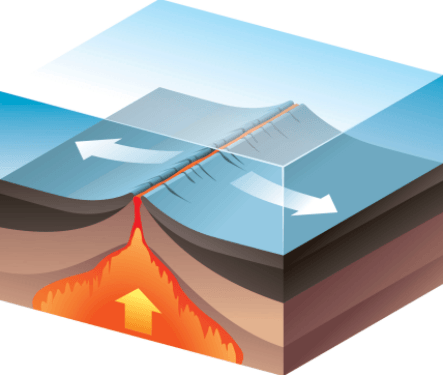
What is formed where these plates are spreading apart?

a)

new ocean floor

b)

earthquakes

c)

volcanoes

d)

mountains

46.

Which is less dense?

a)

Oceanic Crust

b)

Continental crust

47.

Which is more dense?

a)

continental crust

b)

oceanic crust

48.
At which type of boundary are mountains formed?
a)
Convergent
b)
Divergent
c)
Subductive Zone
d)
Transform
49.
At which type of plate boundary does seafloor spreading occur?
a)
Tranform
b)
Convergent
c)
Divergent
d)
Subductive Zone
50.
The San Andrea's Fault in California is which type of boundary?
a)
Convergent
b)
Divergent
c)
Subductive Zone
d)
Transform
51.
The Great Rift Valley in Africa and the Mid-Atlantic Ridge in the Atlantic Ocean are both results of this type of plate boundary
a)
Divergent
b)
Transform
c)
Convergent
52.
Mountains are formed at this type of plate boundary, specifically the Himalayas and Appalachians
a)
Transform
b)
Divergent
c)
Convergent
53.
The Ring of Fire is located in (the)__________ and is where ____________ occurs frequently.
a)
Africa, Earthquakes
b)
Atlantic, Volcanoes
c)
Pacific, Earthquakes
d)
Asia, Volcanoes
54.
When one plate rides up over another causing the other to be pushed down into the mantle
a)
Oceanic plate
b)
subduction
c)
plate boundary
d)
continental drift
55.

Giant pieces of lithosphere that move around the Earth

a)

Oceanic plates

b)

plate boundary

c)

tectonic plates

d)

continental plates

56.
Oceanic crust is.....
a)
Younger and less dense than continental crust
b)
Thinner, younger, and more dense than continental crust
c)
older, thicker, and less dense than continental crust
d)
Bigger and younger than continental crust
57.
Plate movement is caused by _____
a)
The rotation of the Earth
b)
Ocean tides
c)
Convection current in the mantle
d)
The moon's gravity
58.
The solid, outer layer of the Earth that consists of the crust and the rigid upper part of the mantle
a)
Lithosphere
b)
Mesosphere
c)
Mantle
d)
Crust
59.
The order of the earth’s compositional layers from most dense to least dense are
a)
Inner Core, Crust, Mantle and Outer Core
b)
Crust, Mantle, Outer Core and Inner Core
c)
Inner Core, Outer Core, Mantle and Crust
d)
Crust, Outer Core, Inner Core and Mantle.
60.
Identify each layer - #17.
a)
Crust
b)
Mantle
c)
Lithosphere
d)
Asthenosphere
61.

The lithosphere, asthenosphere, mesosphere, inner and outer core are called

a)

mechanical/physical layers

b)

compositional/chemical layers

62.

The Ring of Fire, where many earthquakes occur, is located around the rim of which ocean?

a)

Atlantic

b)

Artic

c)

Indian

d)

Pacific

63.

Which seismic wave is the first to reach a seismic station?

a)

P Wave

b)

S Wave

c)

Q Wave

d)

Surface Wave

64.

Which type of seismic wave causes the most destruction to property?

a)

P Wave

b)

S Wave

c)

Q Wave

d)

Surface Wave

65.

Which type of seismic wave can move through solid layers of the earth but not through the liquid outer core?

a)

P wave

b)

S wave

c)

Q Wave

d)

Surface Wave

66.

Which seismic waves are call "push/pull" because they compress and extend as they move through the earth?

a)

P Wave

b)

S Wave

c)

Q Wave

d)

Surface Wave

67.

The point within the earth where the earthquake originates.

a)

Epicenter

b)

Fault

c)

Focus

d)

Strike-Slip

68.

The scale, which numbered 1-10, that measures the strength or magnitude of an earthquake.

a)

pH scale

b)

Richter Scale

c)

Mercalli Scale

d)

Hardness Scale

69.

How many seismic stations are required to determine the epicenter of an earthquake?

a)

1

b)

2

c)

3

d)

4

70.

What instrument is used to measure seismic waves?

a)

Seismophone

b)

Seismogram

c)

Seismologist

d)

Seismograph

71.

Match the stress on the rock with the type of fault.

a)

Compression

b)

Shearing

c)

Tension

72.
a)

Compression

b)

Shearing

c)

Tension

73.

Match the stress on the rock with the type of Fault.

a)

Compression

b)

Shearing

c)

Tension

74.

Where is the epicenter of this earthquake?

a)

Salt Lake

b)

Los Angeles

c)

San Francisco

d)

Portland

75.

What is a tsunami and how does it form?

a)

A series of extremely long waves caused by a large and sudden displacement of the ocean

b)

A series of short waves caused by a volcano.

c)

A series of extremely long waves caused by an explosion.

d)

Normal waves caused by the moon.

76.

What are two things you can do to prepare for an earthquake?

a)

Emergency kit and determine a way of communicating with family members.

b)

Attach shelves to wall and put heavy stuff on bottom of shelves

c)

Get under doorways or outside away from buildings

d)

All of the above

77.
What is the shaking of the Earth’s crust caused by a release of energy?
a)
Earthquake
b)
Epicenter
c)
Fault
d)
Plate
78.
Which of the following is NOT a cause of an earthquake?
a)
Collapse of Cavern
b)
Eruption of Volcano
c)
Lightning Strikes
d)
Moving Tectonic Plates
79.
What is a break in the lithosphere along which movement in an earthquake has first occurred?
a)
Earthquake
b)
Epicenter
c)
Fault
d)
Focus
80.
Where is the point at which the first movement occurs during an earthquake?
a)
Epicenter
b)
Focus
c)
Fault
d)
Plate
81.
Where is the point on the Earth’s surface directly above the focus of an earthquake?
a)
Epicenter
b)
Fault
c)
Hypocenter
d)
Tremor
82.
Which type of wave is the first to arrive after an earthquake occurs?
a)
P Wave
b)
Rayleigh Wave
c)
S Wave
d)
Shear Wave
83.
Which body wave squeezes and stretches rock materials as they pass through the Earth?
a)
Body Waves
b)
P Waves
c)
S Waves
d)
Surface Waves
84.
Which body waves cause particles of rock material to move at right angles to the direction in which the waves are traveling?
a)
Body Waves
b)
P Waves
c)
S Waves
d)
Surface Waves
85.
What is another term for P Wave?
a)
Compression Wave
b)
Principal Wave
c)
Shear Wave
d)
Secondary Wave
86.
P Waves can move through which of the following?
a)
Gas
b)
Liquid
c)
Solid
d)
All of these
87.
S Waves can move through which of the following?
a)
Gas
b)
Liquid
c)
Solid
d)
All of these
88.
What is an instrument that detects and records waves produced by earthquakes? (This piece of equipment can measure the magnitude of an earthquake.)
a)
Epicenter
b)
Fault
c)
Seismogram
d)
Seismograph
89.
What is the measure of the amount of energy released in an earthquake?
a)
Earthquake
b)
Epicenter
c)
Magnitude
d)
Seismogram
90.
Which scale rates earthquakes based on the amount of damage done?
a)
Mercalli Scale
b)
Richter Scale
c)
Seismogram Scale
d)
Bernoulli Scale
91.
Which scale measures the intensity of the ground movement?
a)
Mercalli Scale
b)
Richter Scale
c)
Seismogram Scale
d)
Bernoulli Scale
92.
What is the temporary state in which loose soil and rock materials take on the property of a liquid?
a)
Aftershock
b)
Liquefaction
c)
Seismic Gap
d)
Tsunami
93.
What is a smaller earthquake that follows a larger earthquake?
a)
Aftershock
b)
Liquefaction
c)
Seismic Gap
d)
Tsunami
94.
What is a large ocean wave that results from an underwater earthquake, landslide, or volcanic eruption?
a)
Aftershock
b)
Liquefaction
c)
Seismic Gap
d)
Tsunami
95.
What is an area along a seismically active fault where no earthquake activity has occurred over a long period of time?
a)
Aftershock
b)
Liquefaction
c)
Seismic Gap
d)
Tsunami
96.
Which of the following will help predict the site of future earthquakes?
a)
Aftershock
b)
Liquefaction
c)
Seismic Gap
d)
Tsunami
97.

vibrations in the earth caused by the sudden release of energy, usually as a result of the movement of rocks along a fault

a)

earthquake

b)

epicenter

c)

focus

d)

surface waves

98.

an earthquake wave that follows the main shock of an earthquake

a)

earthquake

b)

S Wave

c)

aftershock

d)

P Wave

99.

an earthquake wave that travels through the body of the earth rather than on its surface

a)

surface wave

b)

body wave

c)

aftershock

d)

focus

100.

the location where the rupture of an earthquake begins and energy is released

a)

epicenter

b)

focus

c)

seismogram

d)

energy release center

101.

a scientist who studies earthquakes

a)

seimology

b)

seismologist

c)

seismogram

d)

seismograph

102.

the record made by a seismograph; the paper on which earthquake waves are recorded

a)

seismology

b)

seismologist

c)

seismograph

d)

seismogram

103.

the record made by a seismograph; the paper on which earthquake waves are recorded

a)

seismology

b)

seismologist

c)

seismograph

d)

seismogram

104.

the secondary earthquake wave; travels slower and is second to reach the seismograph station

a)

P Wave

b)

S Wave

c)

surface wave

d)

body wave

105.

earthquake waves that travel on or near the surface of the earth

a)

aftershock

b)

S Waves

c)

body waves

d)

surface waves

106.

the study of earthquakes

a)

meteorology

b)

psychology

c)

earth science

d)

seismology

107.

the point on the surface of the earth directly above the focus of an earthquake

a)

focus

b)

energy release center

c)

surface wave

d)

epicenter

108.
The outside layer of the earth is called ______________________.
a)
core
b)
crust
c)
mantle
d)
outer core
109.
The huge pieces of the earth's crust are called ____________________________. 
a)
crust
b)
plates
c)
directions
d)
seismos
110.
The epicenter of an earthquake is
a)
The point below the surface where rock begins to break and the first motion occurs
b)
The seismic station closest to the earthquake
c)
The place where the greatest damage occurs
d)
The point on the surface directly above the focus
111.
Waves move out through the ground from the ..........
a)
rift
b)
hypocenter
c)
epicenter
d)
fault line
112.
This famous transform fault is located in the western United States creates significant earthquake activity for California
a)
New Madrid
b)
Denali Fault
c)
Ramapo Seismic Zone
d)
San Andreas
113.
The Richter scale measures:
a)
the amount of radon gas released
b)
the movement of plates
c)
the strength of an earthquake
d)
the weight of tectonic plates
114.
The Modified Mercalli scale rates the amount of damage from an earthquake
a)
true
b)
false
115.
Which travels fastest, always being the first detected by seismic stations?
a)
P waves
b)
S waves
116.
What do S (secondary) waves do during an earthquake?
a)
Shake the ground
b)
Cause eruptions
c)
Open cracks in the earth's surface
d)
Create loud noises
117.
An earthquake scored high on the Richter scale but low on the Mercalli scale. Why?
a)
it probably happened in an area with no people
b)
it was a fast earthquake
c)
because it damaged a lot
d)
impossible to tell
118.
Liquefaction is when...
a)
the soil behaves like liquid
b)
the ground becomes liquid
c)
magma rises to the surface
d)
buildings are damaged, crumbling like liquid
119.
Which of the following amplifies the S waves during an earthquake?
a)
Soft underlying soil
b)
Strong rocks underground
c)
Closeness to a volcano
d)
Altitude of the epicentre
120.
An instrument that detects and measures earthquakes is a 
a)
seismogram
b)
focus seismic map
c)
focus
d)
seismograph 
121.
Which animals can tell when an earthquake is about to happen?
a)
Spiders
b)
Snakes
c)
Cats
d)
Elephants
122.
How much bigger is a magnitude 8 earthquake compared to magnitude 7 one on the Richter Scale?
a)
1 time bigger
b)
10 times bigger
c)
100 times bigger
d)
1000 times bigger
123.

complete the sentence :

the pocket underneath the volcano stores .............

a)

air

b)

lava

c)

magma

d)

water

124.

Volcanos are formed when ......... from within the earth upper .......... works it ways to the earth surface

(a)  

125.

what are the 3 types of volcano

a)

active volcano

b)

dormant volcano

c)

extinct volcano

d)

non living volcano

e)

living volcano

126.

what could happen if there were no volcanic activity on Earth at all?

a)

peace

b)

Earth will become a dead planet

c)

Without volcanoes, most of Earth's water would still be trapped in the crust and mantle

d)

none of the above

e)

all of the above

127.

the meaning of

dormant

extinct volcano

a)

1 . sleeping

2 . dead

b)

1 . active

2 . dead

c)

1 . active

2 sleeping

128.

tell a negative and positive effect of volcano

a)

will help the plant to grow

b)

destroy all homes

c)

the smoke will help the environment

129.

when the magma comes out of the volcano what is it called ?

a)

lava

b)

magma

c)

air

d)

water

130.

which is an extinct volcano

a)

mount Kilimanjaro

b)

mount Kulal

c)

barren island

131.

which is a dormant volcano

a)

Mauna Kea on Hawaii Island

b)

Pinatubo in Zambales

c)

Mount Everest

d)

none of the above

132.

which of these is NOT a volcano ?

a)

Mayon in Albay volcano in the Philippines.

b)

Bulusan in Sorsogon.

c)

Hibok‑Hibok in Camiguin.

d)

Pinatubo in Zambales.

e)

Mount Everest

133.

What is a dormant volcano?

a)

molten rock

b)

the center of a volcano

c)

will never erupt again

d)

a volcano that is sleeping, but could erupt agian

134.

What is magma?

a)

pieces of the Earth's crust

b)

molten rock inside of a volcano

c)

small rock

d)

plates that meet

135.

What is lava?

a)

Molten rocks inside a volcano

b)

Molten rock outside a volcano

c)

small rocks

d)

magma

136.
A dead volcano is called what?
a)
active
b)
dormant
c)
extinct
137.
What type of volcano is shown on the model above? 
a)
Composite Volcano
b)
Shield Volcano
c)
Cinder Cone Volcano
138.
What type of volcano is shown on the model above? 
a)
Shield Volcano
b)
Composite Volcano
c)
Cinder Cone Volcano
139.
What type of volcano is shown on the model above? 
a)
Cinder Cone Volcano
b)
Composite Volcano
c)
Shield Volcano
140.
Which of the following terms are used to describe a volcano that may erupt at any time? 
a)
Dormant volcano
b)
Active volcano
c)
Extinct volcano
d)
Shield volcano
141.

Magma becomes lava when it reaches a volcano's ______.

a)

Vent

b)

Crater

c)

Chamber

d)

Mantle

142.

In a volcano, magma collects in a packet called ________.

a)

Magma flow

b)

Magma chamber

c)

Magma pipe

d)

Hot spot

143.

A ______ is a duct connecting the magma chamber and the outside of the volcano.

a)

Vent

b)

Crater

c)

Lava flow

d)

Volcanic cone

144.

An opening on the Earth's crust through which hot molten rock flows out from deep inside the Earth.

a)

Volcano

b)

Fault line

c)

Fold

d)

Crater

145.

Rank the volcanic stages from LEAST likely to MOST likely to erupt.

a)

active, dormant, extinct

b)

extinct, dormant, active

c)

dormant, extinct, active

d)

dormant, active, extinct

146.

Why does the volcanic eruption happen ?

a)

When the pressure on magma chamber inside earth increase and push magma to the surface.

b)

When it formes by eruption lava and ash.

c)

when rock underground suddenly breaks along a fault.

147.

A volcano is a mountain that has an opening to allow hot vapor, and gas to escape from the pool of magma below.

a)

True

b)

False

148.

What type of volcano is this

a)

composite volcano

b)

shield volcano

c)

cinder cone volcano

149.

What type of Volcano is this?

a)

composite

b)

shield

c)

cinder cone

150.

Shield Volcanos are

a)

tall and pointed

b)

small and pointed

c)

low and spread out

151.

Where is the ring of fire

a)

around South America

b)

around the Atlantic Ocean

c)

around Africa

d)

around the Pacific Ocean

152.

What kind of volcano is this

a)

composite volcano

b)

shield volcano

c)

cinder cone volcano

153.

Lava and Magma

a)

are different types of volcanic rock

b)

are the same but lava is out of the ground

c)

are the same but magma is out of the ground

d)

lava is denser than magma

154.

The type of volcanos that have craters on the top are

a)

cinder cone and composite

b)

only cinder cone

c)

only composite

d)

only shied

155.

When lava runs easily and flows out in thin layers it makes a

a)

composite volcano

b)

shield volcano

c)

cinder cone volcano

156.

Cinders are

a)

pieces of rock

b)

made of ash

c)

liquid lava

157.

Tectonic plates

a)

only have volcanos on the edges

b)

can have volcanos in the middle

158.

If a volcano can not erupt any more it is called

a)

active

b)

inactive

c)

dormant

d)

extinct

159.

Which is tallest

a)

composite volcano

b)

shield volcano

c)

cinder cone volcano

160.

The Hawaiian Islands were formed

a)

above a divergent fault

b)

above a convergent fault

c)

above a strike-slip fault

d)

above a hotspot in the middle of a plate

161.

When a volcano has an explosive eruption, the material that comes out is called

a)

magma

b)

tephra

c)

lahar

d)

viscosity

162.

Pressure built up inside Mt. Saint Helens before it exploded because the magma was...

a)

more viscous and blocked the flow

b)

less viscous and blocked the flow

c)

more viscous and increased the flow

d)

less viscous and increased the flow

163.

Which type of magma produces explosive eruptions.

a)

lahar

b)

tephra

c)

felsic

d)

mafic

164.

Effusive Eruptions cause which type of volcano to form

a)

composite

b)

shield

c)

cinder cone

165.

Lahar is

a)

flowing lava

b)

a mix of mafic and felsic magma

c)

a volcanic mud flow

d)

not possible with explosive eruptions

166.

Pyroclastic flow is

a)

made of tephra, ash and gas

b)

is mostly mud

c)

the flow of magma up through the inside of the volcano

167.

To try and predict a Volcanic eruption scientists measure

a)

earthquake activity

b)

escaping gases

c)

changes in the angles of the volcano sides

d)

all the above