Wayground logo

Free Printable Worksheets

Font size

S
M
L
XL
Worksheets

Plate Tectonics Review

Total questions: 27

Worksheet time: 16mins

Name
Class
Date
1.
Which of the following causes Earth's tectonic plates to move?
a)
Energy from the Sun
b)
Magnetic Pole Reversal
c)
Convection currents in the mantle
d)
Faults in Mountain Ranges
2.
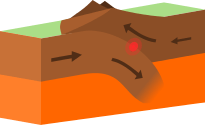
What type of event will occur at this boundary?
a)
Earthquake
b)
Volcano Eruption
c)
Tornado
d)
Mountain Building
3.
What type of plate boundary is this?
a)
Plate
b)
Divergent
c)
Convergent
d)
Transform
4.
A divergent boundary occurs when plates ....
a)
Pull apart
b)
Come together
c)
Slide past each other
d)
subducting
5.

Which of the following is the name of the ancient supercontinent formed 280 Million Years ago.

a)

Pangea

b)

Gondwanda

c)

Laurasia

d)

Neverland

6.
Which of the following is NOT evidence to support the theory of plate tectonics?
a)
Fossils
b)
Mountains
c)
Glaciers
d)
Sand Erosion
7.
What geologic feature/event would you most likely to find at a divergent boundary between two pieces of oceanic crust?
a)
Rift Valley
b)
Mid-Ocean Ridge
c)
Island Arc
d)
Flat land
8.
What geologic feature/event would you most likely to find at a convergent boundary between two pieces of continental crust?
a)
Volcano
b)
Mountain
c)
Rift
d)
Island Arc
9.
Which piece of evidence did Wegener use to prove continental drift?
a)
The shape of the continents
b)
Similar fossils found on separate continents
c)
Tree fossils found in odd places
d)
All of the above
10.
The diagram shows what can occur when two continental plates collide.Which characteristic of the Indian Plate explains why it moves under the Eurasian Plate?
a)
It is larger.
b)
It is denser.
c)
It is molten.
d)
It is younger.
11.
Which type of crust is more dense?
a)
oceanic
b)
continental
c)
divergent
d)
pizza
12.

Cracks or breaks in earth's crust where plates slip past each other

a)

subduction

b)

faults

c)

mid-ocean ridge

d)

san andreas

13.

Occurs when a less dense plate slides under a more dense plate

a)

tectonic plates

b)

subduction

c)

continental drift

d)

landmass

14.

Plates boundary where plates slide or move past each other

a)

divergent

b)

continental drift

c)

transform

d)

convergent

15.

What plate boundary is shown in the picture?

a)

convergent

b)

divergent

c)

transform

d)

neither

16.

What type of plate boundary is shown in the picture?

a)

folded mountains

b)

transform

c)

convergent

d)

divergent

17.

Plates collide or converge into each other

a)

divergent

b)

convergent

c)

transform

d)

convection

18.
What kind of plate boundary is shown here?
a)
divergent
b)
convergent
c)
transform
d)
submergent
19.

New crust forms along a(n)

a)

subduction zone

b)

divergent boundary

c)

convergent boundary

d)

transform boundary

20.

What occurs between two oceanic plates at a divergent boundary?

a)

rift valley

b)

sea floor spreading

c)

volcanic mountain range

21.

When scientists map the location of earthquakes, where do they find that most earthquakes happen?

a)

middle of tectonic plates

b)

in the core of the earth

c)

only near mountains

d)

at plate boundaries

22.

What type of energy waves do earthquakes produce?

a)

sound

b)

heat

c)

light

d)

seismic

23.
What type of seismic wave travels compressionally? 
a)
P wave
b)
S wave
c)
Surface
d)
None
24.

Which wave can travel through solids, liquids, and gases?

a)

P-Waves

b)

S-Waves

c)

Surface (L) Waves

d)
25.

Which type of seismic wave can travel all the way from on side of the Earth to the other?

a)

P-Waves

b)

S-Waves

c)

L-Waves (Surface Waves)

d)

None

26.

What type of fault is the San Andreas in California?

a)

Convergent

b)

Transform

c)

Optimus Prime

d)

Divergent

27.

Which seismic wave travels the fastest, always being the first detected by seismic stations?

a)

P waves

b)

S waves

c)

Surface waves

d)

Tsunami waves