
Font size
 Worksheets
Unit 04 - European Economics
Total questions: 39
Worksheet time: 2hrs 57mins
I live in a country where the citizens get to decide what products they want to make or buy. They also get to decide who they want to sell their products to. However, the government makes some rules about economic decisions in order to protect those people who may want to buy the product. What type of economy do I live within?
Mixed
Pure Market
Pure Command
Traditional
I live in a country where I get to decide if I want to open my own business. I get to decide what product or service I would like to provide, and I get to decide who I want to sell my product to. I get to make all of these economic decisions without any involvement from the government. What type of economy do I live in?
Mixed
Pure Market
Pure Command
Traditional
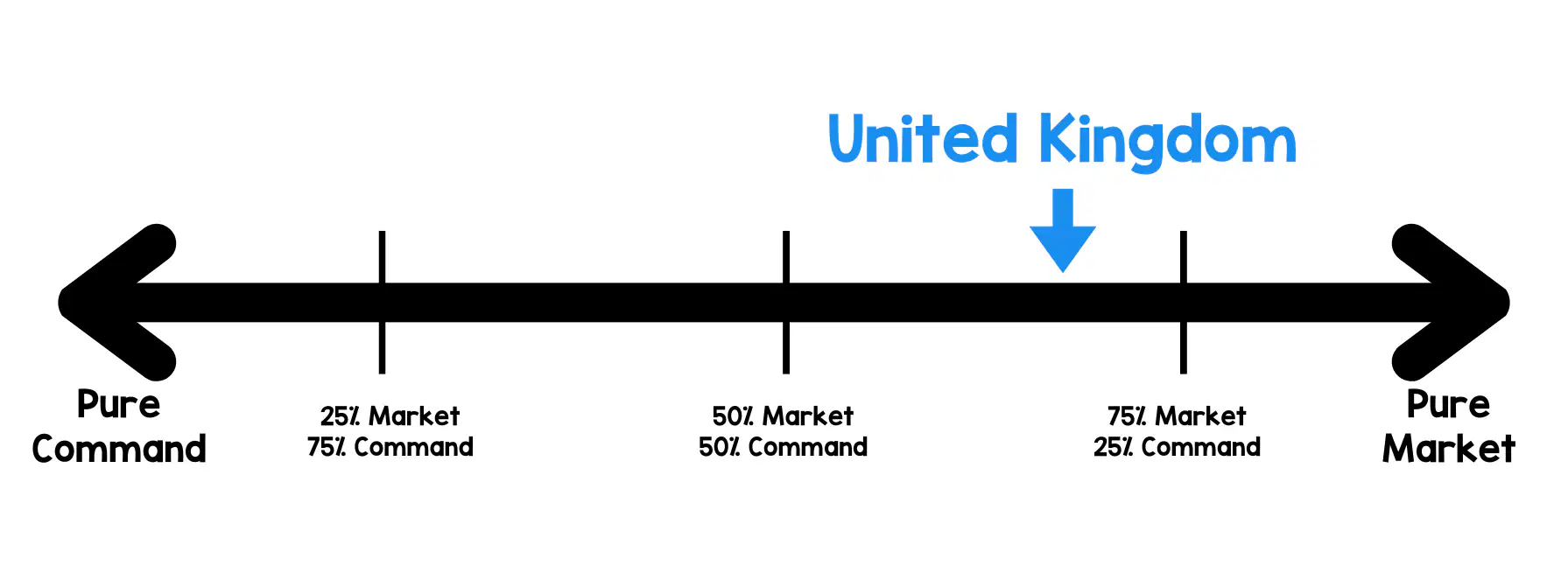
Based on the United Kingdom's location on the economic continuum, it can best be described as:
Market-leaning
Command-leaning
Pure Market
Traditional
Pure Command
Which statement accurately describes a similarity between the United Kingdom, Germany, and Russia's economic systems?
They are all pure market economies
They are all pure command economies
They are all mixed economies
They are all traditional economies
Which statement accurately describes a similarity between the United Kingdom, Germany, and Russia's economic systems?
They are all command-leaning
They are all pure command economies
They are all market-leaning

Which country has the highest amount of government regulation and control of the economy?
A
B
C
All of these
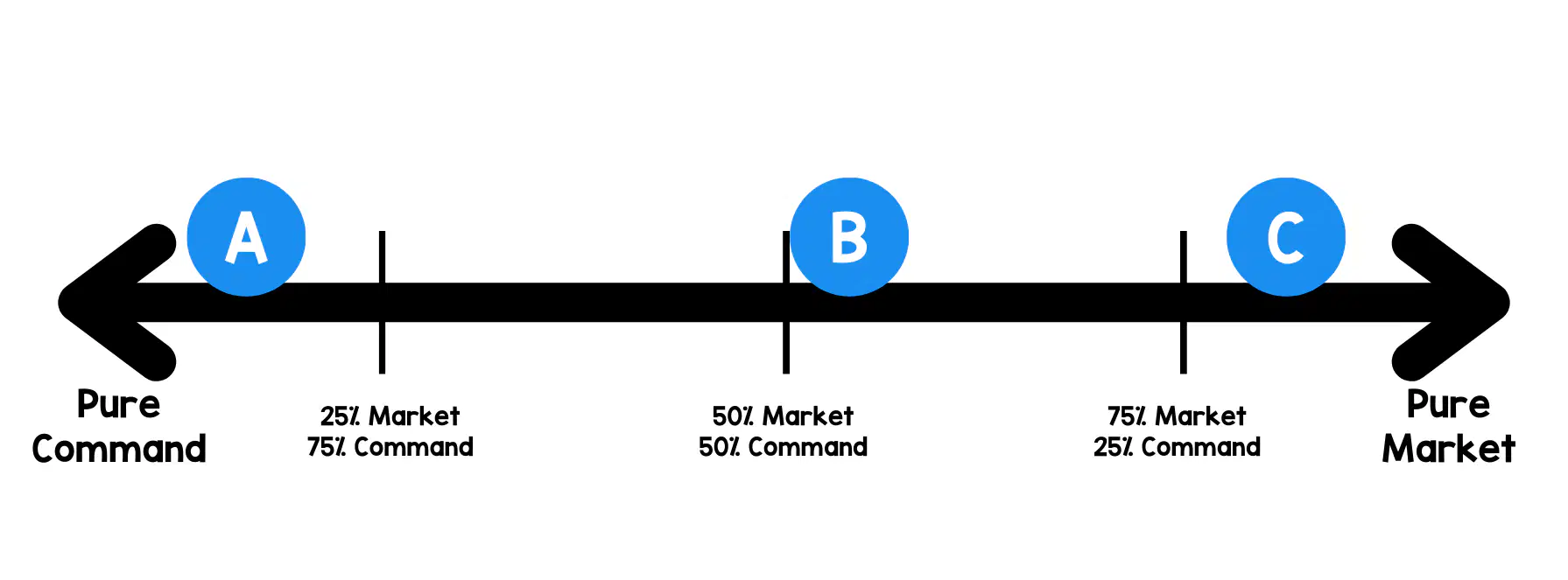
Russia's economy can be best represented by which letter on the graph?
A
B
C
None of these

The photo below represents a community that practices a specific economic system in Russia. These people do not have formal banking or currency, instead they typically trade through bartering. Which economic system does this photo represent?
Market
Command
Mixed
Traditional
Which country is being described in the statements below?
1. Mixed, market-leaning
2. Government regulates industries and sets some prices
3. The economy struggled after reunification, but has still become more and more market leaning.
United Kingdom
Germany
Russia
Which country is being described in the statements below?
1. Government controls many key resources like natural gas and oil.
2. Most command-leaning of the 3 countries
3. Has been moving away from command and closer to market since the fall of of the Soviet Union in 1991
United Kingdom
Germany
Russia
What is the term for goods that are sold and sent out from a country?
export
import
What is the term for items that are bought and brought into a country?
import
export
How does specialization encourage trade?
When countries are able to produce many different types of products themselves, they don't need to trade with other countries.
When countries choose to focus on producing just a few products really well, they must trade with other countries for the goods they do not produce themselves.
When countries stop producing goods and services, they must trade with other countries for all of their goods and services.
Read the example, choose the term that best matches with the example.
In Germany they are really good at producing luxury cars. They could choose to produce smartphones too, but it would be much more expensive than companies in China do. So, Germany exports luxury cars and imports smartphones.
specialization
tariff
quota
embargo
Tariffs, quotas, and embargoes are similar because...
they are all ways to specialize.
they are all physical trade barriers.
they are all trade barriers created by governments.
they are all types of economic systems.
What is a tax on imported goods?
tariff
quota
embargo
What is a limit placed on the amount of a specific good that can be imported into a country?
quota
tariff
embargo
What is a ban on trade, both imports and exports, with a specific country?
embargo
quota
tariff
How does a quota differ from an embargo?
a quota is a limit on imported goods while an embargo is a complete ban on imported goods
a quota is a complete ban on imported goods while an embargo is a limit on imported goods
a quota is a limit on exported goods while an embargo is a complete ban on exported goods
Read the example and choose the term that best matches with it:
The European Union encourages its members to buy goods from other EU members by placing a tax on goods that are imported from non-EU countries.
tariff
quota
embargo
specialization
Read the example and choose the term that best matches with it:
Germany has a limit on the number of cars that can be imported to encourage Germans to buy German cars.
tariff
quota
embargo
specialization
Read the example and choose the term that best matches with it:
The USA bans trade with Cuba and North Korea.
tariff
quota
embargo
specialization
Why does international trade require a system for exchanging currencies between nations?
because everyone must use the US dollar when making international purchases.
because no country uses the same currency so you have to trade money before you can make a purchase.
because many countries do not use the same currency a nation must be able to trade one currency for another in order to make international trade easier
none of the answer choices are correct
1 British pound is worth $1.27 in US Dollars.
This is known as the...
exchange rate
money rate
money laundering
exchange percentage
£1 British pound = $1.27 US Dollars
₽1 Russian Ruble = $0.01 US Dollars
Which currency is stronger? In other words, which has more buying power?
British Pound
Russian Ruble
They have the same value
What is being described below?
1. A group of countries that work together to encourage free trade
2. Use the Euro as their currency
3. Encourages stable and peaceful relationships between nations
NAFTA (North American Free Trade Agreement)
USMCA (United States, Mexico, Canada Agreement)
EU (European Union)
OPEC (Organization of Petroleum Exporting Countries)
What effect will a high literacy rate have on the standard of living of a country?
A high literacy rate will cause the standard of living to go down.
A high literacy rate will cause the standard of living to go up.
A high literacy rate will not have any effect on the standard of living.
A high literacy rate will cause the standard of living to remain stagnant and unchanging.
Russia spends an estimated 5% of its GDP on education. What can you infer then about their literacy rate?
if they are only spending 5% on education then their literacy rate is likely to be low.
5% of Russia's GDP is many millions of dollars. If they are spending that much on education then the literacy rate must be very high.
Russia's literacy rate must be low because the aren't spending enough on education.
Russia's literacy rate must be around 5% because they are only spending 5% on education.
Why does the investment in human capital cause the GDP of a nation to increase?
Investing in human capital means training and educating citizens so that they can be skilled workers who produce goods.
Investing in human capital means paying workers to move to your country to participate in the economy.
Investing in human capital does not increase a nations GDP.
What happens to the GDP of a country that chooses NOT to invest in capital goods? Why?
the GDP of a nation who does not invest in capital goods will decrease because the machinery and technology will be outdated causing production to slow and products to be less desirable.
the GDP of a nation who does not invest in capital goods will increase because they don't waste money on improving tools and technology.
the GDP of a nation who does not invest in capital goods will decrease because they continue to specialize
the GDP of a nation who does not invest in capital goods will increase because they will place tariffs on exported goods
The availability of natural resources plays an important role in any economy. Which nation specializes in the fishing industry because of the abundance of water around them?
Russia
United Kingdom
Germany
The United Kingdom, Germany, and Russia all have mixed economies which allow for entrepreneurship. In which of these 3 counties is it most difficult to be an entrepreneur due to low levels of business freedom?
Russia
Germany
United Kingdom
___________ is a tool that measures economy health; it is the total amount of money that a country makes from goods and services in year.
GPD (Gross Domestic Product)
Specialization
Entrepreneurship
Trade
Which of these are examples of Productive Resources. Choose ALL that apply.
natural resources
human capital
capital goods
entreprenurship
money
_________ are the materials that come from nature and are used to create products.
natural resources
human capital
capital goods
entrepreneurship
_________ are the skilled workers who fill jobs within the economy.
natural resources
human capital
capital goods
entrepreneurship
_________ are the man-made materials that are used to produce goods and services. Examples include factories, machinery, technology, building, and tools.
natural resources
human capital
capital goods
entrepreneurship
__________ is someone who takes a risk and starts a new business.
natural resources
human capital
capital goods
entrepreneurship
Which of these is an example of a physical trade barrier?
A mountain range that makes it difficult to transport goods.
A tariff that discourages importing goods
A quota that limits the amount of trading a country can do with another.
A river that can be used to transport goods to other countries.

