
 Worksheets
Unit 7 - Federalism
Total questions: 72
Worksheet time: 31mins
Which statement best describes concurrent powers?
The federal government follows the lead of state governments.
The federal government has supremacy over state governments.
The federal government shares powers with the state governments.
The federal government sets standards that state governments must follow.
What are concurrent powers?
Powers that ONLY the federal government has.
Powers that ONLY the state governments have.
Powers that are SHARED between federal and state governments.
Which power is delegated to the federal government?
Taxing citizens
Coining money
Establishing courts
Conducting elections
Establishing courts is a concurrent power. What does that mean?
Only the federal government can create courts.
Both the federal and state governments can create courts.
Only the state governments can create courts.
According to the 10th Amendment, which statement describes reserved powers?
Powers not delegated to the federal government are reserved for the state governments.
Powers not delegated to state governments are listed in the Constitution.
Powers delegated to the federal government are shared with the state governments.
Which statement is an example of reserved powers?
raising and maintaining a navy.
declaring war and governing combat.
establishing and funding a system of public education.
setting and fixing the standards of weights and measures.
Maintaining roads and highways is a concurrent power. What does that mean?
Only the federal government must maintain roads and highways.
Only the state governments must maintain roads and highways.
Both the federal and state governments must maintain roads and highways.
Based on the 10th Amendment, which powers are reserved for state governments or individual
citizens?
all powers needed to conduct U.S. foreign policy
all powers needed by Congress to carry out its enumerated powers
all powers not delegated to the national government by the U.S. Constitution
all powers needed to prevent corruption and abuse by the national government
According to the 10th Amendment, all powers not given to the federal government are delegated to who?
The President
The state governments and the people
The Supreme Court
The secretaries of the cabinet departments
Which is the last step in the Amendment Process of the U.S. Constitution?
The voters approve the amendment in a national election.
The president signs the amendment in a public ceremony.
Three-fourths of the state legislatures ratify the amendment.
Three-fourths of the US Congress ratify the amendment.
This is an excerpt from Article V of the Constitution.
"The Congress, whenever two thirds of both houses shall deem it necessary, shall
propose amendments to this Constitution, or, on the application of the legislatures of
two thirds of the several states, shall call a convention for proposing amendments . . ."
Why did the framers add this article to the Constitution?
to make sure that the government would have the popular support of its future citizens
to increase the flexibility of the federal government in the face of future challenges
to increase the Constitutional powers of the federal government over states
to make updating the Constitution an easy process for people in the future
What is an amendment?
A federal law passed by Congress and signed by the President
An addition or change to the U.S. Constitution
An idea for a law proposed by a citizen
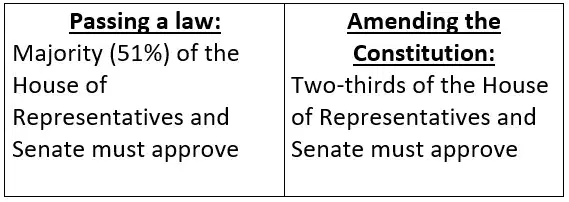
The chart below explains the process for certain government actions.
What conclusion can be made from the chart?
The amendment process is easier than the lawmaking process.
Major laws can only be passed with the approval of both political parties.
In general, the House of Representatives has more power than the Senate.
Constitutional amendments are more difficult to pass than laws because of the required widespread
support.
Is it more difficult for Congress to pass a law or amend the U.S. Constitution?
It is more difficult to pass a law
It is more difficult to amend the U.S. Constitution
Which laws are passed by the Florida legislature?
acts
statutes
ordinances
charters
How is the lawmaking process of the Florida State Legislature and the U.S. Congress similar?
Bills dealing with taxes can originate within either of the houses.
Bills are usually approved on the floor of the house without going to a committee.
Bills have to be approved by both houses of the legislature before they can become law.
Bills can be introduced directly by members of the public in the House of Representatives
but not in the Senate.
Before a statute (Florida state law) can go to the Governor for signature, it must pass...
Both the Florida House of Representatives and the Florida Senate
Only the Florida House of Representatives
Only the Florida Senate
This is an excerpt from Article V of the Constitution.
"The Congress, whenever two thirds of both houses shall deem it necessary, shall
propose amendments to this Constitution, or, on the application of the legislatures of
two thirds of the several states, shall call a convention for proposing amendments . . ."
Why did the framers add this article to the Constitution?
to make sure that the government would have the popular support of its future citizens
to increase the flexibility of the federal government in the face of future challenges
to increase the Constitutional powers of the federal government over states
to make updating the Constitution an easy process for people in the future
The scenario below may be addressed by local, state, or national governments.
"After careful analysis, it has been confirmed that Florida is in
danger of having a record budget deficit since their spending
is set to far exceed tax revenue."
Who is responsible for resolving the issue?
the mayor of Orlando
the governor of Florida
the President of the United States
the United States senators from Florida
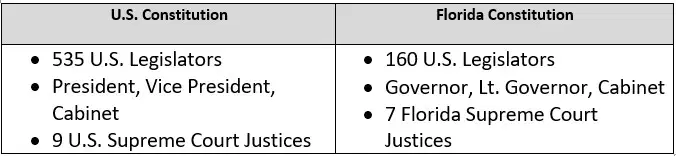
The chart below shows one purpose of Florida's Constitution and the United
States Constitution. Based on the chart, what is the purpose of a constitution?
Creating a process for voting on amendments
Limiting the authority of the governor
Protecting the rights of the people
Providing a framework for government
What document provides a framework for government and outlines the Legislative, Executive, and Judicial branches?
The Constitution
The Bill of Rights
The Articles of Confederation
Which statement accurately contrasts the process of amending of the U.S. Constitution and the Florida Constitution?
The Florida Constitution process involves elected officials, while the U.S. Constitution
does not.
The U.S. Constitution can be altered through a convention process, but the Florida
Constitution cannot.
The Florida Constitution process allows for direct citizen involvement, while the U.S.
Constitution does not.
The U.S. Constitution can be evaluated by a commission every 20 years, but the Florida
Constitution cannot.
Citizens can be directly involved in amending of which constitution?
The U.S. Constitution
The Florida Constitution
Which of the following is a shared obligation of the federal, state, and local governments?
coining money
issuing passports
constructing roads and highways
making treaties with foreign nations
This list shows some of the responsibilities of local government.
- Water treatment
- Public schools
- Road construction
-?
Which word correctly completes the diagram?
Minting coins
Trash and recycling
Postal services
Teacher certificates
Fire protection is an obligation of which level of government?
local
state
federal
Coining/printing/minting money is an obligation of which level of government?
local
state
federal
Coining/printing/minting money is an obligation of which level of government?
local
state (reserved)
federal (delegated)
What is a statute?
A local law
A state law
A federal law
What is an ordinance?
A local law
A state law
A federal law
Who is responsible for Florida's state budget?
The President of the U.S.
The Governor of Florida
The mayor of a city
The Florida legislature
Read the scenario below:
The U.S. Congress passes an amendment with a 2/3 vote from both the House of Representatives and the Senate. It will then go to the states. How many states need to ratify it?
3/4 of states
1/4 of states
2/3 of states
All 50 states
Education, elections, and licenses are state powers. State powers are known as...
Reserved powers
Concurrent powers
Enumerated powers
Which is the last step in the Amendment Process of the U.S. Constitution?
The voters approve the amendment in a national election.
Two-thirds of both houses of Congress ratify the amendment.
Three-fourths of the state legislatures ratify the amendment.
Both the US and Florida Constitutions can be amended (changed).
Which ONE of these documents allows for direct citizen involvement?
Florida Constitution
US Constitution
Before an amendment can be added to the Florida Constitution, what must happen?
3/4 of state legislatures must ratify it
The President must sign in
60% of Florida voters need to vote "yes"
How does the Supremacy Clause impact federalism?
national laws would have more power than state laws, causing limits to state power
delegated powers must be limited, causing state governments to have greater laws
state laws would have more power than national laws, giving more power to the states
How does the Supremacy Clause affect Florida’s government?
Florida must have all laws approved by the U.S. Congress.
Florida may not pass laws that go against the U.S. Constitution.
Florida must have all laws approved by the U.S. Supreme Court.
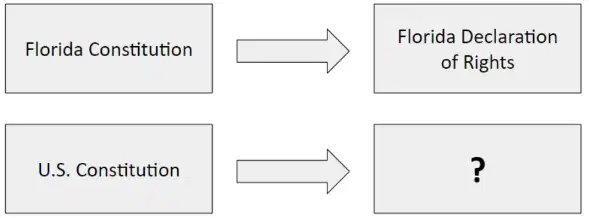
Use the diagram to answer the following question.
Which document would correctly complete the diagram?
Bill of Rights
Magna Carta
Common Sense
Mayflower Compact
Which is the last step in the Amendment Process of the U.S. Constitution?
The voters approve the amendment in a national election.
Two-thirds of both houses of Congress ratify the amendment.
Three-fourths of the state legislatures ratify the amendment.
Constitutional amendments are ___________ to pass because they require widespread support.
easy
difficult
Which is a correct statement about the Florida Constitution?
The Florida Constitution is unique in limiting the state government’s power.
The Florida Constitution is similar to the U.S. Constitution in that they both guarantee individual
freedoms.
The Florida Constitution is unique in limiting the federal government’s power.
Which of the following services is obligated by all levels of government?
Regulating utility services
Declaring war and commanding armies
Constructing roads and highways
Chief executive of the State Government
President
Governor
Mayor
If a road in your neighborhood is damaged (has potholes), which level of government would be responsible for fixing it?
Local government
State government
National government
Delegated/Enumerated/Expressed Powers
Powers of the National Government
Powers of the State Governments
Power that are shared
Constructing roads, highways
Both Concurrent
Reserved States
Delegated Federal
Coining money, declaring war
Both Concurrent
Reserved State
Delegated Federal
Trash and recycling collection
Local government
State government
Federal government
The Florida Constitution is similar to the U.S. Constitution in that they both guarantee individual
freedoms.
The Florida Constitution is unique in limiting the state government’s power.
The Florida Constitution is unique in limiting the federal government’s power.
Which is the last step in the Amendment Process of the U.S. Constitution?
The voters approve the amendment in a national election.
The president signs the amendment in a public ceremony.
Three-fourths of the state legislatures ratify the amendment.
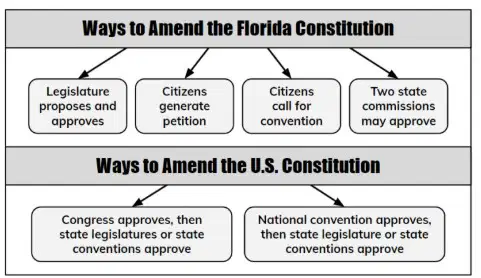
The diagrams represent the amendment process for the Florida and U.S. constitutions.
Which statement accurately contrasts the process of amending the two constitutions?
The Florida Constitution process involves elected officials, while the U.S. Constitution
does not.
The Florida Constitution process allows for direct citizen involvement, while the U.S.
Constitution does not.
The U.S. Constitution can be evaluated by a commission every 20 years, but the Florida
Constitution cannot.
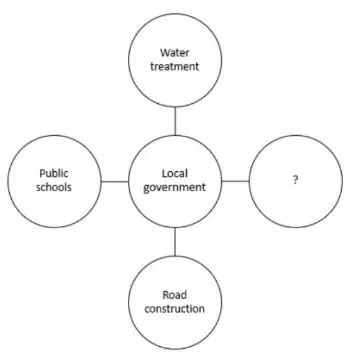
This diagram shows some of the responsibilities of local government.
Which service correctly completes the diagram?
Coining money
Postal services
Teacher certificates
Trash and recycling
Below is a scenario involving public safety concerns.
"Keisha noticed a large pothole in her neighborhood. The pothole is causing inconvenience to drivers,
damaging vehicles, and poses a safety risk. Keisha decides to report the issue to the appropriate
authorities for repair."
Which level of government is primarily responsible for addressing and fixing such issues?
Local
State
National
The excerpt below is from Article VI, Clause 2, of the U.S. Constitution.
“This Constitution, and the Laws of the United States which shall be made in Pursuance
thereof; and all Treaties made, or which shall be made, under the Authority of the United
States, shall be the supreme Law of the Land...”
According to the excerpt above, how does this clause affect Florida’s government?
Florida must have all laws approved by the U.S. Congress.
Florida may not pass laws that go against the U.S. Constitution.
Florida must have all laws approved by the U.S. Supreme Court.
Florida may not pass laws that have already been passed by the U.S. Congress.
Which statement best describes concurrent powers?
The federal government directs the state governments.
The federal government is guided by state governments.
The federal government has supremacy over state governments.
The federal government shares powers with the state governments.
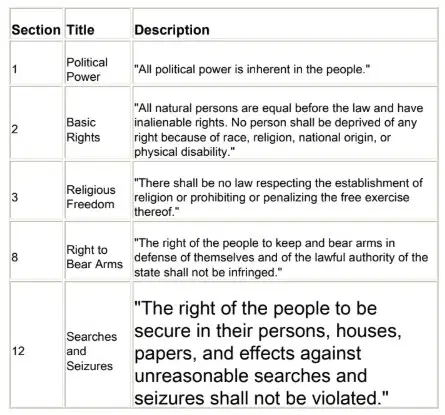
The chart below provides an overview of the Florida Declaration of Natural Rights. Which is a correct statement about the Florida Constitution?
The Florida Constitution is unique in limiting the state government’s power.
The Florida Constitution differs from the U.S. Constitution in that it restricts individual freedoms.
The Florida Constitution is similar to the U.S. Constitution in that they both guarantee individual freedoms.
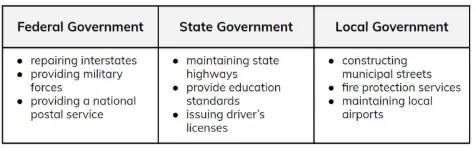
The diagram below displays details about the different levels of government.
Which of the following services is obligated by all levels of government?
Regulating utility services
Constructing roads and highways
Issuing business and driver’s licenses
Declaring war and commanding armies
Which power is only delegated to the federal government?
Taxing citizens
Coining money
Conducting elections
Creating educational standards
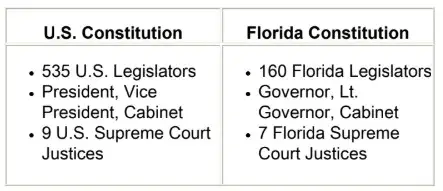
The chart below compares the United States Constitution and the Florida Constitution. What is the purpose of a constitution, based on the chart?
Protecting the rights of the people
Limiting the authority of the governor
Providing a framework for government
Creating a process for voting on amendments
This is an excerpt from Article V of the Constitution.
The Congress, whenever two thirds of both houses shall deem it necessary, shall propose
amendments to this Constitution, or, on the application of the legislatures of two thirds of the
several states, shall call a convention for proposing amendments . . .
What is the long-term impact of the framers adding this article to the Constitution?
To increase the federal government's power over the states
To increase the ability of the federal government to handle future challenges
To make updating the Constitution an easy process for non-citizens in the future
To make updating the Constitution a more difficult process for people in the future
What is the long-term impact the framers including the amendment process in Article VI (6) of the US Constitution?
It increased the ability of the federal government to handle future challenges
It made updating the Constitution an easy process for non-citizens in the future
It increased the federal government's power over the states
How does the Supremacy Clause impact federalism?
Delegated powers must be limited, which causes state governments to have more laws.
Causing the country to no longer be a republican form of government, which shifts power.
National laws would have more power than state laws, which create limits to state power.
Admission of new states to the country would change, which would cause reserved
powers to be weaker.
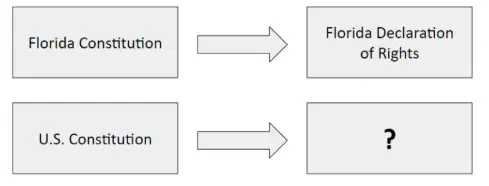
Use the diagram to answer the following question.
Which document would correctly complete the diagram?
Bill of Rights
Magna Carta
Mayflower Compact
English Bill of Rights
The Florida Declaration of Rights is similar to what part of the US Constitution?
Bill of Rights
Supremacy Clause
Article I
Elastic Clause
According to the Supremacy Clause, Florida ______ pass laws that go against the U.S. Constitution.
may not
may
The amendment process for which of the following documents allows for DIRECT CITIZEN involvement?
Florida Constitution
US Constitution
Both US and Florida Constitutions
By establishing three branches of government, both the Florida and US Constitutions...
Provide a framework for government
Protect the rights of the people
Create a process for voting on amendments
Makes state laws called statutes
US Supreme Court
County Comissioner
City Council
Florida Legislature
Legislative Branch
Makes laws
Enforces laws
Interprets laws
Executive Branch
Makes laws
Enforces laws
Interprets laws
Serves 4 years, grants pardons, enforces laws, serves as chief executive
President only
Governor only
Both the President and Governor

