
 Worksheets
Ankle Special Tests/Injuries
Total questions: 26
Worksheet time: 52mins
Test for anterior talofibular ligament
Thompson test
Anterior drawer test
External rotation (kleigers) test
DVT test
Test for calcaneofibular ligament
Bump test
Anterior drawer test
Squeeze test
Talar (calcaneal) tilt
Test for gastrocnemius/soleus
Thompsons test
active, passive, & resistive ROM
DVT test
Bump test
Test for Deltoid ligaments
Anterior drawer test
External rotation (Kleigers) test
DVT test
active, passive, & resistance ROM
Test for interosseous membrane (syndesmosis)
Anterior drawer test
Bump test
Thompsons test
Squeeze test
Test for anterior tibialis muscle
active, passive, resistance TOM
Thompsons test
Bump test
Anterior drawer test
A pronated foot can lead to what kind of injury?
inversion sprain
syndesmosis sprain
lateral sprain
eversion sprain
The most stable position of the foot is in ______:
dorsiflexion
plantarflexion
none of the above
neutral
Which injury is a fx to the base of the 5th metatarsal?
plantar fasciitis
Morton's toe
Jones
Bunion
Which ligament is the first ligament to be injured in an inversion+plantarflexion ankle sprain?
anterior tibiofibular
anterior talofibular
posterior tibiofibular
posterior talofibular
Which injury is characterized by pain in the calcaneus and sole of the foot?
plantar fasciitis
Morton's toe
Jones
bunion
ATFL Sprain-Grade 1 Ankle Sprain
Compression/Squeeze Test
Talar Tilt-Eversion
Anterior Drawer Test
Talar Tilt-Inversion Test
CFL Sprain-Grade 1 or 2 Ankle Sprain
Kleiger's Test
Thompson's Test
Talar Tilt-Inversion
Anterior Drawer Test
Deltoid Sprain-Medial Ankle Sprain
Talar Tilt-Eversion
Kleiger's Test
Anterior Drawer Test
Talar Tilt-Inversion
Various fractures of Bones
Tap/percussion/bump test
Compression/Squeeze test
Anterior drawer test
Long bone compression test
A soccer player comes into the training room complaining of pain in their left ankle. The athlete explained that they fell into a hole while practicing and felt a pop that caused them to fall on the ground. There is swelling on the distal, lateral aspect of the lower leg and ankle. The athlete is unable to bear weight on the ankle. What is the name of the special test used to diagnose high ankle sprains?
Keliger's Test
Appley's Test
Jumper's Knee Test
McMurray's Test

What test is being performed?
Bump
Squeeze
Talar Tilt
Anterior Drawer

Squeeze
Bump
Anterior Drawer
Mortin's

What test is being done?
Thompson
Thomas
Tayor
Talar Tilt

What special test is being performed?
Anterior Drawer
Posterior Drawer
Talar Tilt
Squeeze
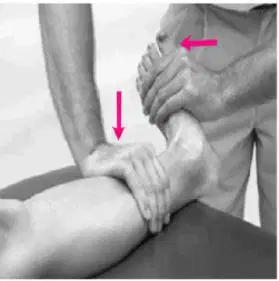
What is the name of this test
Talar Tilt - Eversion
Side to Side
Kleigers
Talar Tilt Inversion - Dorsiflexion
Talar Tilt - Inversion - Plantar Flexion
Which of the following is an athletic scenario for an EVERSION ankle sprain?
An athlete jumps for a rebound and rolls his ankle outwards.
An athlete is running through the woods and rolls her ankle inwards on a tree root.
Which of the following are the tissues damaged with an EVERSION ankle sprain.
Sinus Tarsi
Deltoid Ligament
Medial Malleolus
Lateral Malleolus

You would use this test if you suspected...
an ankle sprain
an achilles tendon rupture
a fracture
a dislocation

Why would you perform this test?
To assess any of the major ligaments in the ankle.
To assess the integrity of the achilles tendon.
To assess the ATF (anterior talofibular) ligament for laxity.
To assess for muscle strain.

What abnormallity do you see on the medial side of the 1st MP Joint
Claw Toe
Hammer Toe
Mallet Toe
Tailors Bunion
Bunion

