
 Worksheets
Science 9 Chp. 21 Practice Test
Total questions: 179
Worksheet time: 9hrs 57mins
What is the thin and solid outermost layer of Earth above the mantle called?
Mantle
Core
Lithosphere
Crust
What is the layer of rock between Earth's crust and core called?
Plate
Lithosphere
Mantle
Crust
What is the central part of Earth below the mantle called?
Core
Plate
Crust
Mantle
Which theory explains how large pieces of the lithosphere move and change shape?
Fault
Subduction
Plate Tectonics
Focus
What is the process by which one lithospheric plate moves beneath another plate called?
Subduction
Plate Tectonics
Focus
Fault
What is a break in a body of rock along which one block slides relative to another called?
Crust
Fault
Mantle
Core
What happens to density and pressure as we move from the crust to the inner core?
Density and Pressure Decreases
Density and Pressure Increases
Nothing

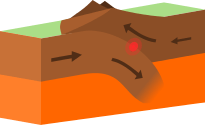
Which of the following is the name of the ancient supercontinent formed 280 Million Years ago.
Pangea
Gondwanda
Laurasia
Neverland


The place where an earthquake originates inside the Earth's surface is called...
Epicenter
Focus
Underground
Crust

The place on the Earth's surface, above the origin of the earthquake.
Epicenter
Focus
Surface
Crust

What is the instrument used to measure earthquakes?
Seismograph
Seismologist
Scale
Seismogram

Which city is closest to the epicenter?
A
B
C

Which seismogram represents a city that is far from the epicenter of an earthquake?
New York, NY
Nome, Alaska
Guadalajara, Mexico
S-waves can move through which of the following?
Gas
Liquid
Solid
All of these
Which wave can travel through all materials?
P - primary
S - secondary
L - Long
Measures the magnitude or size, of an Earthquake
epicenter
focus
Richter scale
Mercalli Scale
What is the measure of the amount of energy released in an earthquake?
Intensity
Epicenter
Magnitude
Seismogram


Which type of volcano is built by alternating layers of lava flows and ash flows? It can
be very explosive.
Cinder Cone
Composite
Lava Dome
Shield
Which type of volcano has steep angled sides, throws blobs of lava in the air that fall as cinders, and is built over a short period of time?
Cinder Cone
Composite
Lava Dome
Shield
Which type of volcano if found in the Hawaiian Islands with thick flowing, slow moving lava? This is the most common type of volcano on earth.
Cinder Cone
Composite
Lava Dome
Shield
An active volcanic area on earth is found at_______.
Diverging Boundaries
Converging Boundaries
Hot Spots
All of the above

This image represent _________.
The rock cycle
sedimentary rocks
metamorphic rocks
igneous rocks

Compaction and cementation will form in __________.
magma
metamorphic rocks
igneous rocks
sedimentary rocks
Water carving away at the bank of a river is an example of ____________.
compaction
cementation
deposition
erosion
A __________ is a natural, nonliving substance that makes up rocks.
Sedimentary rock
Sediment
Mineral
Igneous Rock
This rock started as molten magma. What type of igneous rock is this?
felsic
mafic
intrusive
extrusive
Igneous rocks are also known as
Clastic
Bioclastic
Crystalline
Extrusive
Intrusive
Foliated
Non-foliated
Metallic
Nonmetallic
Metamorphic Rocks are formed through the process of
Deposition and Burial
Heat and Pressure
Weathering and Erosion
Melting and Solidification
The best evidence for determining cooling rate of an igneous rock during its solidification is provided by
the mineral composition
the crystal size of its minerals
the index fossils
faults in the rock
States that younger rocks lie above older rocks if the layers have not been disturbed
superposition
cross-cutting
unconformity
uniformitarianism
What is the law of superposition?
The age of sedimentary rock not found in the original layers.
Metamorphic rock is younger than the nearby igneous rock.
Sedimentary rock in it's original position is older than layers above it.
Metamorphic rock is older because it was deposited to nearby sedimentary rock.

Which rock layer in the diagram seems to be the oldest?
F
B
E
A

According to the law of superposition, which layer is the youngest?
F
B
E
A
Unstable atoms that decay (change) and are considered radioactive
Isotope
Half-Life
Absolute Dating
Radiometric Dating
Length of time for half the atoms of an isotope to decay
Isotope
Half-Life
Radiometric Dating
Absolute Dating
Which process involves the removal of Earth materials from their original sites through transport?
Weathering
Deposition
Erosion
Abrasion
What is the process by which broken down Earth materials are laid down or deposited?
Weathering
Erosion
Deposition
Abrasion
Which type of weathering breaks a rock or mineral into smaller pieces without altering its composition?
Physical Weathering
Chemical Weathering
Abrasion
Ice Wedging
What is the process of scraping rocks through transport from wind, moving water, or glacier movement called?
Abrasion
Ice Wedging
Wetting/Drying
Plants/Animals
In which type of rocks or minerals does ice wedging occur?
Feldspar, slate, shale, and Granite
Sandstone, Quartz, and Quartzite
Any rock type
Granite (and the metamorphic versions of granite like gneiss and schist)
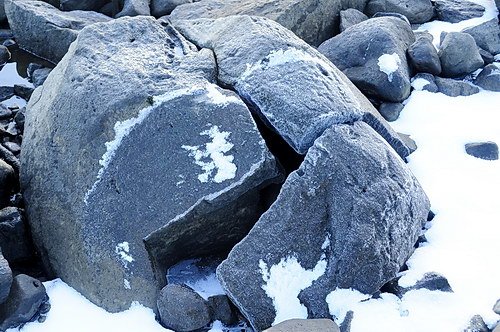


Which of the following are processes of mechanical weathering?
Ice Wedging
Exfoliation
Oxidation
Acid Precipitation
Which of the following are processes of chemical weathering?
Ice Wedging
Exfoliation
Oxidation
Acid Precipitation
What are the factors that affect the rate of weathering?
Surface Area
Rock Type and Composition
Climate
Topography
What is the mechanical weathering process in which outer rock layers are stripped away, often resulting in dome-shaped formations?
Ice Wedging
Oxidation
Exfoliation
What are the two agents of mechanical weathering?
Pressure
Temperature
Oxygen
Carbon Dioxide
Acid Precipitation
What are the four agents of chemical weathering?
Pressure
Water
Oxygen
Carbon Dioxide
Acid Precipitation
What areas are most affected by chemical weathering?
Dry and Cold
Humid and Warm
What areas are most affected by mechanical weathering?
Dry and Cold
Humid and Warm
Which layer of the Earth is the thin and solid outermost layer above the mantle?
Crust
Mantle
Core
Outer core
What is the main composition of Earth's core?
Nickel and iron
Silicon and oxygen
Carbon and hydrogen
Magnesium and calcium
Which process contributes to Earth's high internal temperatures?
Radioactivity
Photosynthesis
Evaporation
Condensation
What is the temperature in the mantle likely to exceed?
1250° C
500° C
2500° C
5000° C
Explain how radioactivity contributes to the high internal temperatures of the Earth.
The breakdown of radioactive isotopes releases energy that heats Earth's interior.
Radioactivity cools the Earth's surface by absorbing heat.
Radioactivity only affects the Earth's atmosphere, not its interior.
Radioactivity causes earthquakes by shaking the Earth's crust.
Compare the temperature of Earth's core to the surface of the sun and explain the significance of this comparison.
Earth's core is nearly as hot as the surface of the sun, indicating extreme internal heat.
Earth's core is much cooler than the surface of the sun, showing it is not very hot.
Earth's core is colder than the mantle, which is unusual.
Earth's core is the same temperature as the Earth's surface.
Who hypothesized that all of the continents were once part of a single landmass before drifting apart?
Alfred Wegener
Charles Darwin
Isaac Newton
Marie Curie
What was the name given to the supercontinent formed when all continents were pieced together?
Gondwana
Eurasia
Pangaea
Laurasia
Which evidence did Wegener use to support his idea of continental drift?
Identical fossils found on widely separated continents
Similar climate patterns across continents
Matching mountain ranges on different continents
Similar languages spoken across continents
What discovery on the ocean floor provided evidence for the movement of continents?
Deep sea trenches
Structures on the ocean floor
Coral reefs
Underwater volcanoes
Symmetrical bands on either side of a mid-ocean ridge indicate what about the movement of the ocean floor?
The ocean floor is stationary
The two sides are moving toward each other
The two sides are moving away from each other
The ocean floor is sinking
How does iron in molten rock align itself as it cools?
With the Earth's magnetic field
With the direction of ocean currents
With the position of the sun
With the wind direction
How often does the Earth's magnetic field reverse polarity?
Every 20,000 years
Every 200,000 years
Every 2,000 years
Every 2,000,000 years
What is recorded as magnetic bands in rock?
The age of the rock
The process of polarity reversal
The amount of iron in the rock
The temperature of the rock
What does the alignment of oceanic rocks support?
The theory of moving plates
The theory of evolution
The theory of relativity
The theory of gravity
How many large pieces is the crust and upper portion of the mantle divided into?
About three
About five
About seven
About ten
What is the lithosphere?
The liquid inner core of Earth
The solid outer layer of Earth consisting of the crust and the rigid upper part of the mantle
The gaseous atmosphere surrounding Earth
The molten mantle beneath the crust
Explain how symmetrical magnetic bands on either side of the Mid Atlantic Ridge provide evidence for plate movement.
They show that the crust is moving away from the ridge
They show that the crust is moving toward the ridge
They show that the crust is stationary
They show that the crust is melting
What is the theory that explains how large pieces of the lithosphere move and change shape?
Plate tectonics
Continental drift
Seafloor spreading
Volcanism
Which of the following is a hypothesis for what causes tectonic plates to move?
Convection currents in the asthenosphere
Wind currents in the atmosphere
Ocean currents in the hydrosphere
Magnetic fields in the core
What geologic features are commonly found near tectonic plate boundaries?
Volcanoes and earthquakes
Deserts and forests
Glaciers and lakes
Sand dunes and canyons
Which type of boundary is formed when two tectonic plates are moving apart?
Divergent boundary
Convergent boundary
Transform boundary
Subduction zone
What is magma?
Liquid rock produced under Earth’s surface
Solid rock found on Earth’s surface
Water vapor in the atmosphere
Ice formed in polar regions
What is a rift valley?
A narrow valley that forms where tectonic plates separate
A deep ocean trench formed by subduction
A mountain range formed by plate collision
A plateau formed by volcanic activity
What happens at a convergent boundary?
Plates slide over each other
Plates move apart
Plates remain stationary
Plates rotate around each other
What is a subduction zone?
The area where one plate slides over another
The area where plates move apart
The area where plates grind past each other
The area where plates remain stationary
Which features are produced by subduction zones?
Ocean trenches, mountains, and volcanoes
Deserts, forests, and lakes
Sand dunes, glaciers, and canyons
Plateaus, valleys, and rivers
Explain how mid-oceanic ridges are formed and what type of plate boundary is involved.
They are formed at divergent boundaries where plates move apart and new rock forms.
They are formed at convergent boundaries where plates collide and mountains rise.
They are formed at transform boundaries where plates slide past each other.
They are formed at subduction zones where one plate sinks beneath another.
What is subduction?
The process by which one lithospheric plate moves beneath another as a result of tectonic forces
The process of mountain formation due to plate collision
The movement of magma to the Earth's surface
The cracking of Earth's surface at transform fault boundaries
What is generated by the subduction of ocean crust?
Volcanoes
Earthquakes
Mountains
Island arcs
When two oceanic plates meet, what may form as magma rises to the surface?
Island arc
Mountain range
Fault line
Ocean trench
What happens when two tectonic plates collide?
Mountains are formed at the boundary of the collision
Volcanoes erupt in the ocean
Earthquakes occur in the middle of the plates
Island arcs disappear
Which type of plate boundary is one cause of earthquakes?
Transform fault boundaries
Divergent boundaries
Convergent boundaries
Subduction zones
Define a fault in geological terms.
A break in a body of rock along which one block slides relative to another
A chain of volcanoes formed on the upper plate
A crack in the Earth's crust where magma rises
A mountain formed by colliding plates
Explain how subduction zones can lead to the formation of volcanoes far inland from their associated oceanic trench.
Magma generated by subduction can rise and form volcanoes away from the trench
Earthquakes push volcanoes inland
Transform fault boundaries move volcanoes
Colliding plates force volcanoes to migrate
Compare and contrast the geological features formed at transform fault boundaries and at the collision of tectonic plates.
Transform fault boundaries cause earthquakes, while colliding plates create mountains
Both boundaries create mountains
Transform fault boundaries form island arcs, while colliding plates form volcanoes
Both boundaries only cause cracks in the Earth's surface
Where do most earthquakes occur?
At the boundaries of tectonic plates
In the center of continents
Near large bodies of water
In desert regions
What are seismic waves?
Waves of energy released during an earthquake
Waves of water in the ocean
Waves of sound in the atmosphere
Waves of light from the sun
What is the focus of an earthquake?
The location within Earth along a fault where the first motion occurs
The point on Earth's surface directly above the earthquake
The area where the most damage happens
The place where seismic waves stop
What is the epicenter of an earthquake?
The point on Earth's surface directly above the earthquake's starting point
The deepest part of the earthquake
The place where the earthquake ends
The area with the least vibration
Which type of wave is also known as a primary wave?
Longitudinal wave
Surface wave
Transverse wave
Shock wave
How do longitudinal waves travel through the Earth's crust?
By compressing and stretching the crust
By moving in circles
By shaking side to side
By heating the crust
Earthquakes generate three types of waves. Which of the following is NOT one of them?
Radio waves
Longitudinal waves
Transverse waves
Surface waves
Explain why earthquakes mostly occur at plate boundaries rather than in the middle of tectonic plates.
Because plates move with respect to each other at boundaries, causing stress and vibrations
Because the center of plates is always stable
Because water is found at plate boundaries
Because boundaries are colder than the center
Which type of seismic wave travels in an up and downward movement and is also called a secondary wave?
P wave
S wave
Surface wave
Longitudinal wave
What is a surface wave?
A wave that travels through Earth's core
A seismic wave that travels along the surface of a medium and has a stronger effect near the surface than in the interior
A wave that travels only through water
A wave that moves in a circular motion
What do seismologists use to detect and measure earthquakes?
Barometers
Thermometers
Seismographs
Anemometers
What is the study of earthquakes, including their origin, propagation, energy, and prediction called?
Geology
Seismology
Meteorology
Volcanology
Why are three seismograph stations necessary to locate the epicenter of an earthquake?
To measure the temperature of the ground
To compare the arrival times of seismic waves at different locations
To record the sound of the earthquake
To predict the weather
How do scientists use the difference in arrival times of P waves and S waves?
To measure the speed of wind
To calculate how far away the earthquake focus is
To determine the color of rocks
To predict rainfall
How do geologists use seismographs to investigate Earth's interior?
By measuring the temperature of rocks
By analyzing the way P and S waves travel through Earth to make a model with layers of different densities
By counting the number of earthquakes per year
By observing volcanic eruptions
What is a seismogram?
A record of seismic activity
A type of earthquake prediction
A tool used to measure temperature
A map of volcanoes
There are more than how many seismograph stations across the world?
100
500
1000
10,000
Explain how the way P and S waves travel through Earth’s interior helps scientists make a model of Earth with layers of different densities.
By showing the color of Earth's layers
By revealing the speed and path of waves, which change as they pass through materials of different densities
By measuring the temperature of each layer
By counting the number of earthquakes in each layer
Which scale is commonly used to measure the magnitude of earthquakes?
Celsius scale
Richter scale
Beaufort scale
Decibel scale
What does the Richter scale express?
The temperature of the Earth's core
The magnitude of earthquakes
The speed of volcanic eruptions
The depth of ocean trenches
Why can't magnitude scales alone predict how severe an earthquake will be?
They do not measure the Earth's temperature
Many factors, such as distance from the focus and local construction techniques, affect the damage
They only measure volcanic eruptions
They are only used for weather forecasting
What are scientists trying to do regarding earthquakes?
Prevent earthquakes from happening
Predict earthquakes
Increase earthquake magnitude
Measure volcanic eruptions
What is a volcano?
A mountain made of ice
Any opening in Earth’s crust through which magma has reached Earth’s surface
A large body of water
A type of earthquake
Which type of volcano has mild eruptions?
Composite volcano
Shield volcano
Cinder cone volcano
Lava dome volcano
What is a characteristic of composite volcanoes?
They have mild eruptions
They have trapped gas and are made of alternating layers of ash, cinders, and lava
They are the smallest volcanoes
They only erupt once
Explain why the ability to predict an earthquake could save thousands of lives.
It allows scientists to measure volcanic eruptions
It helps people prepare and evacuate before an earthquake occurs
It increases the magnitude of earthquakes
It prevents volcanoes from erupting
Which type of volcano is usually very steep?
Composite volcano
Shield volcano
Cinder cone
Underwater volcano
What are the most abundant volcanoes on Earth?
Composite volcanoes
Shield volcanoes
Cinder cones
Underwater volcanoes
Where do most volcanoes occur?
At divergent plate boundaries
At convergent plate boundaries
In the middle of plates
At transform plate boundaries
What is the Ring of Fire?
A chain of underwater volcanoes in the Atlantic Ocean
An area along the edges of the Pacific Ocean with many active volcanoes
A group of volcanoes in the Hawaiian Islands
A region of composite volcanoes in Africa
What happens at divergent plate boundaries to form underwater volcanoes?
Plates collide and magma is trapped
Plates move apart and magma rises to fill the gap
Plates slide past each other and magma cools
Plates remain stationary and magma erupts
Which volcanic island is located on the Mid-Atlantic ridge and grows outward in opposite directions?
Hawaii
Iceland
Japan
Madagascar
What are mantle plumes?
Streams of water under the ocean
Mushroom-shaped trails of hot rock rising from deep inside the mantle
Clouds of volcanic ash in the atmosphere
Layers of sediment on the ocean floor
Which islands are an example of volcanic activity caused by mantle plumes at hotspots?
Galapagos Islands
Hawaiian Islands
Canary Islands
Aleutian Islands
Explain how the movement of tectonic plates at divergent boundaries leads to the formation of underwater volcanoes. (DoK Level 2)
Plates move apart, magma rises to fill the gap, forming volcanic mountains on ocean ridges.
Plates collide, magma is trapped, forming mountains.
Plates slide past each other, magma cools and hardens.
Plates remain stationary, magma erupts randomly.
Using evidence from the text, describe how mantle plumes create a trail of volcanoes as a tectonic plate moves. (DoK Level 3)
Mantle plumes move with the plate, creating volcanoes everywhere.
Mantle plumes stay in one place while the plate moves, forming a trail of volcanoes.
Mantle plumes erupt only once, creating a single volcano.
Mantle plumes cool down and stop volcanic activity.
What are rocks composed of?
Minerals
Water
Gases
Fossils
Which of the following best describes a mineral?
A natural, usually inorganic solid with a characteristic chemical composition and an orderly internal structure
A liquid found in Earth's crust
A living organism
A type of sedimentary rock
How many minerals are found in Earth's crust?
More than 4,000
Less than 100
About 500
Exactly 1,000
What type of rock forms when magma cools and solidifies?
Igneous rock
Sedimentary rock
Metamorphic rock
Fossil rock
What is the difference between extrusive and intrusive igneous rocks?
Extrusive rocks cool on Earth's surface, while intrusive rocks cool beneath Earth's surface.
Extrusive rocks are made of fossils, while intrusive rocks are made of minerals.
Extrusive rocks are always sedimentary, while intrusive rocks are always igneous.
Extrusive rocks form from weathering, while intrusive rocks form from erosion.
What process breaks down rocks over thousands of years?
Weathering
Melting
Freezing
Evaporation
Explain how sedimentary rocks are formed from older rocks. (DoK Level 2)
Older rocks break down through weathering, and the pieces accumulate to form sedimentary rocks.
Older rocks melt and become magma, which then cools to form sedimentary rocks.
Older rocks are compressed by fossils to form sedimentary rocks.
Older rocks are heated and become metamorphic rocks.
Why is weathering important in the formation of sedimentary rocks? (DoK Level 3)
It breaks down rocks into smaller pieces that can accumulate and form sedimentary rocks.
It melts rocks into magma, which then forms sedimentary rocks.
It causes rocks to evaporate, leaving behind sedimentary rocks.
It freezes rocks, making them sedimentary.
Which type of rock is formed from compressed or cemented layers of sediment?
Sedimentary rock
Igneous rock
Metamorphic rock
Volcanic rock
What process causes minerals dissolved in water to "glue" sediment together to form rock?
Melting
Dissolution
Compression
Evaporation
Sedimentary rocks are named according to which characteristic?
Color
Size of fragments they contain
Location found
Age
What type of rock is formed when rocks undergo pressure and heating without melting?
Sedimentary rock
Igneous rock
Metamorphic rock
Volcanic rock
The word "metamorphic" comes from the Greek word "metamorphosis." What does "metamorphosis" mean?
To break apart
To change form
To solidify
To dissolve
Metamorphic rocks may be changed in which two ways?
By melting and freezing
By heat alone or by heat and pressure
By erosion and deposition
By weathering and compaction
What is the most common way metamorphic rocks are formed?
By heat alone
By pressure alone
By heat and pressure deep in the crust
By cooling quickly
What is the sequence of events in which rocks can be weathered, melted, altered, and formed called?
Rock formation
Rock cycle
Sedimentation
Metamorphosis
How long does rock formation usually take?
A few days
A few months
Tens of thousands to millions of years
A few hours
Depending on the circumstances, what can happen to any type of rock?
It can only remain the same
It can become any other type of rock
It can disappear
It can turn into soil
Explain how heat and pressure within the Earth contribute to the formation of metamorphic rocks.
They melt the rocks completely
They cause changes in the texture and mineral content of rocks without melting them
They erode the rocks
They freeze the rocks
Why is the rock cycle important in understanding how rocks change over time?
It shows that rocks never change
It explains how rocks can be weathered, melted, altered, and formed into new rocks over long periods
It only describes sedimentary rocks
It is not important for understanding rocks
Which principle is used to determine the relative age of a rock?
Principle of superposition
Principle of radioactive decay
Principle of absolute dating
Principle of mineral composition
According to the principle of superposition, where would you find the youngest rock layer in an undisturbed sequence?
On the top
In the middle
On the bottom
Scattered throughout
What method do scientists use to determine the absolute age of rocks?
Radioactive dating
Superposition
Mineral observation
Fossil comparison
Why do radioactive elements help scientists determine the age of rocks?
They decay at known rates over time
They change color as they age
They increase in size as they decay
They form new minerals instantly
A geologist finds a sequence of rock layers that has not been disturbed. Using the principle of superposition, how should the geologist determine which layer is the oldest?
The layer at the bottom is the oldest
The layer at the top is the oldest
The middle layer is the oldest
All layers are the same age
If a physicist determines the rate at which a radioactive element decays, how can a geologist use this information?
To determine the absolute age of rocks
To identify the mineral composition
To find the location of the rock
To measure the thickness of rock layers
Which process breaks rocks into smaller pieces without changing their chemical composition?
Physical weathering
Chemical weathering
Erosion
Sedimentation
What is abrasion in the context of physical weathering?
The breaking of rocks by plant roots
The dissolving of rocks by chemicals
The wearing away of rocks by particles suspended in wind or water
The melting of rocks due to heat

