
 Worksheets
Grafik Kinematika
Total questions: 48
Worksheet time: 2hrs 3mins
An object is moving in a circle with constant speed. Which of the following is/are true?
I. The object has constant velocity
II. The object has nonzero acceleration
III. After one revolution, the magnitude of the displacement is a positive value.
I only
II only
III only
I and II only
II and III only
An ideal elastic rubber ball is dropped from a height of about 2 meters, hits the floor and rebounds to its original height.Which of the following graphs would best represent acceleration versus time for the bouncing ball?
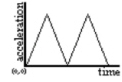
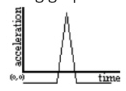
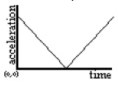
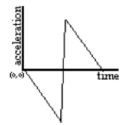
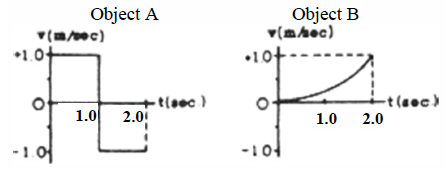
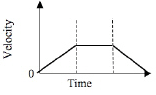
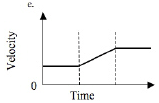
The following three questions relate to two objects that start at x = 0 at t = 0 and move in one dimension independently of one another. Graphs, of the velocity of each object versus time are shown below.
Which object moves with constant non-zero acceleration?
A
B
Both
Neither
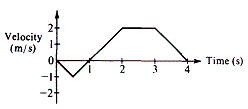
The graph above shows the velocity versus time for an object moving in a straight line. At what time after t = 0 does the object again pass through its initial position?
Between 0 and 1
1 s
Between 1 and 2 s
2s
Between 2 and 3 s
Consider a ball thrown up from the surface of the earth into the air at an angle of 30° above the horizontal. Air friction is negligible. Just after the ball is released, its acceleration is:
0 m/s2
Upwards at 9.8 m/s2
Downwards at 9.8 m/s2
Upwards at 4.9 m/s2
None of these
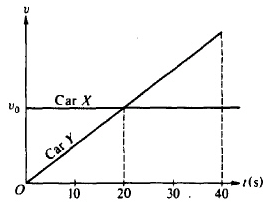
At time t = 0, car X traveling with speed v0 passes car Y which is just starting to move. Both cars then travel on two parallel lanes of the same straight road. The graphs of speed v versus time t for both cars are shown above. Which of the following is true at time t = 20 seconds?
Car X is accelerating faster than car Y.
Car Y is passing car X.
Car Y is in front of car X.
Car Y is behind car X
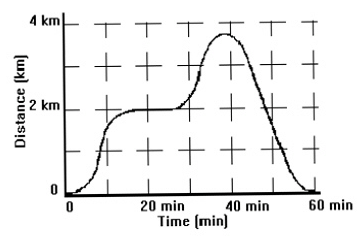
Above is a graph of the distance vs. time for car moving along a road. According the graph, at which of the following times would the automobile have been accelerating positively?
5, 29, & 57 min.
5, 12, 29, & 35 min.
12, 35, & 41 min.
0, 20, 38, & 60 min
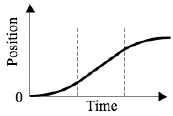
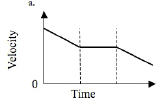
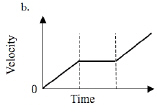
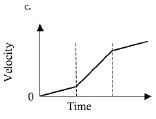
The graph given here shows the position vs. time for an object traveling along the x-axis. Which graph below shows the velocity vs. time for this same object during the same time period?
A ball is tossed straight up and later returns to the point from which it was launched. If the ball is subject to air resistance as well as gravity, which of the following statements is correct?
The speed at which the ball returns to the point of launch is less than its speed when it was initially launched.
The net work done by air resistance on the ball during its flight is zero.
The time for the ball to fall is the same as the time for the ball to rise.
The force of air resistance is directed down-ward both when the ball is rising and when it is falling.
The net work done by gravity on the ball during its flight is greater than zero.
Ball A is thrown upward with 3 times the velocity of Ball B. How will its maximum height compare to Ball B’s maximum height?
2 times higher
3 times higher
6 times higher
9 times higher
None of the above
At time t = 0, car X traveling with speed v0 passes car Y which is just starting to move. Both cars then travel on two parallel lanes of the same straight road. The graphs of speed v versus time t for both cars are shown above. Which of the following is true at time t = 40 seconds?
Car Y is in front of car X.
Car X is accelerating faster than car Y.
Car Y is passing car X.
Car Y is behind car X
A whiffle ball is tossed straight up, reaches a highest point, and falls back down. Air resistance is not negligible.Which of the following statements are true?
I. The ball's speed is zero at the highest point.
II. The ball's acceleration is zero at the highest point.
III. The ball takes a longer time to travel up to the highest point than to fall back down.
I only
II only
I and II
I and II
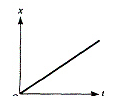
The displacement x of an object moving along the x-axis is shown above as a function of time t. The velocity of this object must be
decreasing
increasing
constant but not zero
equal to g
zero
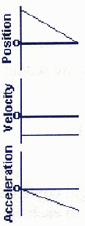
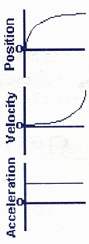
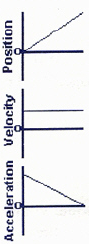
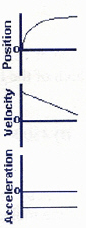
Which of the following sets of graphs might be the corresponding graphs of Position, Velocity, and Acceleration vs. Time for a moving particle?
An object is moving in a circle with constant speed. Which of the following is/are true?
I. The object has constant velocity
II. The object has nonzero acceleration
III. After one revolution, the magnitude of the displacement is a positive value.
I only
II only
III only
I and II only
II and III only
An ideal elastic rubber ball is dropped from a height of about 2 meters, hits the floor and rebounds to its original height.Which of the following graphs would best represent acceleration versus time for the bouncing ball?
The following three questions relate to two objects that start at x = 0 at t = 0 and move in one dimension independently of one another. Graphs, of the velocity of each object versus time are shown below.
Which object moves with constant non-zero acceleration?
A
B
Both
Neither
The graph above shows the velocity versus time for an object moving in a straight line. At what time after t = 0 does the object again pass through its initial position?
Between 0 and 1
1 s
Between 1 and 2 s
2s
Between 2 and 3 s
Consider a ball thrown up from the surface of the earth into the air at an angle of 30° above the horizontal. Air friction is negligible. Just after the ball is released, its acceleration is:
0 m/s2
Upwards at 9.8 m/s2
Downwards at 9.8 m/s2
Upwards at 4.9 m/s2
None of these
At time t = 0, car X traveling with speed v0 passes car Y which is just starting to move. Both cars then travel on two parallel lanes of the same straight road. The graphs of speed v versus time t for both cars are shown above. Which of the following is true at time t = 20 seconds?
Car X is accelerating faster than car Y.
Car Y is passing car X.
Car Y is in front of car X.
Car Y is behind car X
Above is a graph of the distance vs. time for car moving along a road. According the graph, at which of the following times would the automobile have been accelerating positively?
5, 29, & 57 min.
5, 12, 29, & 35 min.
12, 35, & 41 min.
0, 20, 38, & 60 min
The graph given here shows the position vs. time for an object traveling along the x-axis. Which graph below shows the velocity vs. time for this same object during the same time period?
A ball is tossed straight up and later returns to the point from which it was launched. If the ball is subject to air resistance as well as gravity, which of the following statements is correct?
The speed at which the ball returns to the point of launch is less than its speed when it was initially launched.
The net work done by air resistance on the ball during its flight is zero.
The time for the ball to fall is the same as the time for the ball to rise.
The force of air resistance is directed down-ward both when the ball is rising and when it is falling.
The net work done by gravity on the ball during its flight is greater than zero.
Ball A is thrown upward with 3 times the velocity of Ball B. How will its maximum height compare to Ball B’s maximum height?
2 times higher
3 times higher
6 times higher
9 times higher
None of the above
At time t = 0, car X traveling with speed v0 passes car Y which is just starting to move. Both cars then travel on two parallel lanes of the same straight road. The graphs of speed v versus time t for both cars are shown above. Which of the following is true at time t = 40 seconds?
Car Y is in front of car X.
Car X is accelerating faster than car Y.
Car Y is passing car X.
Car Y is behind car X
A whiffle ball is tossed straight up, reaches a highest point, and falls back down. Air resistance is not negligible.Which of the following statements are true?
I. The ball's speed is zero at the highest point.
II. The ball's acceleration is zero at the highest point.
III. The ball takes a longer time to travel up to the highest point than to fall back down.
I only
II only
I and II
I and II
The displacement x of an object moving along the x-axis is shown above as a function of time t. The velocity of this object must be
decreasing
increasing
constant but not zero
equal to g
zero
Which of the following sets of graphs might be the corresponding graphs of Position, Velocity, and Acceleration vs. Time for a moving particle?




What is happening between 4 and 5 seconds?
The object is slowing down in a negative direction.
The object is slowing down in a positive direction.
The object is speeding up in a positive direction.
The object is speeding up in a negative direction.

Find the displacement in the first 5 seconds.
8 centimeters
4 centimeters
2 centimeters
5 centimeters

Find the total displacement in the 7 seconds of motion.
1 centimeter
0 centimeters
9 centimeters
12 centimeters


A person walking along a straight line moves such that her velocity as a function of time can be represented by the graph above. At what time does the person have the same position as she had at time t = 0?
At t = 5 s
During the interval 5 s < t < 8 s
At t = 8 s
During the interval t > 8 s



