
 Worksheets
Chemical Bonding Review
Total questions: 49
Worksheet time: 26mins
Name
Class
Date
1.
Which part of a lithium atom in the ground state is represented by the dots in its Lewis electron-dot diagram?
a)
the inner electrons that make up the kernel of the lithium atom
b)
the outermost electron in the second shell
c)
the valence protons in the nucleus
d)
the neutrons in the outer valence electron shell
2.
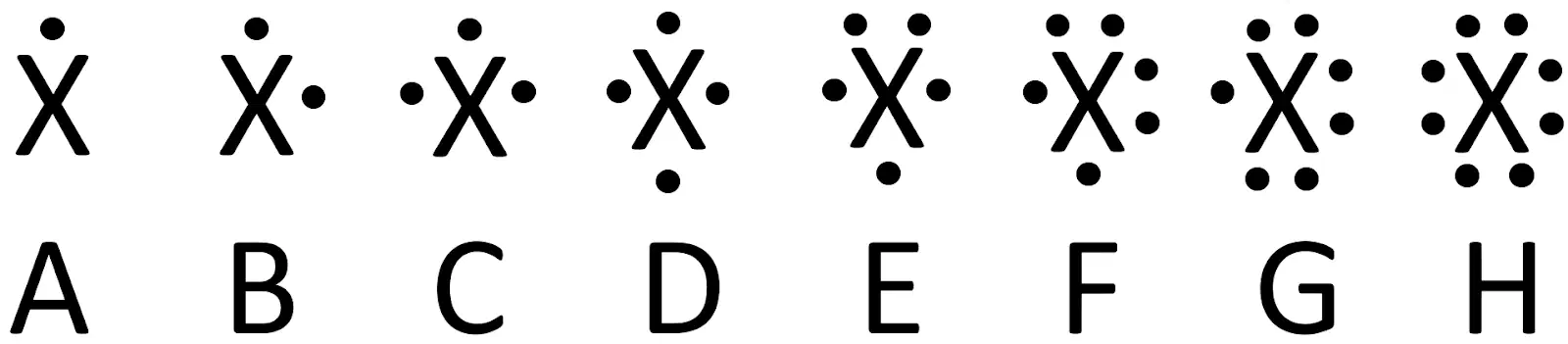
Which of the following Lewis dot diagrams would represent an element in group 14. Write the letter in the space provided.
(a)
3.
Which of the following describes the energy changes that occur during a chemical reactions as chemical bonds are broken and formed?
a)
breaking bonds absorbs energy, whereas forming bonds releases energy
b)
breaking bonds releases energy, whereas forming bonds absorbs energy
c)
both the breaking and formation of bonds absorbs energy
d)
both the breaking and formation of bonds releases energy
4.
How many electrons are shared between the atoms in a molecule of oxygen gas ( O₂ )?
a)
2
b)
3
c)
4
d)
5
e)
6
5.
Which of the following equations best represents the energy being absorbed as bonds are broken during a chemical reaction during a chemical reaction.
a)
Cl₂ → Cl + Cl + Energy
b)
Cl₂ + Energy → Cl + Cl
c)
Cl + Cl→ Cl₂ + Energy
d)
Cl + Cl + Energy→ Cl₂
6.

An metallic atom (represented by letter X) has an oxidation state of +3 reacts with chlorine gas. Which of the following best represents the Lewis dot diagram for this compound?
a)
A
b)
B
c)
C
d)
D
7.
In the formula XF₂, the element represented by X can be classified as a
a)
Group 1 metal
b)
Group 2 metal
c)
Group 1 nonmetal
d)
Group 2 nonmetal
8.
When an atom of chlorine becomes and ion, which of the following takes place?
a)
Electrons are gained and the oxidation number increases.
b)
Electrons are gained and the oxidation number decreases.
c)
Electrons are lost and the oxidation number increases.
d)
Electrons are lost and the oxidation number decreases.
9.
During a chemical reaction, which of the following occurs to an atom of sodium when it reacts with fluorine gas? Sodium...
a)
gains one electron and becomes a positively charged ion
b)
gains one electron and becomes a negatively charged ion
c)
loses one electron and becomes a positively charged ion
d)
loses one electron and becomes a negatively charged ion
10.
What occurs when an atom of chlorine and an atom of hydrogen become a molecule of hydrogen chloride?
a)
A chemical bond is broken and energy is released.
b)
A chemical bond is broken and energy is absorbed.
c)
A chemical bond is formed and energy is released.
d)
A chemical bond is formed and energy is absorbed.
11.
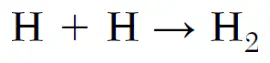
Which of the following statements best represents the energy changes that occur during the following reaction
a)
a bond is broken and energy is released
b)
a bond is broken and energy is absorbed
c)
a bond is formed and energy is released
d)
a bond is formed and energy is absorbed
12.
Which of the following symbols represents an atom in the ground state with the most stable valence electron configuration?
a)
C
b)
N
c)
Ca
d)
Xe
13.
Which statement explains why a molecule of methane gas (CH₄) is nonpolar?
a)
The molecule has a symmetrical distribution of charge and contains ionic bonds.
b)
The molecule has an asymmetrical distribution of charge and contains only covalent bonds.
c)
The molecule has a symmetrical distribution of charge and contains only covalent bonds.
d)
The molecule has an asymmetrical distribution of charge and contains only ionic bonds.
14.
Which of the following atoms has the weakest attraction for electrons in a chemical bond?
a)
hydrogen
b)
sulfur
c)
carbon
d)
fluorine
15.
In a molecule of hydrogen bromide (HBr), the electrons in the bond between hydrogen and bromine are least attracted to the atom of
a)
hydrogen, which has the higher electronegativity
b)
bromine, which has the higher electronegativity
c)
hydrogen, which has the lower electronegativity
d)
bromine, which has the lower electronegativity
16.
Which of the following chemical bonds is most polar?
a)
H-F
b)
H-Cl
c)
H-Br
d)
H-I
17.
Which diatomic molecule is formed when the two atoms share six electrons?
a)
hydrogen gas
b)
nitrogen gas
c)
oxygen gas
d)
fluorine gas
18.
Ionic bonding is best described as the...
a)
transfer of electrons
b)
equal sharing of electrons
c)
unequal sharing of electrons
d)
equal sharing of protons
e)
unequal sharing of protons
19.
Which formula represents an ionic solid?
a)
Li(s)
b)
CO(s)
c)
Ni(s)
d)
NaCl(s)
20.
The polarity of a chemical bond can be determined by...
a)
the difference in the electronegativity values for each atom
b)
the difference in the ionization energies for each atom
c)
the Lewis dot diagrams for each atom
d)
the symmetry of the molecule that contain the atoms
21.
Which compound would have the greatest ionic character?
a)
BaO
b)
HF
c)
HCl
d)
SO
22.
Which of the following chemical bonds is least polar?
a)
C-H
b)
C-N
c)
C-O
d)
C-S
23.
As a bond between an oxygen atom and a hydrogen atom is formed, electrons are
a)
shared to form an ionic bond
b)
shared to form a covalent bond
c)
transferred to form an ionic bond
d)
transferred to form a covalent bond
24.
Polar covalent bonding is best described as the...
a)
unequal sharing of electrons
b)
transfer of electrons
c)
equal sharing of electrons
d)
equal sharing of protons
e)
unequal sharing of protons
25.
Nonpolar covalent bonding is best described as the...
a)
equal sharing of electrons
b)
transfer of electrons
c)
unequal sharing of electrons
d)
equal sharing of protons
e)
unequal sharing of protons
26.
Which of the following substances has nonpolar covalent bonds?
a)
CCl₄
b)
CaO
c)
O₂
d)
CO₂
27.
Which of the following compounds would have an asymmetrical distribution of charge?
a)
CO₂
b)
H₂
c)
CH₄
d)
HF
28.
Which formula represents a polar molecule?
a)
CH₄
b)
CO₂
c)
O₂
d)
H₂O
29.
Which type of bond is found between atoms of solid calcium?
a)
nonpolar covalent
b)
polar covalent
c)
metallic
d)
ionic
30.
Which of the following would best be described as having a mobile, delocalized electrons at STP?
a)
Na(s)
b)
Ne(g)
c)
O₂(g)
d)
H₂O(g)
e)
NaCl(s)
31.
Which type of molecule is NH₃?
a)
polar, with a symmetrical distribution of charge
b)
polar, with an asymmetrical distribution of charge
c)
nonpolar, with a symmetrical distribution of charge
d)
nonpolar, with an asymmetrical distribution of charge
32.
Nitrogen gas (N₂) is a diatomic element. Which of the following best describes the polarity of the bonds within this molecule? The electrons are shared...
a)
equally, and the resulting bond is polar
b)
equally, and the resulting bond is nonpolar
c)
unequally, and the resulting bond is polar
d)
unequally, and the resulting bond is nonpolar
33.
Which of the following best describes Na₃PO₄?
a)
the compound contains both ionic and covalent bonds
b)
the compound contains only ionic bonds
c)
the compound contains a sea of electrons
d)
the compound contains hydrogen bonds
e)
the compound contains only polar covalent bonds
34.
Which of the following best describes a molecule of CO₂.
a)
the bonds are polar covalent and the molecule is nonpolar
b)
the bonds are nonpolar covalent and the molecule is nonpolar
c)
the bonds are polar covalent and the molecule is polar
d)
the bonds are nonpolar covalent and the molecule is polar
35.
Which of the following best describes why H₂O has a higher melting point than H₂S?
a)
H₂S has weaker covalent bonds than H₂O
b)
H₂O has stronger covalent bonds than H₂S
c)
H₂S contains hydrogen bonds
d)
H₂O contains hydrogen bonds
36.
Which of the following substances would not show hydrogen bonding in between molecules?
a)
NH₃
b)
HBr
c)
HF
d)
H₂O
37.
In terms of element classification, which of the following describes the type of bonding in a KBr.
a)
K is a metal and Br is a nonmetal
b)
there is an unequal distribution of charge
c)
the salt is ionic
d)
there is a transfer of electrons
38.
In terms of element classification, which of the following describes the type of bonding in a molecule of HCl.
a)
H and Cl are nonmetals
b)
there is an unequal distribution of charge
c)
the molecule is polar covalent
d)
there is an unequal sharing of electrons
39.
In terms of electrons, describe the type of bonding in a molecule of H₂.
a)
transfer of electrons
b)
equal sharing of electrons
c)
unequal sharing of electrons
d)
the electrons are mobile
e)
the molecule is symmetrical
40.
In terms of electrons, describe the type of bonding in a salt crystal of NaCl.
a)
transfer of electrons
b)
equal sharing of electrons
c)
unequal sharing of electrons
d)
the electrons are delocalized
e)
the salt crystal is contains a metal and a nonmetal
41.
In terms of electrons, describe the type of bonding in a molecule of HCl.
a)
transfer of electrons
b)
equal sharing of electrons
c)
unequal sharing of electrons
d)
there is a "sea of electrons"
e)
the molecule has a asymmetric
42.
In terms of electrons, describe the type of bonding in a ribbon of pure Mg(s). (check off all that apply)
a)
the electrons are mobile
b)
the electrons are delocalized
c)
there is a "sea of electrons"
d)
the electrons are immobile
e)
the electrons are localized
43.
In terms of molecular polarity, describe the type of bonding in H₂O.
a)
the molecule is polar covalent
b)
the molecule is ionic
c)
the molecule is nonpolar covalent
44.
In terms of molecular polarity, describe the type of bonding in O₂.
a)
the molecule is polar covalent
b)
the molecule is ionic
c)
the molecule is nonpolar covalent
45.
In terms of molecular polarity, describe the type of bonding in NH₃.
a)
the molecule is polar covalent
b)
the molecule is ionic
c)
the molecule is nonpolar covalent
46.
In terms of molecular polarity, explain why NH₃ is more soluble in H₂O than O₂.
a)
both NH₃ and H₂O are polar and O₂ is nonpolar
b)
both O₂ and H₂O are polar and NH₃ is nonpolar
c)
both NH₃ and H₂O are nonpolar and O₂ is polar
d)
both O₂ and H₂O are nonpolar and NH₃ is polar
47.
Identify the molecular polarity of the C-F bond in CF₄.
a)
the bond is polar covalent
b)
the bond is ionic
c)
the bond is nonpolar covalent
48.
Which of the following compounds are ionic? Choose all that apply.
a)
KCl
b)
AlF₃
c)
BaBr₂
d)
H₂O
e)
CO
49.
In terms of intermolecular forces, explain why substance A has a lower boiling point than substance B.
a)
substance A has stronger intermolecular forces than substance B
b)
substance B has a higher melting point than substance A
c)
substance B has stronger intermolecular forces than substance A
d)
substance A is a polar molecule and substance B is a nonpolar molecule
100 %

