
 Worksheets
Extra Assignment #2
Total questions: 250
Worksheet time: 17hrs 49mins

Ray
Plane
Line
Segment

Ray
Segment
Line
Point

Segment
Arrow
Line
Ray

Select the correct 4 Coplanar Points
D,E,F,H
D,F,G,H
G,D,E,F

Which 3 Points are Collinear?
D,E,F
G,D,E
H,G,E
G,E,F
Given A, B, and C are collinear points on a segment AC. Find the length of BC, if AB = 7 units and AC = 18 units.
12
11
25
10

Determine the measure of BC if AC = 32
17
18
19
16

Example 2: Find x if the length of PR is 45 units in length. [Refer to the figure]
3
44
5
6
If M, N, O, and P are four points on a segment MP, what will be the correct expression to find the value of OP?
OP = MP + (MN + NO)
OP = MP + MN + NO
OP = MP - (MN + NO)
OP = MP - MN + NO

Suppose AC = 48, find the value of x. Then, find the length of AB.
13
16
12
15

2. Which is the correct name for the obtuse angle in the diagram?
∠ACB
∠ACD
∠BCD
∠C

3. Find the indicated measure. (Enter number value only)
(a)

4. Find the indicated angle measure. (Enter number value only)
(a)

5-9. Match the angle with its correct measure and classification.
∠MLN
60, ACUTE
∠NLP
70, ACUTE
∠NLQ
120, OBTUSE
∠OLP
40, ACUTE
∠MLQ
180, STRAIGHT

10. What equation can be used to help find ∠CBD?
3x + 15 + x + 7 = 94
3x + 15 = x + 7
4x + 22 = 94
3x + 15 = 94

Given the diagram, which is correct?
BC+CD=BD
BD+BC=CD
CD+BC=BD
BC+BD=CD

If T is the midpoint of SU, find x.
3
4
5
2

If RT=36, find the value of x.
3
4
5
6

If DF=9x-39, find EF.
16
58
116
23

If HJ=7x-27, find the value of x.
4
5
6
7
How is the distance formula correctly written:
d = (y1 − y2)2 −(x2 − x1)2
d = (x2 − x1)2 + (y2 − y1 )2
d = (y1 − y 2)2 + (x2 − x1)2
d = (x)2− (y)2
A(3,1) B(-2,-1) written correctly is:
(−2−3)2 + (−1−1)2
(1−3)2 + (−1−2)2
(−2−3)2 − (−1−1)2
(−2−3)2 − (−1−1)2
A(2,0) B(-2,4) is written as
d = (4−2)2 − (0−2)2
d = (4−0)2 − (−2−2)2
d = (−2 +0)2 + (4+2)2
d = (−2−2)2 + (4−0)2
A part of a line consisting of two points and all points between them.
ray
endpoint
line segment
plane
A point at one end of a segment or the starting point of a ray.
line segment
endpoint
ray
line
It is a location and has no size, represented by a dot.
ray
endpoint
point
line
A flat surface that has no thickness and extends forever.
point
line
plane
ray

Are points D and E collinear or coplanar?
Collinear
Coplanar
Both
Neither


Find the length UW if V is a midpoint (not to scale)
(a)

What is the distance between AB
0
8
9
7

Find the exact distance between J and K. No need for lowest radical form.
68
53
64 or 8
73
Find the approximate distance between (-5, -8) and (-1, -16). Round to the nearest hundredth (x.xx)
8.94
4.47
10.00
24.86

What is the slope between AB
0
5
undefined
-5
Match the following terms with their correct definitions.
A part of a line that starts at a point and extends indefinitely in one direction.
Intersections in a Plane
The exact middle point in a line segment.
Ray
The point where two lines or rays meet.
Midpoint
A part of a line that is bounded by two distinct end points and contains every point on the line between its endpoints.
Line Segment
Which of the following statements accurately describe the properties of lines?
Lines can be curved
Lines extend indefinitely in both directions
Lines have a definite beginning and end
Lines are always straight
Identify the statements that accurately describe the additive property of length.
It states that the whole is greater than the sum of its parts
It refers to the ability to add line segments together
It is relevant only when dealing with curved lines
It states that the length of a whole line is equal to the sum of its parts
It implies that the length of a line segment cannot be negative
Which of these statements are true about intersections in a plane?
A line and a plane can intersect at a point
Two planes can intersect at a line
Two lines in a plane always intersect at a point
Two lines in a plane can intersect at more than one point
A line and a plane can intersect at a line

YZ and XY are congruent.
True
False

QR and PQ are congruent.
True
False
QR and PQ are congruent.
True
False

KN ≅ RS
True
False
Which one is not a polygon?


which one is a polygon?


A polygon is...
A shape with straight sides that meet at angles
A shape with at least 5 sides
A shape that has curved edges
A shape that has 4 sides or more
True or False: A circle is a polygon.
True
False
A polygon is regular if....
All angles are equal and all sides are equal
Only all sides are equal
Only all angles are equal
All sides have different measurements

Name this polygon.
hexagon
pentagon
trapezoid
octagon

Name this polygon.
quadrilateral
triangle
hexagon
heptagon

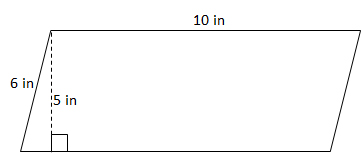
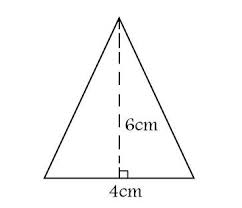


Find the area of the square.
12,100 ft2
440 ft
220 ft2
10,100 ft2

60 square mm
Area of parallelogram
44 square mm
Area of trapezoid
104 square mm
Area of composite figure
a figure composed of two or more two-dimensional figures
composite figure
the number of square units a figure covers
area

What is the area of the figure?
275 cm2
75 cm2
125 cm2
200 cm2

What is the area of the unshaded region?
117 cm2
33.5 cm2
58.5 cm2
25 cm2

What is the area of the unshaded region? (a)
16 ft2
32 ft2
8 ft2

Select the best estimate of the area of the figure?
150 in2
14 in2
36 in2
50 in2

4. What is the area of the rectangle?
30 mm2
36 mm2
45 mm2
56 mm2
The Pythagorean Theorem ONLY works on which triangle? #3
Side a on a right triangle is ALWAYS the longest side. #4

Find the length of the missing side. #1
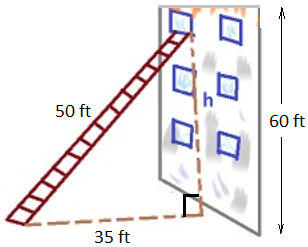
Find the length of variable h. #16

Which equation reflects the right triangle shown? #21
x2 + 142 = 202
142 + 202 = x2
142 – 202 = x2
x2 – 142 = 202
The legs of a right triangle have lengths of 10 and 24. What is the length of the hypotenuse? #27
13
14
26
34

Give another name for plane M.
Name three collinear points.
(a)
How many point/s are required to name a specific plane?
3
2
∞
1
0

Name a point that is coplanar with line DF but not collinear.
G
H
E
A__________ is a fixed position in space and has no dimensions or size.
Point
Line
Plane
Cube

Name two planes that contain line QP.
Planes PSR, QNM
Planes SPL, QRM
Planes NML, QPR
Planes PRQ, SLP


Find the midpoint:
(−1,−3)
(−2,−23)
(−1,−25)

Find the midpoint:
(−23,−25)
(−1,−3)
(−21,−25)
(−3,−1)
Which of the following is the correct midpoint formula given two endpoints (x1, y1) and (x2, y2)?
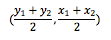
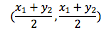
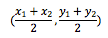

Find the midpoint of the line segment with the given endpoints.
(0, 2), (-2, -8)
(1, 5)
(-4, -18)
(-1, -3)
(1, -5)
Find the midpoint of the line segment with the given endpoints.
(0, -3), (-2, -4)
(-1.5, -3)
(1, 0.5)
(-1, -3.5)
(-4, -5)
Find the midpoint of the line segment with the given endpoints.
(8, -1), (6, -1)
(4, -1)
(7, -1)
(1, 0)
(3.5, 2.5)
Find the other endpoint of the line segment with the given endpoint A and midpoint M.
A(-4, 2), M(8, 7)
(20, 12)
(-1, 7.5)
(-6, -2.5)
(1.5, -5.5)
Find the other endpoint of the line segment with the given endpoint A and midpoint M.
A(10, -3), M(4, 3)
(3, -3)
(-7.5, 7.5)
(-2, 9)
(3.5, 3.5)
Find the other endpoint of the line segment with the given endpoint A and midpoint M.
A(2, 7), M(-3, 10)
(4.5, 3.5)
(-8, 13)
(4, -2.5)
(2.5, -1.5)


Complementary Angles are...
Two angles that are next to each other.
Two angles whose measures add up to 90°
Two angles whose measures add up to 180°
Two angles that are across from each other and whose measures are equal.
Supplementary Angles are...
Two angles that are next to each other.
Two angles whose measures add up to 90°
Two angles whose measures add up to 180°
Two angles that are across from each other and whose measures are equal.

True or False. These angles are complementary.
True
False

Find M.
(a)

True or False. ∠1 and ∠2 are vertical angles.
True
False

What is the equation that could be used to solve for the missing angle measure?
x + 64 = 90
x = 64
x + 64 = 180
90 - x = 64


Find the value of x.
15
16
18
19

Find the missing angle.
53
67
77
43
What is the complement of an angle whose measurement is 84 degrees?
96 degrees
6 degrees
86 degrees
16 degrees
What is an example of a pair of complementary angles?
12° and 55°
11° and 169°
17° and 73°
89° and 11°
Find the supplementary angle for 104 degrees...
70 degrees
74 degrees
76 degrees
Find the supplementary angle for 51 degrees...
129 degrees
119 degrees
126 degrees

What equation can be written to find the value of x in the figure?
x+59=180
x=59
x+59=90
x+59+90+180=4750000

Which of the following is true about the conditional statement below?
If a man is 7 feet tall, then he plays basketball.
Hypothesis: a man is 7 feet tall
Conclusion: he plays basketball
Hypothesis: IF a man is 7 feet tall
Conclusion: THEN he plays basketball
Hypothesis: THEN he plays basketball
Conclusion: IF a man is 7 feet tall
Hypothesis: he plays basketball
Conclusion: a man is 7 feet tall
Which of the following is true about the conditional statement below?
If you are flying, then you are in a
jet.
Hypothesis: you are flying
Conclusion: you are in a
jet
Hypothesis: IF you are flying
Conclusion: THEN you are in a
jet
Hypothesis: THEN you are in a
jet
Conclusion: IF you are flying
Hypothesis: you are in a
jet
Conclusion: you are flying

Which of the following is true about the conditional statement below?
If you are in Alaska, then you are
cold.
Hypothesis: you are in Alaska
Conclusion: you are
cold
Hypothesis: IF you are in Alaska
Conclusion: THEN you are
cold
Hypothesis: THEN you are
cold
Conclusion: IF you are in Alaska
Hypothesis: you are
cold
Conclusion: you are in Alaska
Which of the following is the CONVERSE of the statement below?
If an object is a ring, then it is
made of gold.
If an object is made of gold, then it is a ring.
If an object is not a ring, then it is not made of god.
If an object is not made of gold, then it is not a ring.
There is no converse of the statement.

Which of the following is the CONVERSE of the statement below?
If an object is a bird, then it can fly.
If an object can fly, then it is a bird.
If an object is not a bird, then it cannot fly
If an object cannot fly, then it is not a bird
There is no converse of the statement
Which of the following is the CONVERSE of the statement below?
If your grade is a 96, then you are
making an A.
If you are making an A, then your grade is a 96.
If you are not making an A, then your grade is not a 96.
If your grade is not a 96, then you are not making an A.
There is no converse of the statement.

Which of the following is the CONVERSE of the statement below?
If you play football, then you wear
a uniform.
If you wear a uniform, then you play football.
If you do not play football, then you do not wear a uniform.
If you do not wear a uniform, then you do not play football.
There is no converse of the statement.
Which of the following is the INVERSE of the statement below?
If an object is a computer, then it
has a hard drive.
If an object is not a computer, then it does not have a hard drive.
If an object does not have a hard drive, then it is not a computer.
If an object has a hard drive, then it is a computer.
There is no inverse of the statement.

Which of the following is the INVERSE of the statement below?
If an object is a battery, then it is
rechargeable.
If an object is not a battery, then it is not
rechargeable.
If an object is rechargeable, then it is not a battery.
If an object is not rechargeable, then it is not a battery.
There is no inverse of the statement.
Which of the following is the INVERSE of the statement below?
If an animal is black and white,
then it is a penguin.
If an animal is not black and white, then it is not a penguin
If an animal is a penguin, then it is black and white.
If an animal is not a penguin, then it is not black and white.
There is no inverse of the statement.

Which of the following is the CONTRAPOSITIVE of the statement below?
If a species walks on two feet, then
it is human.
If a species is not human, then it does not walk on two feet.
If a species is human, then it walks on two feet.
If a species does not walk on two feet, then it is not human.
There is no contrapositive of the statement.
Which of the following is the CONTRAPOSITIVE of the statement below?
If a gem is a ruby, then it is red.
If a gem is not red, then it is not a ruby.
If a gem is not a ruby, then it is not red.
If a gem is red, then it is a ruby.
There is no contrapositive statement.

Which of the following is the CONTRAPOSITIVE of the statement below?
If a species is a fish, then it lives in
water.
If a species does not live in water, then it is not a fish.
If a species is not a fish, then it does not live in water.
If a species lives in water, then it is a fish.
There is not contrapositive of the statement.
Which of the following is the BICONDITIONAL of the statement below?
If there is lightning, then there is thunder.
If there is not lightning, then there is not thunder.
If there is thunder, then there is lightning.
There is lightning if and only if (iff) there is thunder.
There is no biconditional statement.

Which of the following is the BICONDITIONAL of the statement below?
If it is water, then it is wet.
If it is not wet, then it is not water.
If it is wet, then it is water.
It is water if and only if (iff) it is wet.
There is no biconditional statement.
Which of the following is a valid conditional statement for the following phrase:
An acute angle has a measure less than 90°.
If an angle is acute, then it has a measure less than 90°.
If an angle is not acute, then it does not have a measure less than 90°.
If an angle is acute, then it is acute.
If an angle does not measure less than 90°, then it is not acute.
If the conditional statement was "If an angle is acute, then it has a measure less than 90°.", which type of statement is the following?
An angle is acute if and only if (iff) it has a measure less than 90°.
Biconditional
Converse
Inverse
Contrapositive
If the conditional statement was "If an angle is acute, then it has a measure less than 90°.", which type of statement is the following?
If an angle does not have a measure less than 90°, then it is not acute.
Contrapositive
Converse
Biconditional
Inverse
If the conditional statement was "If an angle is acute, then it has a measure less than 90°.", which type of statement is the following?
If an angle has a measure less than 90°, then it is acute.
Converse
Contrapositive
Biconditional
Inverse
If the conditional statement was "If an angle is acute, then it has a measure less than 90°.", which type of statement is the following?
If an angle is not acute, then it does not have a measure less than 90°.
Inverse
Contrapositive
Biconditional
Converse
∼p→∼q
Inverse
q→p
Converse
p→q
Original Conditional
∼q→∼p
Contrapositive
What is the converse ( q→p ) of the statement:
If you are 13, then you are a teenager.
If you are not 13, then you are a teenager.
If you are 13, then you are not a teenager.
If you are a teenager, then you are 13.
If you are not a teenager, then you are not 13.
What is the conclusion (q) of the statement:
If two angles are congruent, then they have the same degree.
they have the same degree.
two angles are congruent
two angles are not congruent
they do not have the same degree.
What is the contrapositive ( ∼q→∼p ) of the statement:
If you play the guitar, then you are a musician.
If you are a musician, then you play the guitar.
If you are not a musician, then you do not play the guitar.
If you do not play the guitar, then you are not a musician.
If you play the guitar, then you are a musician.
What is the inverse ( ∼p→∼q ) of the statement:
If you play the guitar, then you are a musician.
If you are a musician, then you play the guitar.
If you are not a musician, then you do not play the guitar.
If you do not play the guitar, then you are not a musician.
If you play the guitar, then you are a musician.
What is the negation of the hypothesis (~p) of the statement:
If two angles are congruent, then they have the same degree.
they have the same degree.
two angles are congruent
two angles are not congruent
they do not have the same degree.
What is the contrapositive ( ∼q→∼p ) of the statement:
If you are 13, then you are a teenager.
If you are not 13, then you are a teenager.
If you are 13, then you are not a teenager.
If you are a teenager, then you are 13.
If you are not a teenager, then you are not 13.
∼p
Negation of the hypothesis
∼q
Negation of the conclusion
p
Hypothesis
q
Conclusion
A statement that contains the phrase “if and only if”
converse
inverse
biconditional
contrapositive
Which type of statement is:
Two lines are perpendicular if and only if they intersect and 90 degrees.
Biconditional
Converse
Contrapositive
Inverse
Which of the following statements are Conditional Statements
I am not sure if that is an acute angle
If an angle is a straight angle, then it measures 180°
I do not like cauliflower.
If you play basketball, then you know how to dribble.


What is this statement: If the reception is at the country club, then Maria will be getting married.
When writing a biconditional statement, we use the phrase ___ between the hypothesis and conclusion.
if
then
if and only if
always
Write the true biconditional for the statement: If x = 12, then 2x − 5 = 19.
If 2x − 5 = 19, then x = 12.
x = 12 if and only if 2x − 5 = 19.
x = 12 and 2x − 5 = 19.
This statement cannot be written as a true biconditional.
Select the conditional statement(s) of the biconditional statement.
Points are collinear if and only if they all lie in one line.
If collinear points lie in one line, then they are a line.
If points all lie in one line, then they are collinear.
Collinear points lie in one line.
If points are collinear, then they all lie in one line.
Select the conditional statement(s) of the biconditional statement:
Points lie in one plane if and only if they are coplanar.
Coplanar points lie in one plane.
If points lie in one plane, then they are coplanar.
If points are coplanar, then they lie in one plane.
Planes have coplanar points.
Select the TWO conditional statements of the biconditional statement:
I am a sophomore if and only if I am in 10th grade.
If I am in 10th grade, then I am a sophomore.
If I am a sophomore, then I am in 10th grade
Sophomores are 10th graders
If am not a sophomore, then I am not in 10th grade.
Select the if-then statements that could have formed the following biconditional.
Two lines are perpendicular if and only if their slopes are opposite reciprocals.
If two lines are perpendicular, then their slopes are the same.
If two lines are perpendicular, then their slopes are opposite reciprocals.
If two lines have opposite reciprocal slopes, then they are perpendicular.
If two lines have opposite reciprocal slopes, then they are parallel.
Two lines will always be parallel or perpendicular.
If it is Friday, then I will get paid.
It is Friday.
What is the conclusion?
If it is snowing heavily, then school will be canceled.
If school is canceled, the big test will not be given today.
It is snowing heavily, then...
AND his second child Thing2
THEN He will name his 3rd child Thing3
AND Joe ate an apple every day.
THEN Dr. Dre stayed away.
I saw the light on and the tea kettle is hot on the stove. Someone must be home.
Deductive
Inductive
The product of any two odd numbers is _____________
A, D, G, J, _____
All numbers that are divisible by 2 are divisible by 4
If M is the midpoint of AB, then AM = MB. Which of the following "reasons" fits for the statement?
Addition POE
Def. of Midpoint
Reflexive POE
Symmetric
If A = B, then 8A = 8B Which of the following "reasons" fits for the statement?
Multiplication POE
Division POE
Reflexive POE
Addition POE
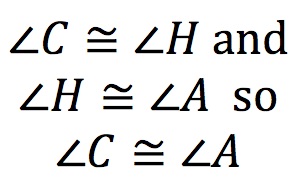
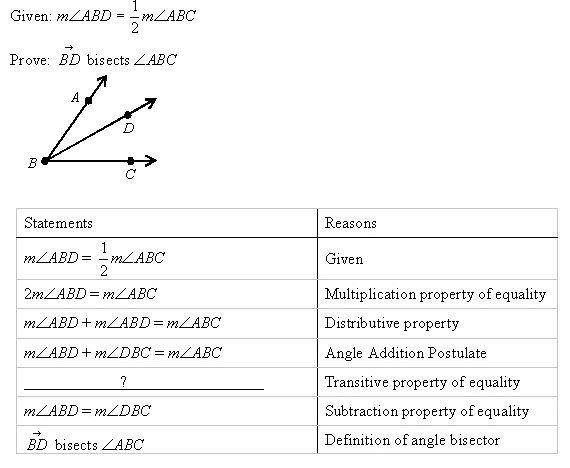


Given: B is the midpoint of AC. What should you conclude?
AB + BC = AC
AB = BC
A is the segment bisector of BC
ABC is a straight angle
Which of the following is an example of the transitive property?
If x = 5 and and x = y, then y = 5.
If x = y then y = x
x = x
If 2x + 4 = 2, then x = -1


What is the justification?
Definition of congruence
Reflexive Property of Congruence
Segment Addition Postulate
Definition of Midpoint

What is the justification?
Transitive Property of Equality
Subtraction Property of Equality
Division Property of Equality
Substitution Property of Equality

Multiplication Property of Equality
Segment Addition Postulate
Definition of Midpoint
Symmetric Property of Congruence

What is the justification?
Definition of Congruence
Segment Addition Postulate
Transitive Property of Congruence
Definition of Midpoint

Match the following. #30
C is the midpoint of AE
Given 1
AE ≅ EC
Def. of Midpoint
∠BCA≅∠DCE
Vertical Angle Theorem
BC ≅ DC
Given 2
△ABC≅△EDC
and
∠A≅∠E
SAS
CPCTC

Which two angles are supplementary
∠1 and ∠3
∠2 and ∠6
∠4 and ∠6
∠7 and ∠8

Which two angles are alternate exterior?
1 & 3
2 & 6
4 & 7
7 & 1

Which of the following two angles are congruent?
1 & 4
4 & 5
1 & 5
7 & 8

Which two angles are corresponding?
4 and 8
4 and 6
1 and 2
2 and 8

If angle 2 is 70 degrees, what is the measure of angle 1?
70 degrees
20 degrees
110 degrees
180 degrees

If angle 2 is 70 degrees, what is the measure of angle 4?
70
110
20
180


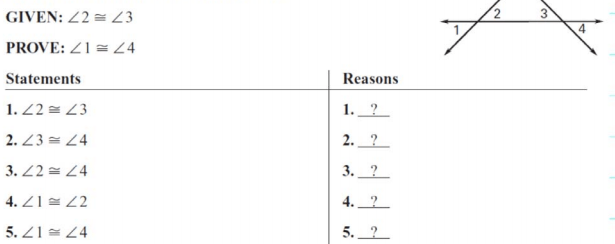
Match the following statement with its reason to complete the proof
Given
<1 congruent to <2
Vertical Angles Theorem
<2 congruent to <3
Transitive Property
<1 congruent to <3
Converse of Corresponding Angles Postulate
m is parallel to n

Solve for x.
23
-20
32
20
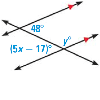


3x + 10 + 3x - 28 = 360
-18x = 180
6x + 18 = 180
6x - 18 = 180

Angles that lie on opposites sides of the transversal and outside of the parallel lines.
Alt. Int. Angles
Vertical Angles
Alt. Ext. Angles
Same-Side Int. Angles

To plot a point: Start at the origin and go...
right then up
up then right
down then right
The coordinate (0,0) is also called the ___.
y-axis
x-axis
origin
Which axis runs horizontally (left and right)?
x-axis
y-axis
Which axis runs vertically (up and down)?
x-axis
y-axis
Which is the Y coordinate of (4, 9)?
4
9
In the coordinate points (2, 7) the 2 represents ___.
the Y coordinate
the origin
the X coordinate
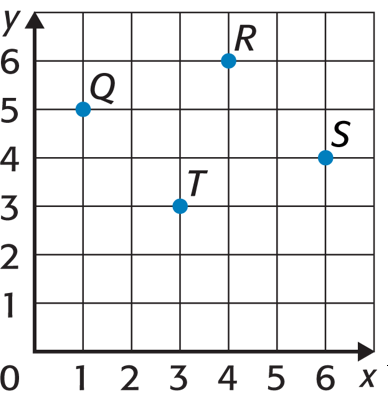
Which letter is located at (4, 6)?
Q
R
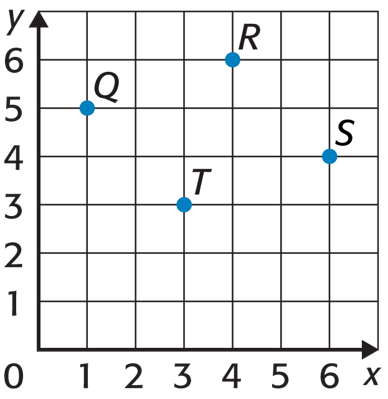
The coordinates for Point S are ( __ , __ )
(4, 6)
(6, 4)
How do you write an ordered pair?
(X, X)
(Y, X)
(X, Y)
(Y, Y)
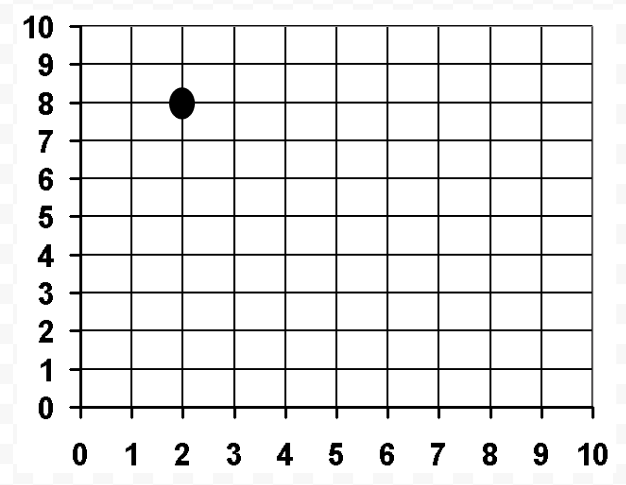
What is the ordered pair?
(8, 2)
(2, 7)
(2, 8)
The coordinates for the origin are ( __ , __ )
(1, 1)
(0, 0)

What are the coordinates of point X?
(5, 5)
(2, 3)
(4, 4)

What are the coordinates for point R?
(2, 5)
(0, 1)
(1, 0)
The ORIGIN is located at-
(1,1)
(0,0)
(0,1)
(1,0)

What is the ordered pair of point E?
(2,5)
(5,2)
(3, 4)
What is the ordered pair of point B?
(2,2)
(8,2)
(2,8)
To plot a point: Start at the origin and go...
right then up
up then right
down then right
The coordinate (0,0) is also called the ___.
y-axis
x-axis
origin
Which axis runs horizontally (left and right)?
x-axis
y-axis
Which axis runs vertically (up and down)?
x-axis
y-axis
Which is the Y coordinate of (4, 9)?
4
9
In the coordinate points (2, 7) the 2 represents ___.
the Y coordinate
the origin
the X coordinate
Which letter is located at (4, 6)?
Q
R
The coordinates for Point S are ( __ , __ )
(4, 6)
(6, 4)
How do you write an ordered pair?
(X, X)
(Y, X)
(X, Y)
(Y, Y)

