
 Worksheets
Mammal's Nervous System Quiz
Total questions: 30
Worksheet time: 17mins
What is the main function of a mammal's nervous system?
To produce hormones
To transmit information to the brain
To control muscle movement
To regulate body temperature
What is the role of the peripheral nervous system in a mammal's body?
To transmit signals to the brain
To maintain homeostasis
To control muscle movement
To process sensory information
What is the evolutionary significance of the mammalian nervous system?
It has remained unchanged over millions of years
It has allowed mammals to survive in a competitive environment
It has become less complex over time
It has no impact on mammalian survival
Which of the following is not one of the traditional five senses?
Taste
Magnetism
Sound
Sight
What is the advantage of sound over sight in terms of information gathering?
It can give exact information over long distances
It works well in the dark
It can detect small molecules
It can supply directional information
Which group of mammals are experts at using sound echoes to gain information about the world?
Lions and Tigers
Dolphins and Elephants
Wolves and Bears
Bats and Whales
What is the primary function of taste in mammals?
Determining the edibility of an object
Supplying directional information
Detecting bad weather
Communicating using vibrations
Which sense is important to nocturnal mammals and those that live in dense vegetation?
Touch
Taste
Sound
Smell
What is the possible explanation for mammals being able to detect bad weather and earth tremors approaching?
They can use the detection of magnetic fields
They can sense vibrations travelling through the earth
They have a better sense of smell
They have a better sense of touch
What is the reason why we cannot see the wing beats of a fly as it flies?
The fly is too small
The fly moves too fast
The fly's wings move too quickly
The fly's wings move too slowly
Which animals can distinguish shorter periods of time than mammals?
Dogs
Cats
Reptiles
Birds
What is the term for the daily cycles linked to our body's metabolism?
Circadian rhythms
Biological clocks
Metabolic cycles
Time perception
What is a stimuli?
a thing or event that evokes a specific functional reaction in an organ or tissue.
What is a neuron?
What is the advantage of sound over sight in terms of information gathering?
It can give exact information over long distances
It works well in the dark
It can detect small molecules
It can supply directional information
Which group of mammals are experts at using sound echoes to gain information about the world?
Lions and Tigers
Dolphins and Elephants
Wolves and Bears
Bats and Whales
Which sense is important to nocturnal mammals and those that live in dense vegetation?
Touch
Taste
Sound
Smell
What is the possible explanation for mammals being able to detect bad weather and earth tremors approaching?
They can use the detection of magnetic fields
They can sense vibrations travelling through the earth
They have a better sense of smell
They have a better sense of touch
What is the minimum time span of human perception of time?
One hundredth of a second
One tenth of a second
One twentieth of a second
One thirtieth of a second
What is the reason why we cannot see the wing beats of a fly as it flies?
The fly is too small
The fly moves too fast
The fly's wings move too quickly
The fly's wings move too slowly
Which animals can distinguish shorter periods of time than mammals?
Dogs
Cats
Reptiles
Birds
What is the term for the daily cycles linked to our body's metabolism?
Circadian rhythms
Biological clocks
Metabolic cycles
Time perception

what kind of receptor is stimulated here?
baroreceptor
chemoreceptor
mechanoreceptor
thermoreceptor

what kind of receptor is stimulated here?
photoreceptor
chemoreceptor
mechanoreceptor
thermoreceptor
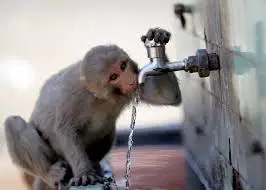
what kind of receptor is stimulated here?
photoreceptor
osmoreceptor
chemoreceptor
thermoreceptor

what kind of receptor is stimulated here?
photoreceptor
thermoreceptor
chemoreceptor
mechanoreceptor

what kind of receptor is stimulated here?
photoreceptor
thermoreceptor
chemoreceptor
mechanoreceptor

what kind of receptor is stimulated here?
mechanoreceptor
thermoreceptor
chemoreceptor
photoreceptor

This part of the neuron receives chemical messages from the neurotransmitters of other neurons. It is labeled A in the diagram.
Dendrite
Axon
Axon Terminal
Cell Body

