
 Worksheets
Chapter 8: Earth's Waters
Total questions: 25
Worksheet time: 13mins
Name
Class
Date
1.
A(n) is all the land area that supplies water to a river system.
a)
water shed
b)
delta
c)
artesian well
d)
aquifer
2.
A(n) ________ is a place where ground water bubbles or flows out of cracks in rocks.
a)
aquifer
b)
natural spring
c)
artesian well
d)
glaciers
3.
Which of the following is NOT an example of surface water?
a)
ponds and lakes
b)
aquifers
c)
wetlands
d)
glaciers
4.
Clouds represent which step of the water cycle?
a)
transpiration
b)
evaporation
c)
precipitation
d)
condensation
5.
Water has some unique properties because it is
a)
polar
b)
non-polar
c)
a universal solute
d)
ionic
6.
A(n) ________ is a large piece of a glacier that has broken off and calved into the ocean.
a)
delta
b)
aquifer
c)
ice cube
d)
iceberg
7.
Which of the following lists the world's oceans from LARGEST to SMALLEST?
a)
Arctic, Southern, Indian, Atlantic, Pacific
b)
Pacific, Arctic, Indian, Southern, Atlantic
c)
Pacific, Atlantic, Indian, Southern, Arctic
d)
Atlantic, Indian, Pacific, Arctic, Southern
8.
_________ is the measure of the mass of dissolved solids in a mass of water.
a)
density
b)
saltiness
c)
salinity
d)
surface tension
9.
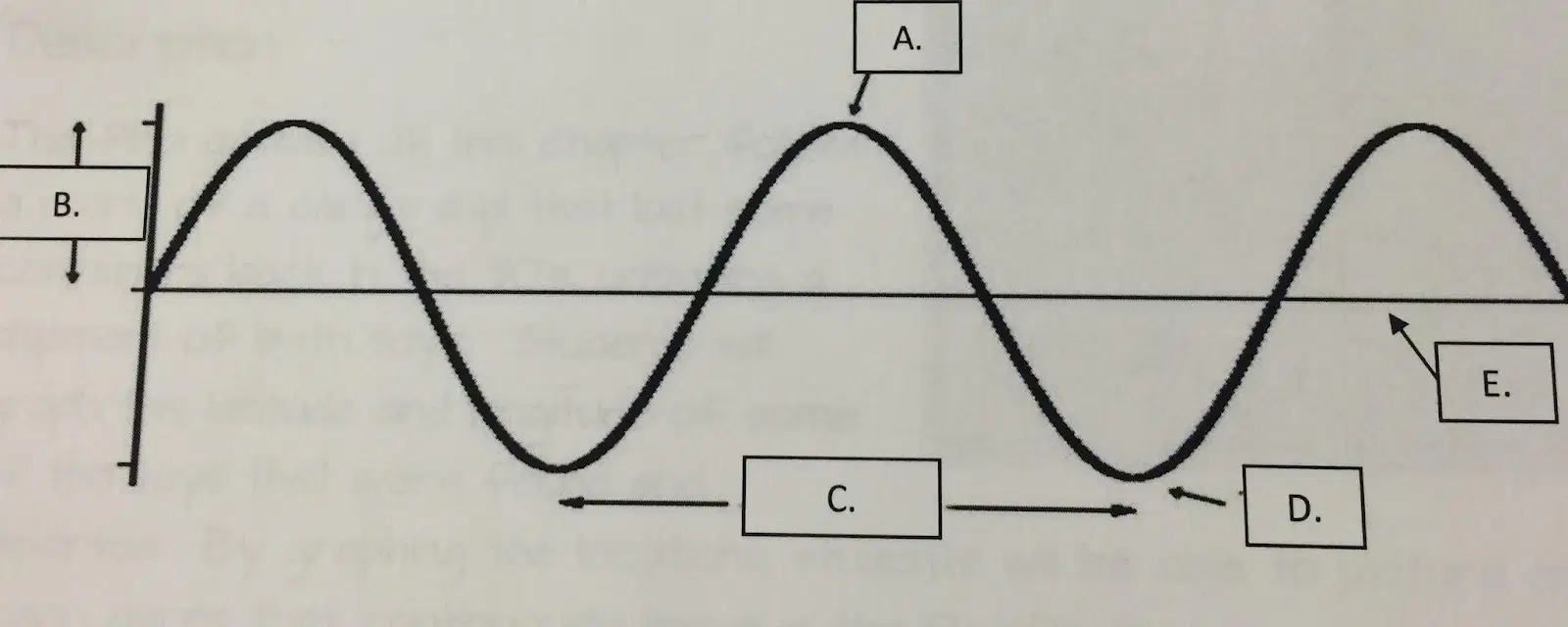
Which of the following is labeled A in the figure below?
a)
crest
b)
trough
c)
wavelength
d)
amplitude
10.
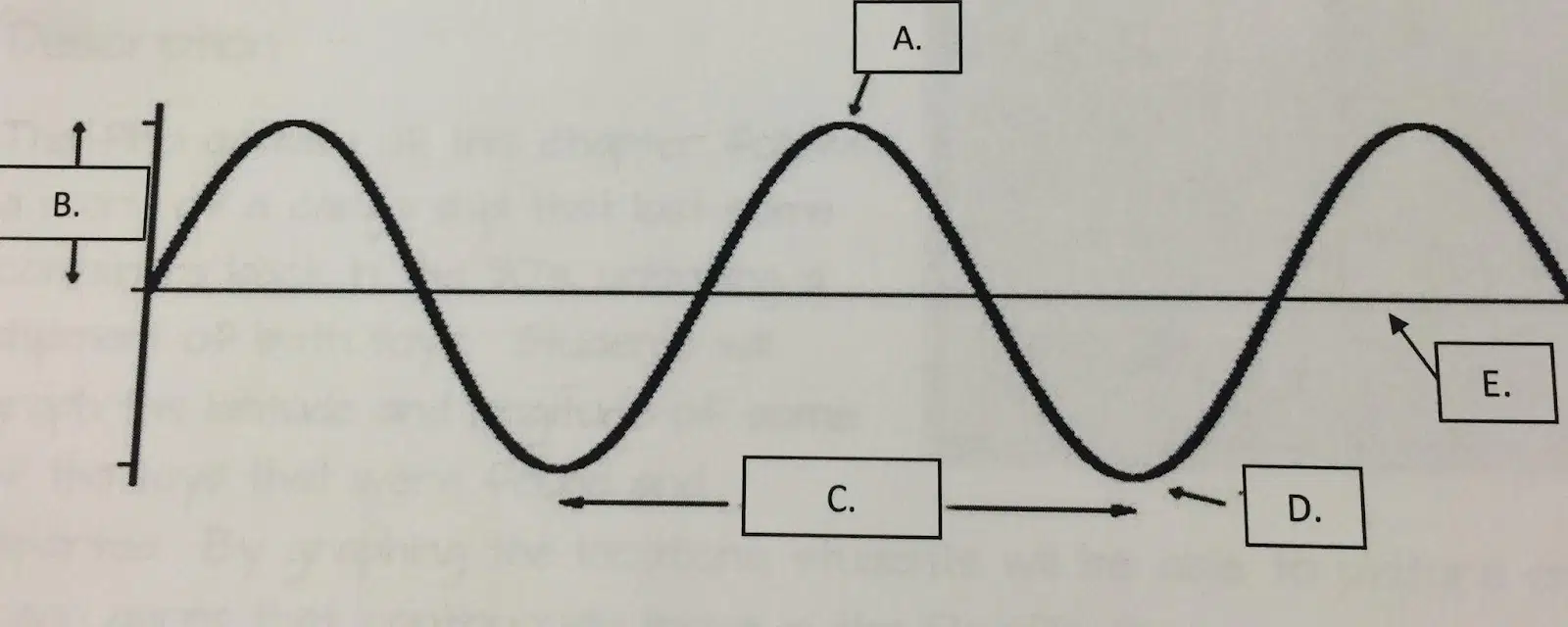
Which of the following is labeled B in the figure below?
a)
wavelength
b)
amplitude
c)
crest
d)
trough
11.
The ________ Ocean makes up 20% of the Earth's surface and is 1/2 the size of the Pacific Ocean.
a)
Atlantic
b)
Arctic
c)
Southern
d)
Indian
12.
________ % of the Earth's water is salt water in the ocean.
a)
75
b)
3
c)
97
d)
50
13.
The ________ ocean is larger than all Earth's land mass put together, and is the deepest ocean.
a)
Arctic
b)
Indian
c)
Pacific
d)
Atlantic
14.
________ is the property of water which causes it to have a skin and hold up small objects.
a)
Universal solvent
b)
Surface tension
c)
Capillary action
d)
Polarity
15.
The energy that drives the water cycle comes from the
a)
sun
b)
moon
c)
tides
d)
currents
16.
Which of the following lives in the dark zone?
a)
rat-tail fish
b)
tripod fish
c)
oarweed
d)
mackerel
17.
Which of the following lives in the sunlit zone?
a)
anglerfish
b)
man-of-war
c)
octopus
d)
brittle star
18.
Most of the Earth's fresh water is caught up in ________, frozen rivers of water.
a)
snowbanks
b)
ice cubes
c)
glaciers
d)
icebergs
19.
Water is able to travel up stems to leaves in a plant. This is an example of _________.
a)
condensation
b)
tension
c)
dissolving
d)
capillary action
20.
A___________ is a type of hot spring which begins to rise through narrow passages being forced out by heated gases and steam from below.
a)
artesian well
b)
aquifer
c)
geyser
d)
natural spring
21.
The process that produces water vapor from bodies of water is
a)
condensation
b)
precipitation
c)
evaporation
d)
exasperation
22.
A(n) _________ is a layer of rock and sediment that holds water.
a)
wetland
b)
cave
c)
pond
d)
aquifer
23.
Plants release water through their leaves during
a)
condensation
b)
evaporation
c)
transpiration
d)
precipitation
24.
All freshwater on Earth comes from
a)
evaporation
b)
run-off
c)
condensation
d)
precipitation
25.
After precipitation, the remaining water that does not soak into the soil flows over the ground surface and is called
a)
run-off
b)
aquifer
c)
stream
d)
artesian well
100 %

