wayground logo

Free Printable Worksheets

NEW

Font size

S
M
L
XL
Worksheets

Relations and Functions Practice!

Total questions: 50

Worksheet time: 8hrs 12mins

Name
Class
Date
1.

What is the definition of function?

a)

Has inputs and outputs

b)

Every input has only ONE output

c)

Inputs have different outputs every time

d)

x-values and y-values

2.
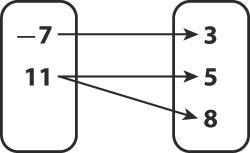
Is the relation a function? Why.
a)
Yes, because the x-value 11 has two y-values pair with it.
b)
Yes, because each x-value has only one y-value paired with it.
c)
No, because the x-value 11 has two y-values pair with it.
d)
No, because each x-value has only one y-value paired with it.
3.
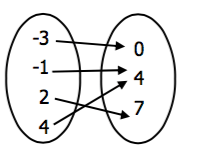
Is this mapping a function or not a function? 
a)
Function
b)
Not a Function 
4.
Is this table a function or not a function? 
a)
Function
b)
Not a Function
5.
Which set of values is a function?
a)
(9,5) (10,5) (9,-5) (10,-5)
b)
(3,4) (4,-3) (7,4) (3, 8)
c)
(6,-5) (7, -3) (8, -1) (9, 1)
d)
(2, -2) (5, 9) (5, -7) (1, 4)
6.
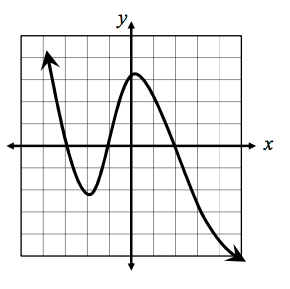
Is this graph a function or not a function? 
a)
Function 
b)
Not a Function
7.
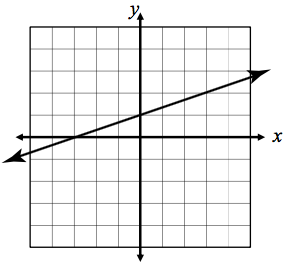
Which graph does NOT pass the vertical line test?
a)
Graph 1
b)
Graph 2
c)
Graph 3
d)
Graph 4
8.
.
a)
Function
b)
Not a Function
9.
Is this is a function or not a function?
a)
Function
b)
Not a Function
10.
Is this a function or not a function?
a)
Function
b)
Not a Function
11.

Which of the following is a function?

a)
b)
c)
d)
12.

Which of the following is a function?

a)

A

b)

B

c)

C

d)

D

13.

Is the following a function?

a)

Yes, this is a function.

b)

No, it's not a function.

c)

Can't be determined with this information.

14.

Is the following graph a function?

a)

Yes, because the x never repeats.

b)

Yes, because they are individual dots.

c)

No, because the x repeats.

d)

No, because it is not a line.

15.

Which is a function?

a)

W

b)

X

c)

Y

d)

Z

16.

Which is a function?

a)

A

b)

B

c)

C

d)

D

17.
a)
Function
b)
Not a Function
18.
Which set of values is a function?
a)
(9,5) (10,5) (9,-5) (10,-5)
b)
(3,4) (4,-3) (7,4) (3, 8)
c)
(6,-5) (7, -3) (8, -1) (9, 1)
d)
(2, -2) (5, 9) (5, -7) (1, 4)
19.
Is this graph a function or not a function? 
a)
Function
b)
Not a Function
20.
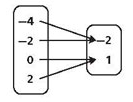
Give the domain and range. Tell if it is a function.
a)
D: {-4, -2, 0, 2}
R: {-2, -2, 1, 1}
Function
b)
D: {-4, -2, 0, 2}
R: {-2, 1}
Function
c)
D: {-4, -2, 0, 2}
R: {-2, -2, 1, 1}
Not a Function
d)
D: {-4, -2, 0, 2}
R: {-2, 1}
Not a Function
21.
All of the y values or outputs are called what?
a)
Domain
b)
Range
c)
Relation
d)
Function
22.
All of the x values or inputs are called what?
a)
Domain
b)
Range
c)
Relation
d)
Function
23.
For the function {(0,1), (1,-3), (2,-4), (-4,1)}, write the domain and range.
a)
D: {1, -3, -4,}
R: {0, 1, 2, -4}
b)
D:{0, 1, 2, -4}
R:{1, -3, -4}
c)
D:{0, 1, 2, 3, 4}
R:{1, -3, -4}
24.
Which set of values is a function?
a)
(9,5) (10,5) (9,-5) (10,-5)
b)
(3,4) (4,-3) (7,4) (3, 8)
c)
(6,-5) (7, -3) (8, -1) (9, 1)
d)
(2, -2) (5, 9) (5, -7) (1, 4)
25.

Identify the domain of the following relation:

a)

-6, 14, 2, 28

b)

(-6,14), (0,32), (2,38), (4,44)

c)

{-6, 0, 2, 4}

d)

14, 32, 38, 44

26.
What is the range of the following relation:
(9, -2) (4, 3)  ( 8, 10) ( -4, 8)
a)
-4, 4, 8, 9
b)
-2, 3, 8, 10
c)
(9, -2) ( 4, 3)
d)
(8, 10) (-4, 8)
27.
A set of ordered pairs is called what?
a)
Coordinates
b)
Relation
c)
Function
d)
Vertical Line Test
28.
Given the points (3, 5) (2, 4) (9, 0)  and  (?, 6). What could replace the ? to create a non-function? 
a)
1
b)
3
c)
4
d)
7
29.
Which ordered pair could you add to the following list of points to create a function?  (3, 5) (4, 9) (2, 5) 
a)
(3, 7)
b)
(4, 1) 
c)
(1, 9)
d)
(2, 6)
30.
What is the Domain?
a)
{-3, -1, 1, 3, 5, 7, 9}
b)
{-3, -2, -1, 0, 1, 2, 3}
c)
-3 ≤ x ≤ 3
d)
-3 ≤ x ≤ 9
31.

What is the input?

a)

0, 4, 10, 12

b)

1, 2, 4, 5, 10, 12

c)

0, 4, 10, 4, 12

d)

1, 2, 5

32.

What variable typically represents the domain?

a)

x

b)

y

33.

What variable typically represents the range?

a)

x

b)

y

34.

What is the range?

a)

{1, 2, 3, 5}

b)

{-1, -2, -3, -4, -5}

c)

{1, 2, 3, 4, 5}

d)

{-1, -2, -4, -8, -16}

35.

What is the range?

a)

{0, 1, 2, 15}

b)

(0, 1, 2, 3}

c)

{3, 7, 11, 15}

d)

{3, 7, 11, 3}

36.

What is the domain?

a)

{1, 2, 3, 5}

b)

{-1, -2, -3, -4, -5}

c)

{1, 2, 3, 4, 5}

d)

{-1, -2, -4, -8, -16}

37.

What is the domain?

a)

{5, 10, 15}

b)

{(5,2), (5,4), (10,6), (15,8)}

c)

{2, 4, 6, 8}

d)

{5, 2, 4, 10, 15}

38.

What is the range?

a)

{1, 2, 3, 4, 5, 6}

b)

{0, 1, 2, 3, 4, 5, 6}

c)

{2, 4, 8}

d)

{-1, 0, 1, 2, 3, 6}

39.

What is the domain?

a)

{1, 2, 3, 4, 5, 6}

b)

{0, 1, 2, 3, 4, 5, 6}

c)

{2, 4, 8}

d)

{-1, 0, 1, 2, 3, 6}

40.
Does this mapping diagram represent a function?
a)
No, because an input value goes to multiple output values
b)
Yes, because each input goes to one and only one output
41.
Which set of values is a function?
a)
(9,5) (10,5) (9,-5) (10,-5)
b)
(3,4) (4,-3) (7,4) (3, 8)
c)
(6,-5) (7, -3) (8, -1) (9, 1)
d)
(2, -2) (5, 9) (5, -7) (1, 4)
42.
Is this graph a function or not a function? 
a)
Function 
b)
Not a Function
43.
Is this graph a function or not a function? 
a)
Function
b)
Not a Function
44.
Is this graph a function or not a function? 
a)
Function
b)
Not a Function
45.
The graph represents a...
a)
Function
b)
Non-Function
46.
The graph represents a...
a)
Function
b)
Non-Function
47.
The graph represents a...
a)
Function
b)
Non-Function
48.
The graph represents a...
a)
Function
b)
Non-Function
49.
The graph represents a...
a)
Function
b)
Non-Function
50.
A set of ordered pairs is called what?
a)
Coordinates
b)
Relation
c)
Function
d)
Vertical Line Test