
 Worksheets
Honors Science - Fall Interim Review Unit 1
Total questions: 77
Worksheet time: 1hrs 27mins

Matter is made of tiny particles called atoms and molecules.
True
False

Which of the following statements about the particle theory of matter is incorrect?
All matter is made up of tiny particles.
All substances are made of the same particles.
The particles can move when they are heated.
Particles are held together by strong electrical forces.

State of matter that takes the shape of it's container and has a definite volume.
Solid state
Liquid state
Gas state
Plasma state

State of matter that can fill containers with no fixed shape or volume.
Solid state
Liquid state
Gas state
Plasma state

State of matter in which materials have a definite shape and volume.
Solid state
Liquid state
Gas state
Plasma state
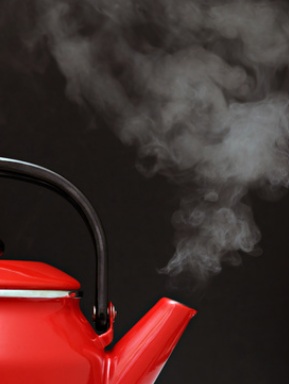
What change of state is taking place in this photograph?
Condensation
Freezing
Vaporization
Melting

What change of state is taking place in this photograph?
Condensation
Freezing
Vaporization
Melting

The diagram shows the changes in state of water (H2O). What is the process Z called?
Condensation
Freezing
Vaporization
Melting

Which of the following is a property of gases?
They have a definite volume.
They are not compressible.
They have no definite shape.
They have no ability to flow.

When a beaker of water is heated its volume increases a little. What is happening to the particles in the liquid?
They are getting bigger.
They are moving slower.
They are moving faster.
They are getting smaller.

When you place a bottle of water in the freezer its volume increases. What is happening to the particles in the liquid?
They are getting bigger.
They are moving slower.
They are moving faster.
They are getting smaller.

Which is NOT a property of a solid?
They do not flow.
Definite volume.
No definite shape.
They are incompressible.

Which state of matter is represented in the following diagram?
Liquid
Liquid and gas
Gas
Solid

Which of the following states is correct?
Gases cannot be compressed.
Solids are easily compressed.
Gases are easier to compress than solids.
Liquids cannot be compressed or expanded.

Which change of state occurs when particles in a solid begin to move slowly past each other?
Melting
Freezing
Condensing
Vaporizing

The melting point of the sample is
-60 ºC
-100 ºC
60 ºC
100 ºC

What term goes on the y-axis? (A)
Heat(Energy)
Temperature
Phase
Type of Matter
What phase of matter exists in part C of the graph?
Gas
Liquid
Solid
Plasma
On which parts of the graph does the temperature remain the same?
Between C and D
Between D and E
At C, D, or E
On both flat sections
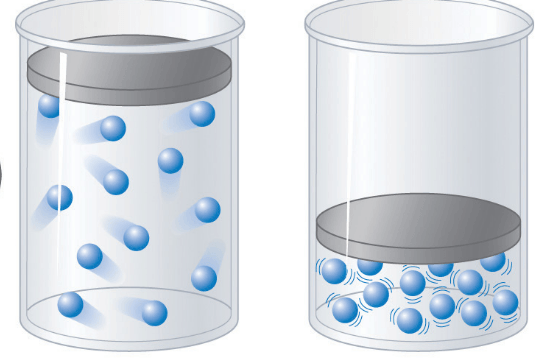

Which one is the correct properties of gases?
Pressure, Volume, Temperature, Plasma
Pressure, Volume, Temperature, Mass
Solid, Liquid, Gas

What relationship is shown in this graph?
As pressure increases, volume also increases
As temperature increases, volume decreases
As pressure increases, volume decreases
As temperature decreases, volume decreases
If you increase the pressure on a fixed amount of gas in a sealed syringe at constant temperature, what happens to the volume of the gas?
increases
decreases
stays the same

If we decrease the pressure on this gas, what will happen to the volume?
The volume will decrease
The volume will increase
The volume will not be affected
If a hairspray can is heated, what can be expected of the pressure of the gas inside the can?
The pressure will increase
The pressure will decrease
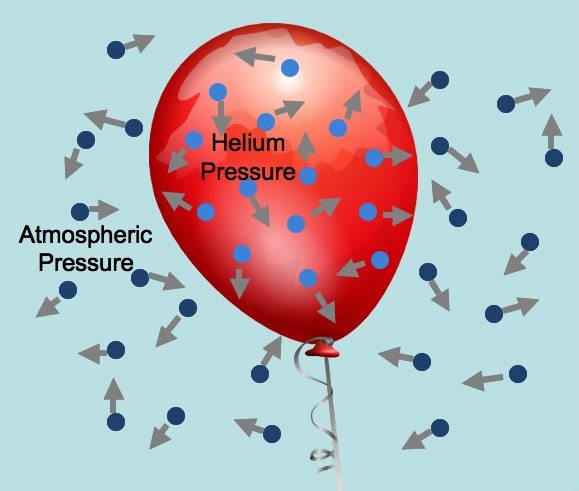
State of matter that takes the shape of it's container and has a definite volume.
Solid state
Liquid state
Gas state
Plasma state
State of matter that can fill containers with no fixed shape or volume.
Solid state
Liquid state
Gas state
Plasma state
State of matter in which materials have a definite shape and volume.
Solid state
Liquid state
Gas state
Plasma state
The diagram shows the changes in state of water (H2O). What is the process Z called?
Condensation
Freezing
Vaporization
Melting
When a beaker of water is heated its volume increases a little. What is happening to the particles in the liquid?
They are getting bigger.
They are moving slower.
They are moving faster.
They are getting smaller.
When you place a bottle of water in the freezer its volume increases. What is happening to the particles in the liquid?
They are getting bigger.
They are moving slower.
They are moving faster.
They are getting smaller.
Which state of matter is represented in the following diagram?
Liquid
Liquid and gas
Gas
Solid
Which change of state occurs when particles in a solid begin to move slowly past each other?
Melting
Freezing
Condensing
Vaporizing
The total energy of the movement of particles is called...
mechanical energy
kinetic energy
potential energy
thermal energy

How much KNO3 solute is saturated at 40 degrees?
75
55
65
85
How much C12H22O11 solute is saturated at 40 degrees?
240
220
230
250
How much Ce2(SO4)3 solute is saturated at 80 degrees?
20
15
30
2

Which solute is MOST likely a gas?
KNO3
NaNO3
KCl
Ce2(SO4)3
At what temperature can you fully dissolve 140g of NaNO3?
62
73
81
You cannot determine this
At what temperature can you fully dissolve 60g of KNO3?
27
30
37
You cannot determine this
What type of a solution is 60g NaNO3 at 40ºC in 100g H2O?
Saturated
Unsaturated
Supersaturated
What type of a solution is 100g KNO3 at 40ºC in 100g H2O?
Saturated
Unsaturated
Supersaturated
What type of a solution is 260g sugar at 50ºC in 100g H2O?
Saturated
Unsaturated
Supersaturated
What type of a solution is 25g NaCl at 70ºC in 100g H2O?
Saturated
Unsaturated
Supersaturated
A dilution is when
solute is added to the volume of solution
water is added to the volume of solution
solute is removed from the volume of solution
water is removed from the volume of solution
The ___ is the part of the solution being dissolved
solute
solvent
Which of the following is a solution?
sand
concrete
coffee
chocolate cookie
Which of the following is a solution?
salt (NaCl)
salad
blood
Oxygen gas (O2)
Which of the following is not a solute?
coffee grounds
Kool Aid powder
food die in water
paint thinner
Which of the following factors affects the solubility amount & rate of solubility?
temperature
surface area
agitation
amount of solvent


Which would NOT increase the rate at which a sugar cube dissolves?
Reducing the amount of solvent
Crushing the sugar cube
Stirring the solution
Heating the solvent
You can make a solute dissolve more quickly in a solvent by
adding more solute.
adding ice.
heating the solvent.
removing some solvent.
The amount of solute that can be dissolved in a specific amount of solvent at a given temperature is its
concentration.
density.
dilution.
solubility.

Three 10 g samples of sugar are represented below.
Sample A dissolves in water more slowly than sample B.
Sample B dissolves more slowly than sample C.
Which of the following best explains why sample A dissolves more slowly than the other two?
It has the most volume.
It has the smallest surface area.
It has the largest number of sugar molecules.
It has the fewest bonds between sugar modules.
A student pours mineral salts into a bottle of cold water. Which of the following best explains why shaking the bottle will affect the dissolving rate of the salt?
Shaking exposes the salts to the solvent more quickly.
Shaking helps more water evaporate.
Shaking equalizes the water temperature.
Shaking causes more ions to precipitate out of solution.

