
 Worksheets
Honors Science - Fall Interim Review Unit 2
Total questions: 187
Worksheet time: 2hrs 15mins

The vertical (up and down) columns in the Periodic Table are called
groups
towers
periods
atomic numbers
The letter, C, is a ... of carbon.
Name
Nickname
Chemical Symbol
Pseudonym
Which of the following are physical properties of metal?
Luster
Conductivity
Malleability
Ductility
True or False: The reactivity of metals tends to decrease as you move from left to right across the periodic table.
True
False
Name this group: These metals are the most reactive.


Name this group: These metals are the second most reactive.


Name this group: These metals are the second most reactive.
Name this group: These metals contain familiar metals such as gold, iron, and copper.


Name this group: These metals, located near the nonmetals, are never found uncombined in nature.


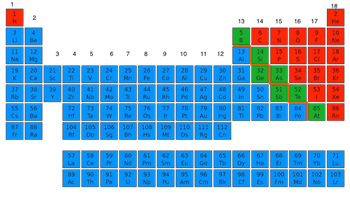
Find these groups: Locate Lanthanides and Actinides.


Which of the following could be properties of nonmetals?
Poor electrical conductivity
Poor thermal conductivity
Dullness
Brittleness
I am a metal
I am in group 2
I am in period 6
I am…
Mo
Re
S
Ba
I am a nonmetal
I am in period 2
I am in group 16/6A
Ba
Si
Ba
O
Find an element with similar chemical properties to Barium (Ba).
Ca an Ra, because they are in the same group and have similar chemical properties.
Cs and La, b/c they are in the same period number.
Ca and Y, b/c they are 90 degree angle and have similiar properties.
Why do all bonds form?
so the number of protons equals the number of electrons
so an atom can become unstable
to fill the outermost energy level
What is a cation's charge?
positive
negative
neutral
depends on the element
What is an anion's charge?
positive
negative
neutral
depends on the element's charge
Is potassium a cation or an anion?
cation
anion
How many atoms are there in the compound MgCO3?
3
4
5
6
How many atoms of sulfur are in each molecule of H2SO4?
1
4
2
7
Lithium is in group 1 of the periodic table, which ion would it form?
Li-
Li2-
Li+
Li2+
Generally, atoms form bonds so that _______________.
Each atom loses its electrons
Each atom has a stable electron configuration
Each atom has an unstable electron configuration
Each atom gains electrons
Which statements about the formation of ionic bonds in sodium chloride are true?
A sodium atom transfers its valence electron to a chlorine atom.
The oppositely charged ions attract each other in an ionic bond.
A chlorine atom accepts a valence electron from a sodium atom.
The chlorine atoms become positive ions.
The sodium atoms become negative ions.
Ionic bonds are formed from a combination of metal elements and __________________ elements.
non-metal
receive
metal
donate
In the formation of ionic bonds, the electrons will be ____________ from metal elements to non-metal elements.
oppositely
receive
transferred
donate
Atoms form ions because they want to have a (a) outer shell.
An example of an ionic compound is Sodium Chloride, which is made from Na+ and Cl- ions. Why do these ions form an ionic bond?
They have like charges
They are from the same group
They are from the same period
They have opposite charges
Oxygen is in group 6 of the periodic table, which ion would it form?
O-
O+
O2-
O2+
What two types of atoms make a covalent bond?
2 non-metals
1 metal and 1 non-metal
2 metals
pairs of electrons are shared between two non-metal atoms.
two non-metal atoms are attracted to each other by opposite charges.
Identify the following compound as ionic or covalent: SO2
ionic
covalent
Identify the following compound as ionic or covalent: Ca(OH)2
ionic
covalent
Identify the following compound as ionic or covalent: CH3COOH
ionic
covalent
What is it called if there are three pairs of electrons being shared?

What do we call the number of valence elctrons that most atoms need to become stable?
triplet
quartet
octet
heptet
What group of elements does not tend to form compounds because they already have an octet?
metalloids
halogens
noble gases
metals
What kind of bond forms when nonmetal/metalloid atoms share electrons with each other?
metallic bond
ionic bond
covalent bond
Nitrogen and Oxygen will make a ____________ bond
ionic
covalent
metallic


What type of bond does nitrogen gas form?
ionic
single covalent
double covalent
triple covalent

What type of bond does oxygen gas form?
ionic
single covalent
double covalent
triple covalent

Have a low melting point (< 200°C)
Which of the following describes covalent bonds?
Bonds form because of opposite charges
electrons are shared to fill outer electron shells
Electrons are transferred between atoms
Covalent bonds are magical
What two types of atoms make a covalent bond?
2 Nonmetals
1 Nonmetal and 1 Metal
2 Metals
2 Noble Gases
A material that has a low boiling point
Ionic
Covalent
Both
Cl2
Ionic
Covalent
Both
The valence electrons are shared when the outermost orbitals overlap.
Ionic
Covalent
Both
2

Can be brittle or hard
ionic
covalent
Oppositely-charged ions attract each other
ionic
covalent
Electrons are equally shared
non-polar covalent
polar covalent
ionic
Electrons are unequally shared
non-polar covalent
polar covalent
ionic
Which has the greater electronegativity: H or F?
LiBr is called
lithium bromine
lithium (I) bromine
lithium bromide
lithuim (I) bromide
Which of these combinations is an ionic compound made of?
Metal and Metal
Nonmetal and Nonmetal
Metal and Nonmetal
Cation and Cation
Name the following ionic compound: BeCl2
beryllium chlorine
beryllium II chloride
beryllium chloride
beryllium dichloride
Name the following ionic compound: Cs2S
cesium sulfide
cesium sulfate
cesium II sulfate
cesium II sulfide
When naming a compound, which of these is written first?
Metal
Nonmetal
Anion
Cation
The number that tells you if an ion has lost or gained electrons
atomic number
oxidation number
mass number
electron number
If I gain electrons I become
Positive because I've added to my atom
negative because I've added electrons
same because i'm balanced
equal because now I have electrons
Name for NaH
sodium hydrogen
potassium hydride
sodium hydride
potassium hydrogen
Formula for barium sulfide
B2S3
BaS
Ba2S
BaS2
Name for PBr2
phosphorus bromide
phosphorus dibromide
phosphorus dibromine
phosphorus bromine
Formula for Disilicon Heptasulfide
SiS6
SiS7
Si2S6
Si2S7
Name for SrBr2
strontium bromine
strontium bromide
strontium dibromide
strontium dibromine
Name for BaO
Barium oxide
Barium monoxide
Monobarium oxide
Monobarium monoxide
Name for CO
carbon monoxide
carbon oxide
monocarbon oxide
carbide monoxide

When cations and anions join, they form what kind of chemical bond?
ionic
Metalic
Covalent

Which of the following sets of elements will MOST LIKELY form an ionic bond?
He, O
Na, F
Na, K
Cl, F

Which compound is MOST LIKELY formed using covalent bonds?
K2O
CaBr₂
SiO₂
KBr

Which pair of elements would MOST LIKELY bond to form a covalently bonded compound?
Na and F
P and O
Ba and Cl
Mg and S
Which of the following sets of elements will MOST LIKELY form an ionic bond?
He, F
Na, Cl
Na, K
Cl, He
When two or more different elements are chemically combined, it forms a ___.
mixture
element
solution
compound


2HgO → 2Hg + O2
Al + O2 → 2Al2O3
The chemical reaction AgNO3 + NaCl --> AgCl + NaNO3 is a
single displacement
double displacement
composition
decomposition
2HgO → 2Hg + O2
2Mg + O2 → 2MgO
In an endothermic reaction, heat is ...
taken in
given out
A substance that increases the rate of a reaction without being used up during the reaction is called a
catalyst
product
reactant
solute

