
Font size
 Worksheets
Periodic Table Elements Quiz
Total questions: 84
Worksheet time: 3hrs 48mins
What is the atomic number of the element with the symbol 'H'?
1
4
Which element has the symbol 'O'?
Ozone
Oxygen
What is the atomic number of the element with the symbol 'Fe'?
1
26
Which element has the symbol 'Na'?
Sodium
Nitrogen
What is the atomic number of the element with the symbol 'C'?
6
123
Which element has the symbol 'Ag'?
Silver
Aluminum
What is the atomic number of the element with the symbol 'K'?
2
19
Which element has the symbol 'Mg'?
Molybdenum
Mercury
Magnesium
Manganese
What is the atomic number of the element with the symbol 'Ne'?
10
108
Which element has the symbol 'Pb'?
Lead
Mercury
What is the atomic number of the element with the symbol 'Si'?
14
100
Which element has the symbol 'Ca'?
Calcium
Cobalt
What is the atomic number of the element with the symbol 'N'?
7
117
What is the difference between the substances Co and CO?
Co is the symbol for cobalt.
They both are carbon
CO is the symbol for a substance that has two elements carbon and oxygen.
The both have calcium

What elements are in water?
Hydrogen
Helium
Carbon
Oxygen
What elements are in sodium chloride NaCl?
carbon
sodium
chlorine
silicon

What elements are in carbon dioxide ?
carbon
calcium
copper
oxygen
The smallest piece of an element:
quark
electron
shell
atom
Protons and neutrons are found in the center of the atom called the:
nucleus
neutron
shell
cell
Electrons have a _____ charge.
neutral
negative
positive
both positive and negative
The abbreviation for an element:
element name
atomic number
chemical symbol
atomic symbol
What is the sum of an atom's protons and neutrons called?
atom
atomic theory
atomic mass
atomic number
The _____ is based on the number of protons in the nucleus of the atom.
atomic structure
periodic table of the elements
atomic number
atomic mass
What subatomic particle is represented by this symbol (+):
neutron
proton
electron
What subatomic particle is represented by this charge (-):
neutron
proton
electron
All matter is made of _____.
light
energy
cells
atoms
The periodic table is ordered by which number?
atomic number
atomic mass

What is the atomic number of silicon?
14
28.0855
What is the atomic mass of silicon?
14
28.0855
What is the chemical symbol of silicon?
Si
28.0855
14
What is the name of the element?
Si
28.0855
14
Silicon
Put each state in order from particles closest together to particles farthest apart.
Solid
Liquid
Gas
What is the process that turns a solid into a liquid?
melting
freezing
evaporation
condensation
What is the process that turns a solid into a liquid?
melting
freezing
evaporation
condensation
What is the process that turns a gas into a liquid?
melting
freezing
evaporation
condensation
What is the process that turns a liquid into a gas?
melting
freezing
evaporation
condensation
What is the process that turns a liquid into a solid?
melting
freezing
evaporation
condensation
Which process requires that more energy is added to a substance for the change to occur?
melting
freezing
condensation
Which process requires that energy is removed from a substance for the change to occur?
melting
freezing
evaporation
If a liquid turns into a gas, what is happening to the amount of energy in the liquid?
It is decreasing
It stays the same
It is increasing
If a liquid turns into a solid, what is happening to the energy in the liquid?
It is decreasing
It stays the same
It is increasing
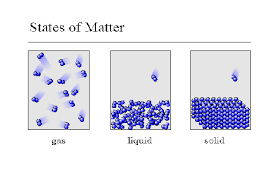

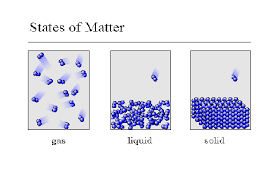

Look at the picture. Which state of matter is in beaker A?
Solid
Liquid
Gas
Blue thingys
Look at the picture. Which state of matter is in beaker C?
Solid
Liquid
Gas
Blue thingys

True or False: Atoms/ molecules in solids do not move or vibrate at all.
True
False

What causes states of matter to change?
Magnetic Energy
Thermal Energy
Gravitational Energy
Electrical Energy

When changing a substance from liquid to gas, the energy has to...
INCREASE
DECREASE
When changing a substance from liquid to solid, the energy has to...
INCREASE
DECREASE

What needs to happen for matter to melt?
Heat energy must increase.
Heat energy must stay the same.
Heat energy must decrease.

Phase change from liquid to gas is called:
Freezing
Condensation
Vaporization
Sublimation
Phase change from solid to gas is called:
Freezing
Condensation
Vaporization
Sublimation
Phase change from liquid to solid is called:
Melting
Freezing
Deposition
Condensation
Phase change from gas to liquid is called:
Melting
Freezing
Deposition
Condensation
Phase change from gas to solid is called:
Sublimation
Freezing
Deposition
Vaporization

TRUE or FALSE: Liquids have a definite volume but NOT a definite shape.
TRUE
FALSE

Which of the following statements is true about solids?
Definite shape and definite volume
NO definite shape and No definite volume
Definite shape but NO definite volume
NO definite shape but definite volume

The 4th state of matter is Plasma which is electrified gas.
TRUE
FALSE
The center of an atom is known as the
nucleus
electron cloud
neutron cloud
mass circle

What does the nucleus of an atom contain?
Electrons and neutrons
Protons and neutrons
Neutrinos and positrons
Electrons and megatrons



