

wayground logo

Free Printable Worksheets

Font size

S
M
L
XL
Worksheets

Global - Ancient Indian Civilization

Total questions: 25

Worksheet time: 13mins

Name
Class
Date
1.
Early Indian civilization was centered around what river?
a)
Tigris
b)
Indus
c)
Nile
d)
Yellow
2.
What devastating environmental occurrences are frequent in the Indus River Valley?
a)
Strong wind and monsoons
b)
Tornadoes
c)
Hurricanes
d)
Earthquakes
3.
What geographic feature protected the Indus River Valley’s Northern region?
a)
Pacific Ocean
b)
Mount Vesuvius volcano
c)
Himalayan mountains
d)
Nile river
4.
Which was a major city in the Indus River valley region?
a)
Rome
b)
Mesopotamia
c)
Harappa
d)
Mecca
5.
Why do we know so little about the Indus Valley civilization?
a)
It existed for only a few hundred years.
b)
There are few artifacts from the Indus Valley.
c)
Its written language has not yet been deciphered.
d)
It existed in a part of the world that has been largely ignored.
6.
The caste system was introduced by what group of invaders?
a)
Muslims
b)
Persians
c)
Romans
d)
Aryans
7.
What major religion teaches both reincarnation and the conformity to a caste system?
a)
Hinduism
b)
Christianity
c)
Taoism
d)
Buddhism
8.
Although researchers do not know exactly what caused the demise of Indus Valley civilizations, which of the following is a hypothesized cause?
a)
Natural disasters
b)
Population extinction
c)
Kidnapping
d)
A fire
9.
In Aryan society, the Brahmins were…?
a)
Children
b)
Teachers
c)
Priests
d)
Farmers
10.
What is the definition of Hinduism?
a)
A way of life that values material items
b)
A way to liberate its followers from illusions and mistakes of everyday life
c)
A form of praising one and only one God
d)
A way of life that promotes sinfulness and freedom
11.
What are Vedas?
a)
Books of prayer
b)
Ancient textbooks
c)
Ancient songs
d)
Farming machines
12.
Which of the following groups made up the lowest level of the caste system?
a)
Brahmins
b)
Farmers
c)
The Untouchables
d)
Teachers
13.
What major religion was founded in India, spread to China, and taught a life of happiness through getting rid of material possessions?
a)
Hinduism
b)
Christianity
c)
Taoism
d)
Buddhism
14.
Who was the founder of Buddhism?
a)
Asoka
b)
Siddhartha Gautama
c)
Mumtaz Mahal
d)
Shah Jahan
15.
Siddhartha Gautama, the founder of Buddhism, was born into a -
a)
noble family
b)
poor family
c)
family of farmers
d)
middle-class family
16.
Which event allowed Siddhartha Gautama to understand the cause of suffering?
a)
the rise of Christianity
b)
meditating under a fig tree
c)
learning under Confucius's mentorship
d)
a global plague
17.
What is one of Buddhism’s four noble truths?
a)
treat everyone with respect
b)
let go of material wealth
c)
everyone can be enlightened by taking the 8-Fold path
d)
respect your elders
18.
Why was Buddhism so appealing as a religion in India?
a)
It was low maintenance to follow
b)
It didn't recognize social distinctions based on the caste system
c)
It allowed people to keep their material things
d)
It was welcoming towards both men and women
19.

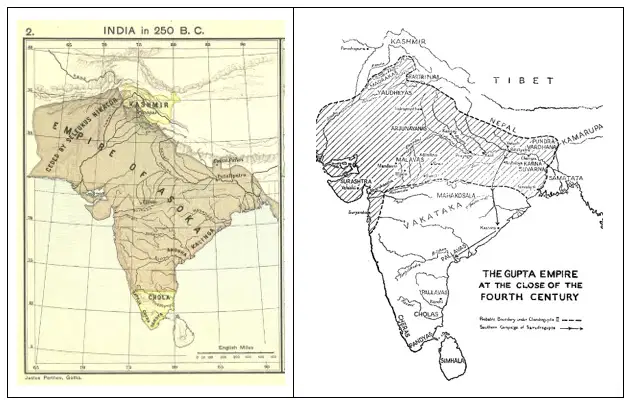
Whose rule is described in the description below?

• Created a bureaucracy in India

• Divided the empire into 4 provinces

• Hired district officials who assessed taxes and imposed laws

• Taxed citizens heavily to raise an army of men and elephants
a)
Susruta
b)
Ashoka
c)
Chandragupta Maurya
d)
Siddhartha Gautama
20.
Which Empire in India controlled the most territory?
a)
Aryan
b)
Maurya
c)
Gupta
d)
Harappan
21.

Which Indian emperor is known for spreading Buddhism beyond India and promoting non-violence?

a)

Akbar

b)

Ashoka

c)

Chandragupta Maurya

d)

Harsha

22.

Which sacred texts are considered the oldest scriptures of Hinduism?

a)

Bhagavad Gita

b)

Ramayana

c)

Vedas

d)

Upanishads

23.

What was a major achievement of the Indus Valley civilization?

a)

Development of a writing system

b)

Invention of the wheel

c)

Building the Great Wall

d)

Discovery of iron

24.

Which river valley civilization is known for its advanced urban planning and drainage systems?

a)

Chinese

b)

Egyptian

c)

Indus Valley

d)

Mesopotamian

25.

What is the primary goal of Buddhism according to its teachings?

a)

Worshipping multiple gods

b)

Conquering other nations

c)

Accumulating wealth

d)

Achieving enlightenment and ending suffering
