wayground logo

Free Printable Worksheets

Font size

S
M
L
XL
Worksheets

MIS-EXM4-23-VS5-CM-1.1

Total questions: 40

Worksheet time: 20mins
Name
Class
Date
1.
In which process do particles move closer together but remain in motion?
a)
condensation
b)
diffusion
c)
evaporation
d)
freezing
2.
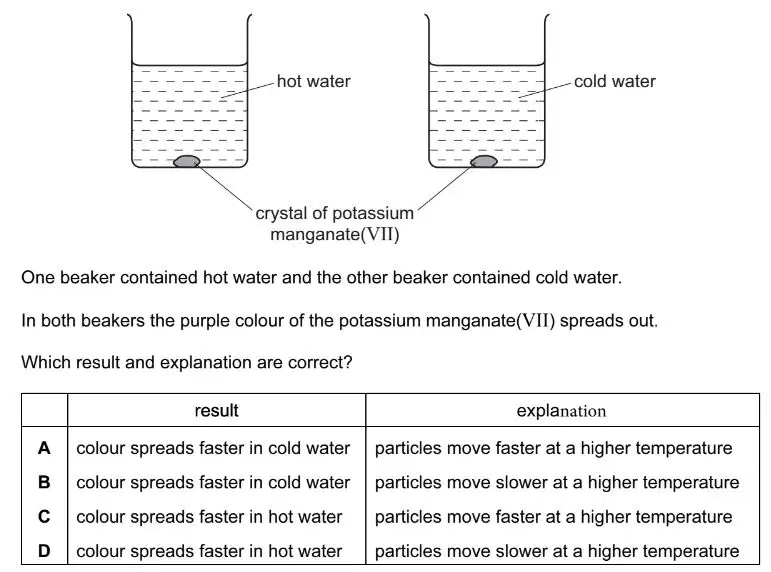
A crystal of purple potassium manganate(VII) was added to each of the beakers shown in the diagram.
a)
A
b)
B
c)
C
d)
D
3.
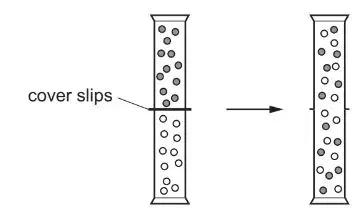
Two gas jars each contain a different gas. The gas jars are connected and the cover slips are removed. The diagram shows what happens to the particles of the gases. Which process has occurred?
a)
chemical reaction
b)
condensation
c)
diffusion
d)
evaporation
4.
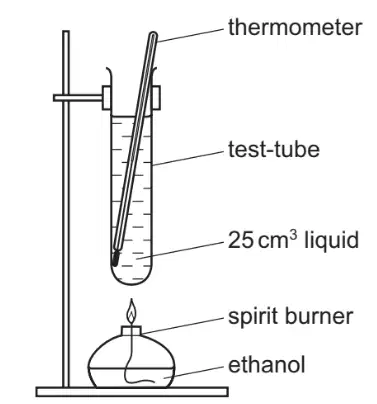
A liquid is heated until it boils. Which result shows that the liquid in the test-tube is pure water?
a)
Condensation forms at the top of the test-tube.
b)
Steam is produced.
c)
The thermometer reads 100°C.
d)
There is nothing left behind in the test-tube.
5.
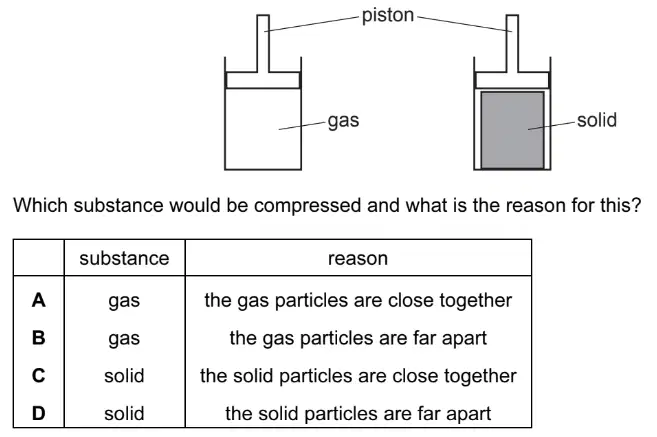
An attempt was made to compress a gas and a solid using the apparatus shown.
a)
A
b)
B
c)
C
d)
D
6.
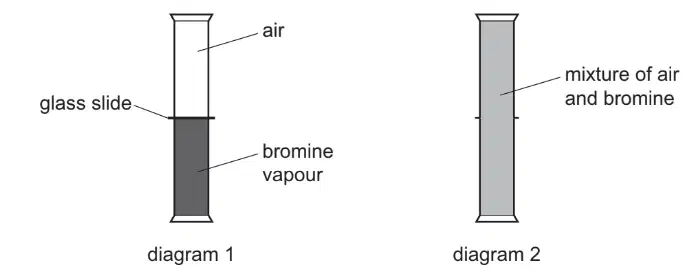
A gas jar of bromine vapour and a gas jar of air are set up as shown in diagram 1. The glass slide is removed. Diagram 2 shows the appearance of the gas jars after one hour. Which statement explains why the bromine and air mix together?
a)
Bromine is denser than air.
b)
Bromine is lighter than air.
c)
Bromine molecules moved upwards and molecules in air moved downwards.
d)
Molecules in bromine and air moved randomly.
7.
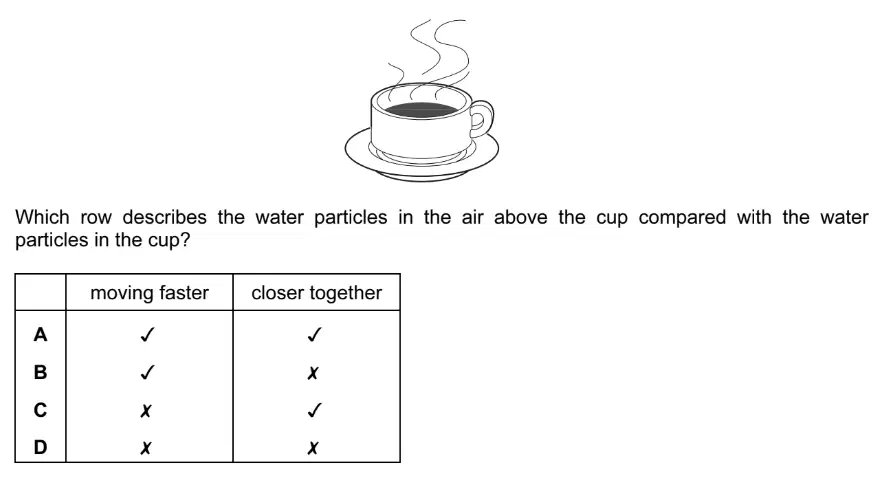
The diagram shows a cup of tea.
a)
A
b)
B
c)
C
d)
D
8.
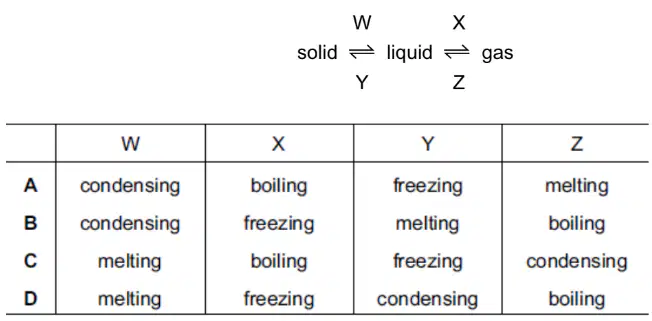
What are the processes W, X, Y and Z in the following diagram?
a)
A
b)
B
c)
C
d)
D
9.
‘Particles moving very slowly from an area of high concentration to an area of low concentration.’ Which process is being described above?
a)
a liquid being frozen
b)
a solid melting
c)
a substance diffusing through a liquid
d)
a substance diffusing through the air
10.
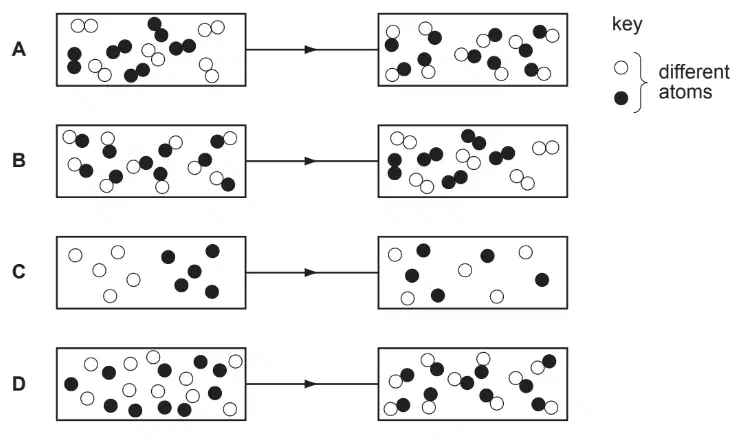
Which diagram shows the process of diffusion?
a)
A
b)
V
c)
C
d)
D
11.
In which substance are the particles close together and slowly moving past each other?
a)
air
b)
ice
c)
steam
d)
water
12.
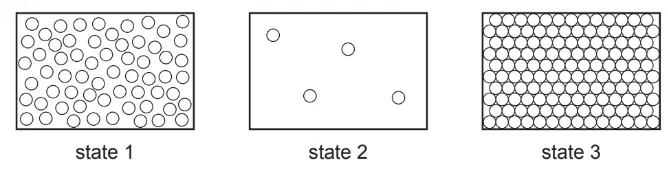
The diagrams show the arrangement of particles in three different physical states of substance X. Which statement about the physical states of substance X is correct?
a)
Particles in state 1 vibrate about fixed positions.
b)
State 1 changes to state 2 by diffusion.
c)
State 2 changes directly to state 3 by condensation.
d)
The substance in stage 3 has a fixed volume.
13.
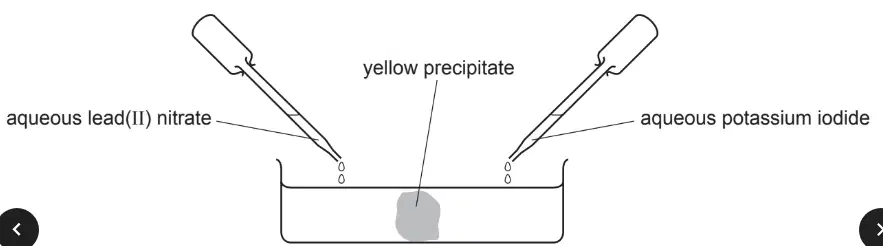
Aqueous lead(II) nitrate and aqueous potassium iodide are added to a dish containing water, as shown. A yellow precipitate forms after a few minutes. Which process occurs before the precipitate forms?
a)
diffusion
b)
distillation
c)
fermentation
d)
filtration
14.
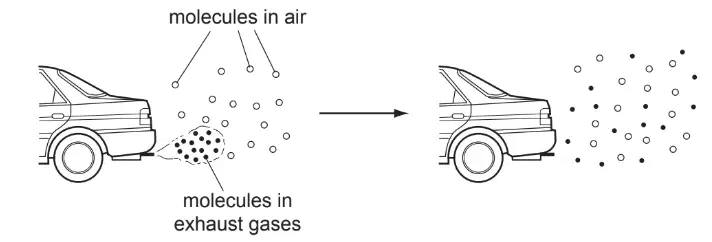
The diagram shows how the molecules in the exhaust gases diffuse into the air. Which statement describes what happens to these molecules next?
a)
The molecules fall to the ground because they are heavier than air molecules.
b)
The molecules go back together as they cool.
c)
The molecules spread further into the air.
d)
The molecules stay where they are.
15.
An aluminium atom has a nucleon number of 27 and a proton number of 13. How many neutrons does this aluminium atom contain?
a)
13
b)
14
c)
27
d)
40
16.
An atom of element Q contains 19 electrons, 19 protons and 20 neutrons. What is Q?
a)
calcium
b)
potassium
c)
strontium
d)
yttrium
17.
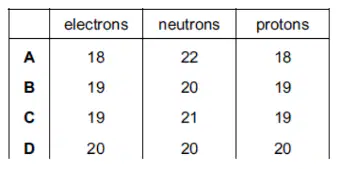
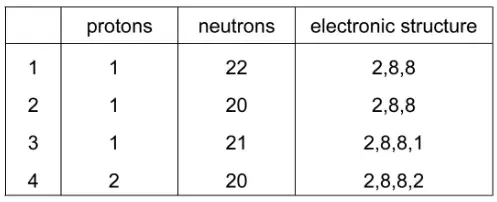
The table shows the atomic structure of four atoms. Which atom is not a metal?
a)
A
b)
B
c)
C
d)
D
18.
Which statement about atoms is correct?
a)
Atoms contain protons and electrons in the nucleus.
b)
Neutrons are negatively charged.
c)
Protons are positively charged.
d)
The nucleon number is the number of neutrons.
19.
The relative atomic mass of chlorine is 35.5. When calculating relative atomic mass, which particle is the mass of a chlorine atom compared to?
a)
a neutron
b)
a proton
c)
an atom of carbon-12
d)
an atom of hydrogen-1
20.
Atoms contain electrons, neutrons and protons. What is the definition of nucleon number?
a)
the number of neutrons in the nucleus of an atom
b)
the number of protons in the nucleus of an atom
c)
the total number of neutrons and protons in the nucleus of an atom
d)
the total number of particles in an atom
21.
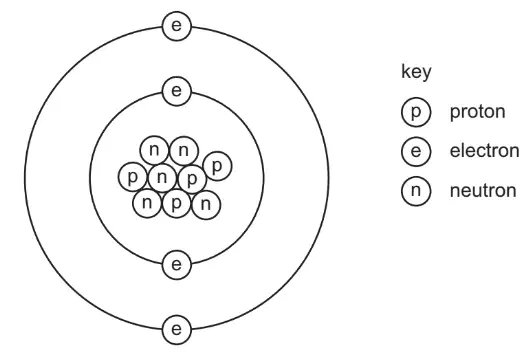
The diagram shows the atomic structure of an element X. What is X?
a)
aluminium
b)
beryllium
c)
boron
d)
fluorine
22.
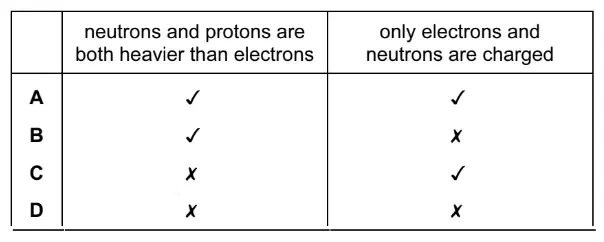
Which statements comparing the properties of electrons, neutrons and protons are correct?
a)
A
b)
B
c)
C
d)
D
23.
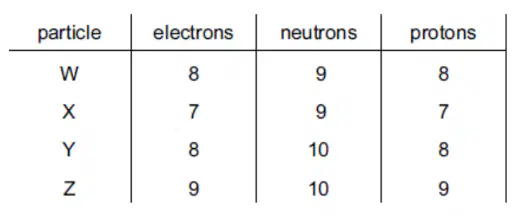
The atomic structures of four particles are shown. Which two particles are isotopes?
a)
W and X
b)
W and Y
c)
X and Z
d)
Y and Z
24.
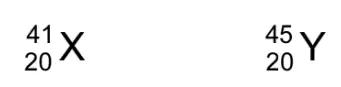
Two atoms, X and Y, can be represented as shown. Which statement is not correct?
a)
X and Y are atoms of different elements.
b)
X and Y are isotopes.
c)
X and Y have different mass numbers.
d)
X and Y have the same number of electrons.
25.
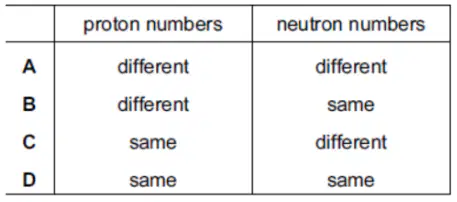
Two atoms have the same relative atomic mass but different chemical properties. Which row about the proton and neutron numbers of these atoms is correct?
a)
A
b)
B
c)
C
d)
D
26.
The table shows the numbers of particles present in the nuclei of four atoms or ions. Which two particles belong to the same element?
a)
1 and 2
b)
1 and 3
c)
2 and 3
d)
2 and 4
27.
What is different for isotopes of the same element?
a)
nucleon number
b)
number of electron shells
c)
number of electrons in the outer shell
d)
proton number
28.
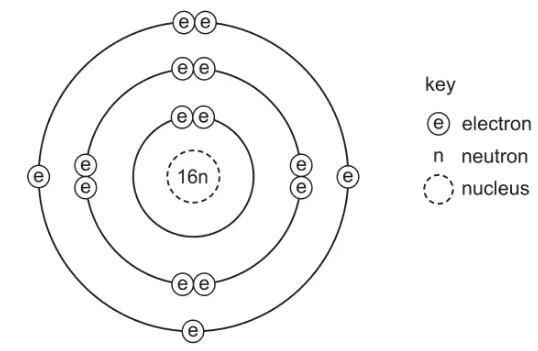
Which element has the atomic structure shown?
a)
Al
b)
P
c)
S
d)
Si
29.
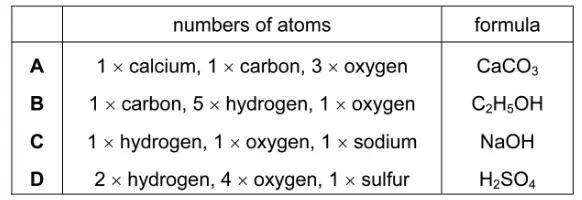
The table shows the numbers of atoms present in the formula of some compounds. Which row is not correct?
a)
A
b)
B
c)
C
d)
D
30.
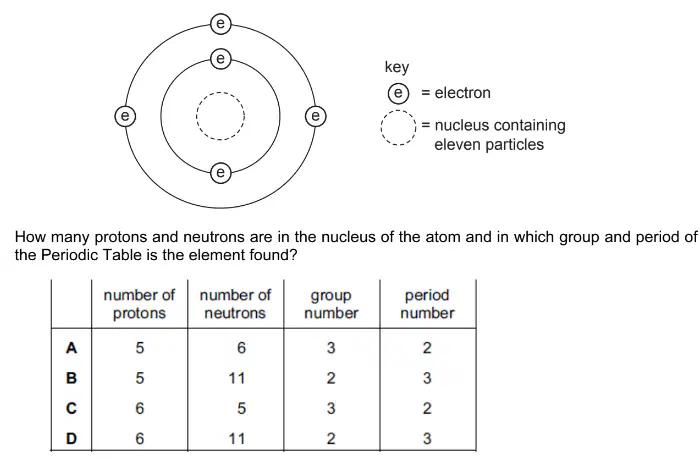
The diagram shows an atom of an element.
a)
A
b)
B
c)
C
d)
D
31.

Two atoms of magnesium, Mg, react with one molecule of oxygen, O2.

What is the formula of the product?

a)

MgO

b)

MgO2

c)

Mg2O

d)

Mg2O2

32.

A molecule, Z, contains two atoms of oxygen, six atoms of hydrogen and three atoms of carbon.

What is the formula of Z?

a)

CH3CH2CHO

b)

CH3COCH3

c)

C2H5CO2H

d)

C3H6CO2H

33.

Iron forms an oxide with the formula Fe2O3.

What is the relative formula mass of this compound?

a)

76

b)

100

c)

136

d)

160

34.

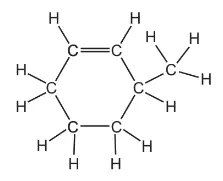
The structure of an organic compound, X, is shown. What is the molecular formula of X?

a)

C6H9

b)

C6H12

c)

C7H12

d)

C7H14

35.

A compound contains one atom of calcium, two atoms of hydrogen and two atoms of oxygen.

What is the correct chemical formula of the compound?

a)

CaO2H2

b)

HOCaOH

c)

H2CaO2

d)

Ca(OH)2

36.

The formulae of compounds W, X and Y are shown.

W CuSO4.5H2O

X MgSO4.7H2O

Y Cu(NO3)2.6H2O

Which statement is correct?

a)

W contains twice as many hydrogen atoms as oxygen atoms.

b)

X contains the most oxygen atoms.

c)

Y contains the most hydrogen atoms.

d)

Y contains the same number of hydrogen and oxygen atoms.
37.

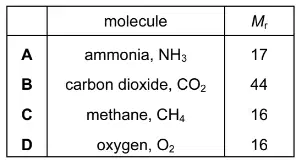
Which relative molecular mass, Mr, is not correct for the molecule given?

a)

A

b)

B

c)

C

d)

D

38.

A compound with the formula XF2 has a relative formula mass of 78.

What is element X?

a)

argon

b)

calcium

c)

neon

d)

zirconium

39.

What is the balanced chemical equation for the reaction between calcium and water?

a)

Ca + H2O → CaOH + H2

b)

Ca + H2O → Ca(OH)2 + H2

c)

Ca + 2H2O → CaOH + H2

d)

Ca + 2H2O → Ca(OH)2 + H2

40.

A compound has the formula CH3CO2H.

How should the relative molecular mass, Mr, of this compound be calculated?

a)

12 + 1 + 16

b)

3(12 + 1) + 2(12 + 16) + 1

c)

(4 × 12) + (2 × 1) + 16

d)

(2 × 12) + (4 × 1) + (2 × 16)