
 Worksheets
Space notebook quiz 1
Total questions: 20
Worksheet time: 40mins
A student makes a model of how the planets orbit the Sun. He used a basketball ball to represent the Sun. He used ping-pong balls to represent each planet and painted each one a different color. Then, he placed all the ping-pong balls equal distances apart in a line extending out from the sun.
What are two limitations of the student's model? (Limitations are things about the model that limit its accuracies)
He used the same size balls to represent the planets.
He made planets orbit the sun.
The planets are not the correct distances from the sun.
The solar system can't be modeled using actual objects.
Which PLANET in our solar system is closest from the Sun?
Pluto
Mercury
How do the sizes of the outer planets (4 furthest to the sun) compare to the sizes of the inner planets (4 closest from the sun)?
The inner planets are larger.
The outer planets are smaller.
There is no size difference between the inner and outer planets.
The outer planets are larger.
Describe how the distances between the orbits of the inner planets (1st four from the sun) compare to the distances between the orbits of the outer planets (four farthest from the sun).
The distances between orbits of the outer planets are much smaller.
The distances between orbits of the outer planets are much larger.
The distances between orbits of the inner planets are much larger.
There is no difference between the distances of the orbits of the inner planets and the outer planets.

Choose all that are true about our Solar System:
Has 8 planets that are very close together
Has 8 planets, but is mostly empty space
Has 9 planets that are very close together
Has 9 planets, but is mostly empty space
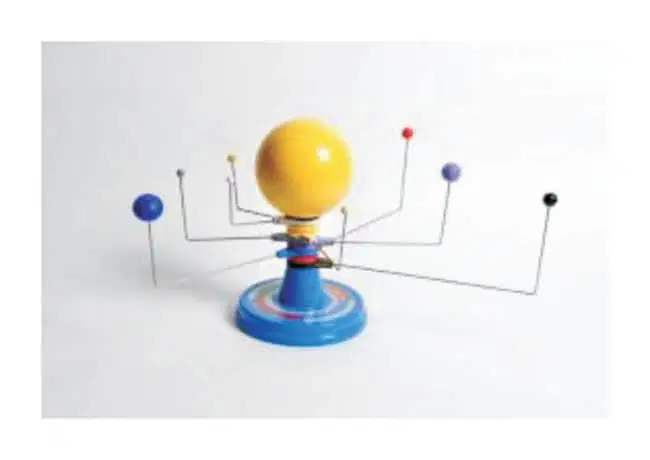
Why is making a model of the solar system difficult?
Its hard to find objects to represent each planet
The solar system is so big and the objects in it are so small in comparison
There are too many parts in a model
The objects are too close together to put in a model
Which planet in the Solar system is the hottest on average?
Mercury
Venus
Mars
Saturn

Which planet in our solar system has the fastest orbit of the Sun?
Mercury
Venus
Earth
Mars
Pluto
Jupiter
What planet is rotating the fastest on its axis?
Mercury
Jupiter
Venus
Earth
What planets year (Period of Revolution) is shorter than its day (Period of Rotation)?
Venus
Jupiter
Earth
Uranus
Imagine that a new object is found in our solar system. It is small and made of rock and orbits the dwarf planet Eris. How would scientists classify this object?
A moon
A comet
An asteroid
A meteoroid
Which of the following bodies in our solar system orbit the sun? (Select all that are correct)
Meteoroids
Moons
Dwarf Planets
Comets
Asteroids
the distance between the Earth and the Sun
1) has a day longer than its year
2 )is the hottest planet
3 )rotates counter clockwise (east to west)

