Wayground logo

Free Printable Worksheets

Font size

S
M
L
XL
Worksheets

Gr.10 MCQ test, Hooke's law, forces, density

Total questions: 25

Worksheet time: 25mins

Name
Class
Date
1.
Which of the following statement best describes Hooke’s law?
a)
The extension of a spring is directly proportional to the force applied
b)
The extension of a spring is directly proportional to the force applied, provided that the limit of proportionality is not exceeded
c)
The extension of a spring is inversely proportional to the force applied, provided that the limit of proportionality is not exceeded
d)
The force applied to a spring is inversely proportional to the extension
2.
What is the MOST suitable name of point A?
a)
Limit of breakage
b)
Limit of proportionality
c)
elastic limit
d)
Limit of elasticity
3.
The gradient of the following graph is
a)
Spring constant
b)
Constant spring
c)
1/ spring constant
d)
1/constant spring
4.
A spring has a spring constant of 330 N/m. How far is the spring compressed if 150 N of force are used
a)
2.2m
b)
5m
c)
0.45m
d)
0.0014m
5.
Which of the following is a true statement regarding springs?
a)
The higher the value of the spring constant, the stiffer the spring.
b)
Springs are designed to provide unpredictable variations in force.
c)
In Hooke's law, the force exerted by the spring acts in the same direction as displacement.
d)
The force exerted by a spring has a quadratic relationship with the displacement form equilibrium.
6.
The following diagram shows how the length of a spring increases when different masses are suspended from it, within its elastic limit. What is the length of the spring before the masses where suspended?
a)
6.0 cm
b)
6.5 cm
c)
8.0 cm
d)
7.5 cm
7.
The following shows how the load applied to a spring varies with its extension during an experiment. Which of the following is/are true? (This question may have more than one correct answers)
a)
The force constant of the spring during elastic deformation is 1N/mm
b)
Hooke's law has been conformed to throughout the experiment
c)
A load of 4 N will produce an extension of 4 mm
d)
The proportional limit was not exceeded
8.
During what interval is the car's velocity zero?
a)
A
b)
B
c)
C
d)
D
9.

The table shows a moving object with constant acceleration along the time. If the velocity at the fifth second is left in missing, then predict, what is the velocity of object at that time?

a)

100 m/s

b)

200 m/s

c)

120 m/s

d)

180 m/s

10.
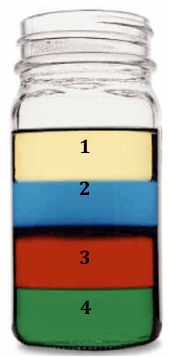
Put the liquids in order from most dense to least dense?
a)
4, 3, 2, 1
b)
1, 2, 3, 4
c)
3, 4, 2, 1, 
d)
4, 3, 1, 2
11.
Calculate the density of the cube. (Hint: calculate the volume of the cube using V= Bh)
a)
0.33 g/cm3
b)
0.4 g/cm3
c)
0.6 g/cm3
d)
0.5 g/cm3
12.
What is the volume of Object X?
a)
10.0 cm3
b)
15.0 cm3
c)
20.0 cm3
d)
25.0 cm3
13.

Letting go of a balloon full of air is demonstrating Newton's ______ _______ ________ _________ because the air comes out of the back and the balloon moves forward.

a)

1st law of motion

b)

2nd law of motion

c)

3rd law of motion

d)

13th law of motion

14.
What is Newton's First Law
a)
F=ma
b)
Every action has an equal and opposite reaction
c)
An object at rest stays at rest, an object in motion stays in motion. 
d)
Friction 
15.
Look at the illustration below of a block sitting on a table-top. The magnified view illustrates a force that exists between the two objects.
Which type of force is demonstrated in the magnified view?
 
a)
magnetic force
b)
electrical force
c)
gravitational force
d)
frictional force
16.

Are forces applied when the objects involved are in direct contact.

a)

Contact forces

b)

Normal forces

c)

action-at-a-distance forces

17.

The point through which the whole weight of the body acts is called

a)

Inertial Point

b)

Center of gravity

c)

Centriod

d)

Central point

18.

Why is the car on the right more stable?

a)

Its center of mass is higher

b)

it has a wider base

c)

it has more height

d)

all of the above

19.

The diagrams show four solid cones. The center of mass of each cone is marked by a point labelled M.


Which cone is the most stable

a)

A

b)

B

c)

C

d)

D

20.

If the density of a bar of gold is 19.3 g/cm3 , what is the density of gold in kg/m3 ?  

a)

1930 kg/m3

b)

19300 kg/m3

c)

193000 kg/m3

d)

0.0193 kg/m3

21.

A tunnel has a length of 50 km. A car takes 20 min to travel between the two ends of the tunnel. What is the average speed of the car?

a)

2.5 km / h

b)

16.6 km / h

c)

150 km / h

d)

1000 km / h

22.

A ball rolling down a hill was displaced 19.6m while uniformly accelerating from rest. if the final velocity was 5 m/s, calculate the acceleration.

Which formula is MOST appropriate for solving this question?

a)

v = u + at

b)

v2 = u2 + 2as

c)

s= ut + ½ at2

d)

s = ½ (u + v) t

23.

Which one of these options is NOT a derived quantity?

a)

Area

b)

Volume

c)

Density

d)

Temperature

24.

The following graphs show a displacement – time graph.

Which graph corresponds to a body at rest?

a)

A

b)

B

c)

C

d)

D

25.

What vector gives the sum of these two vectors?

a)

b)

c)

d)