
 Worksheets
CFA #2 (12.1 & 12.2)
Total questions: 23
Worksheet time: 12mins
Name
Class
Date
1.
For each missing word or phrase, select the choice that correctly completes the sentence.
In the process of ________________, DNA is used as a template for making another type of nucleic acid called (ATP / pyruvate / RNA / NADPH). The process begins when the enzyme (RNA polymerase / DNA replicase / ATP synthase / catalase) binds to a region of DNA.
a)
translation
b)
replication
c)
differentiation
d)
transcription
2.
For each missing word or phrase, select the choice that correctly completes the sentence.
In the process of (translation / replication / differentiation / transcription), DNA is used as a template for making another type of nucleic acid called _______________. The process begins when the enzyme (RNA polymerase / DNA replicase / ATP synthase / catalase) binds to a region of DNA.
a)
ATP
b)
pyruvate
c)
RNA
d)
NADPH
3.
For each missing word or phrase, select the choice that correctly completes the sentence.
In the process of (translation / replication / differentiation / transcription), DNA is used as a template for making another type of nucleic acid called (ATP / pyruvate / RNA / NADPH). The process begins when the enzyme _______________ binds to a region of DNA.
a)
RNA polymerase
b)
DNA replicase
c)
ATP synthase
d)
catalase
4.
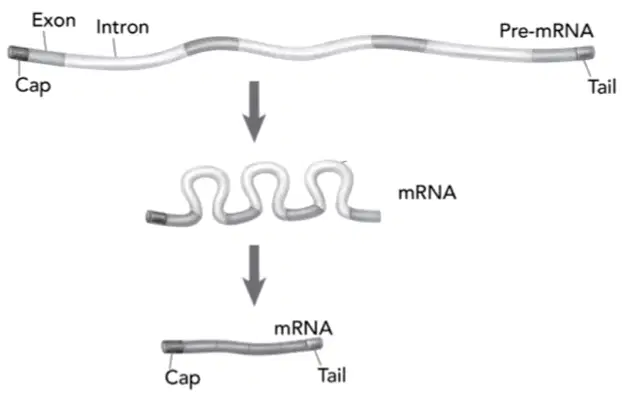
The diagram shows the process in which pre-mRNA is changed into mRNA. Which events are described in the diagram?
a)
Introns are removed, and remaining exons are spliced together.
b)
Exons are removed, and remaining introns are spliced together.
c)
Introns and exons are removed, and remaining DNA is spliced together.
d)
Introns are removed, condensed, and then combined again.
5.
Which of these events occurs first during the process of transcription?
a)
RNA polymerase joins nucleotides into the RNA molecule.
b)
RNA polymerase zips back together the split DNA molecule.
c)
Introns are removed from the RNA molecule.
d)
Exons are removed from the RNA molecule.
6.
George is studying a computer model of a DNA molecule, in which the letters A, C, G, and T are listed in a very long sequence. The model includes a total of 2000 genes that are scattered along the full length of the molecule. The genes make up only a small fraction of the molecule.
a)
RNA polymerase joins nucleotides into the RNA molecule.
b)
RNA polymerase zips back together the split DNA molecule.
c)
Introns are removed from the RNA molecule.
d)
Exons are removed from the RNA molecule.
7.
The "language" of RNA is called the ________________, and it uses three-letter "words" called (polypeptides/amino acids/codons/nucleotides).
a)
nucleotide strategy
b)
transcription strategy
c)
substitution mutation
d)
genetic code
8.
The "language" of RNA is called the (nucleotide strategy/transcription strategy/substitution mutation/genetic code), and it uses three-letter "words" called ________________.
a)
polypeptides
b)
amino acids
c)
codons
d)
nucleotides
9.
A sequence of amino acids called a ____________ is produced during the process of (transcription/intron removal/translation/replication). During this process, the (anticodon/glucose/intron/exon) of a tRNA molecule binds to a codon of mRNA.
a)
DNA Polymerase
b)
DNA Transcriptase
c)
carbohydrate
d)
polypeptide
10.
A sequence of amino acids called a (DNA Polymerase/ DNA Transcriptase / carbohydrate / polypeptide) is produced during the process of ________________. During this process, the (anticodon/glucose/intron/exon) of a tRNA molecule binds to a codon of mRNA.
a)
transcription
b)
intron removal
c)
translation
d)
replication
11.
A sequence of amino acids called a (DNA Polymerase / DNA Transcriptase / carbohydrate / polypeptide) is produced during the process of (transcription/intron removal/translation/replication). During this process, the ______________ of a tRNA molecule binds to a codon of mRNA.
a)
anticodon
b)
glucose
c)
intron
d)
exon
12.
Consider this sequence of nucleotides in an mRNA molecule.
AGGGUCCAA
Which could describe the translation of this sequence?
a)
3 codons that are translated into 3 amino acids
b)
3 codons that are translated into 9 amino acids
c)
3 codons that are translated into 3 polypeptides
d)
9 nucleotides that are translated into 9 amino acids
13.
Carlita was hired today for a job as a laboratory assistant. She will work for a professor of molecular biology who wants to make new discoveries about genes, DNA, RNA, and their functions.
Carlita's work will MOST LIKELY contribute to which of these specific research goals?
a)
Identifying the molecule that makes up genes
b)
Describing the role of RNA polymerase in RNA synthesis
c)
Determining the links between genes and the traits they influence
d)
Identifying the types of nucleotides that make up RNA
14.
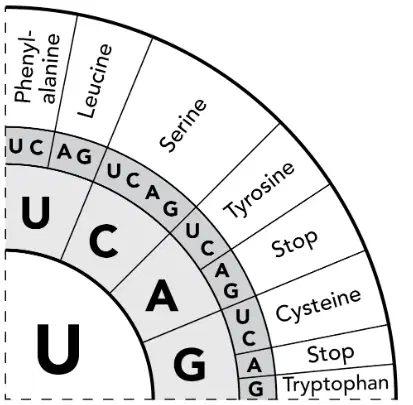
Percy is studying the diagram shown here. The diagram is one fourth of a larger diagram that explains the genetic code.
By studying the diagram, Percy would be MOST LIKELY to construct an answer to which of these questions?
a)
How many codons make up a typical mRNA molecule?
b)
Are specific codons associated with introns and exons?
c)
Which amino acid is most common in a typical protein?
d)
Are all codons translated into amino acids?
15.
Velma is developing a computer model of translation. Her instructor points out that the model does not include ribosomes or ribosomal RNA. If the model is accurate in other ways, how does the absence of ribosomes and ribosomal RNA affect it?
a)
Certain amino acids would be missing from the polypeptides.
b)
The polypeptides would be much longer than normal.
c)
Amino acids would be joined together in an incorrect order.
d)
Amino acids would not join together, and no polypeptides would form.
16.
Generally single stranded
a)
DNA
b)
RNA
17.
Contains Thymine
a)
DNA
b)
RNA
18.
Contains Uracil
a)
DNA
b)
RNA
19.
Contains ribose sugar
a)
DNA
b)
RNA
20.
Contains deoxyribose sugar
a)
DNA
b)
RNA
21.
Carries copies of the instructions for assembling proteins
a)
mRNA
b)
rRNA
c)
tRNA
d)
introns
e)
exons
22.
Makes up the subunits of ribosomes.
a)
mRNA
b)
rRNA
c)
tRNA
d)
introns
e)
exons
23.
Carries amino acids and matches them to the coded message for assembling proteins.
a)
mRNA
b)
rRNA
c)
tRNA
d)
introns
e)
exons
100 %

