
 Worksheets
Review: Checking and Savings
Total questions: 48
Worksheet time: 24mins
Name
Class
Date
1.
The following are reasons to open a checking account EXCEPT...
a)
Keeps your money safe.
b)
Gives you more options for paying bills.
c)
Makes a paper trail to track your money.
d)
You earn interest on your money.
2.
True or False: You have a limit on how many times you can get money out of your savings account.
a)
True
b)
False
3.
A popular savings strategy in which 50% of your income goes towards necessities, 20% goes towards saving and debt repayment, and 30% goes towards flexible spending,
a)
50/30/20 Rule
b)
Pay Yourself First
c)
Emergency Fund
4.
A method of saving whereby you put a fixed amount of income into a savings account before you pay monthly bills or make purchases.
a)
50/30/20 Rule
b)
Pay Yourself First
c)
Emergency Fund
5.
A method of saving whereby you put a fixed amount of income into a savings account before you pay monthly bills or make purchases.
a)
50/30/20 Rule
b)
Pay Yourself First
c)
Emergency Fund
6.
Money set aside for unanticipated expenses or loss of income
a)
50/30/20 Rule
b)
Pay Yourself First
c)
Emergency Fund
7.
You should have enough money in your Emergency Fund to cover how many months of expenses.
a)
1-3 months
b)
3-6 months
c)
6-9 months
d)
9-12 months
8.
The FDIC protects the deposits of customers against loss up to $250,000 per account. What does FDIC stand for?
a)
Federal Deposit Income Corporation
b)
Federal Deposit Interest Corporation
c)
Federal Deposit Income Company
d)
Federal Deposit Insurance Corporation
9.
The NCUA protects against credit union failure up to $250,000 per individual depositor. What does NCUA stand for?
a)
National Credit Union Administration
b)
National Credit Union Account
c)
National Credit Union Assessment
d)
National Credit Union Armory
10.
The interest that you earn on interest is called...
a)
compound money
b)
compound interest
c)
compound savings
d)
simple interes
11.
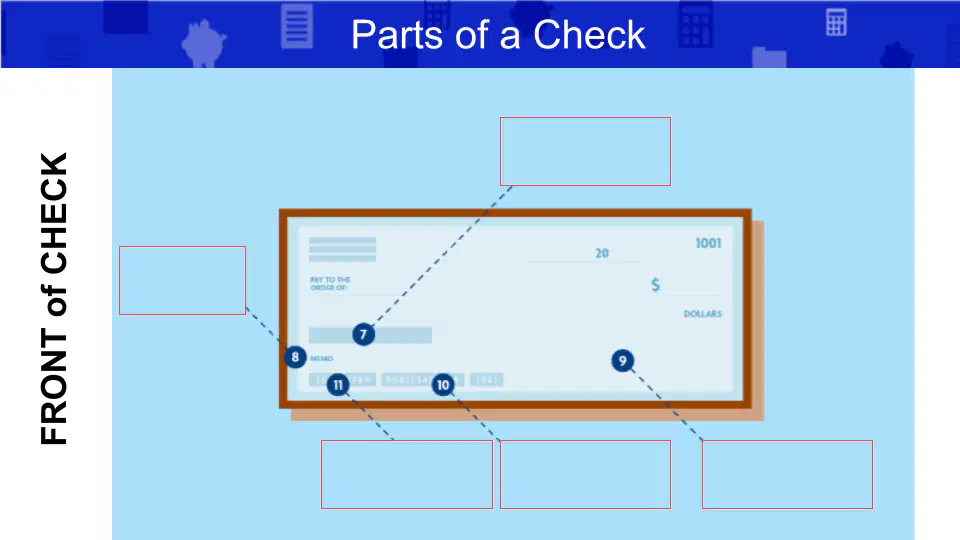
Number 11 is the...
a)
account number
b)
routing number
c)
name of bank
d)
signature line
12.
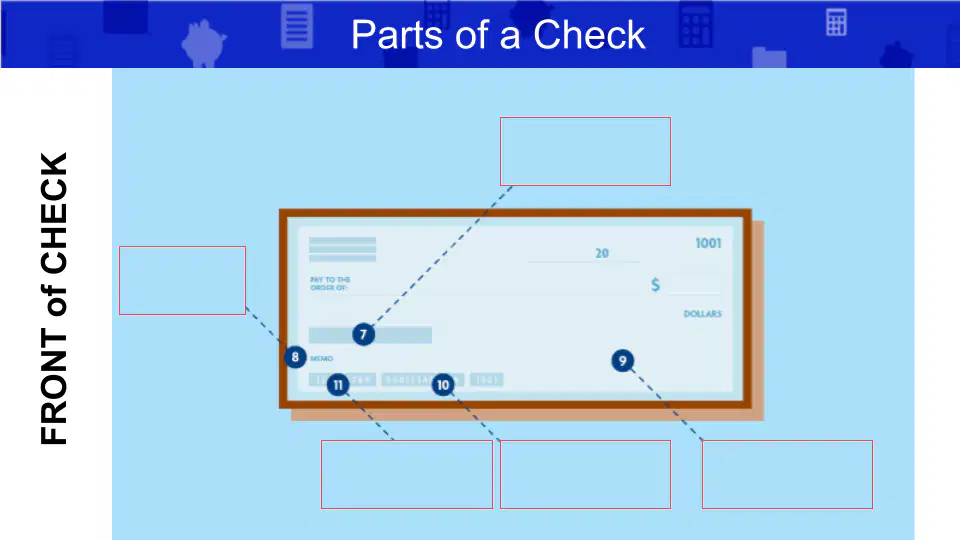
Number 10 is the...
a)
account number
b)
routing number
c)
name of bank
d)
signature line
13.
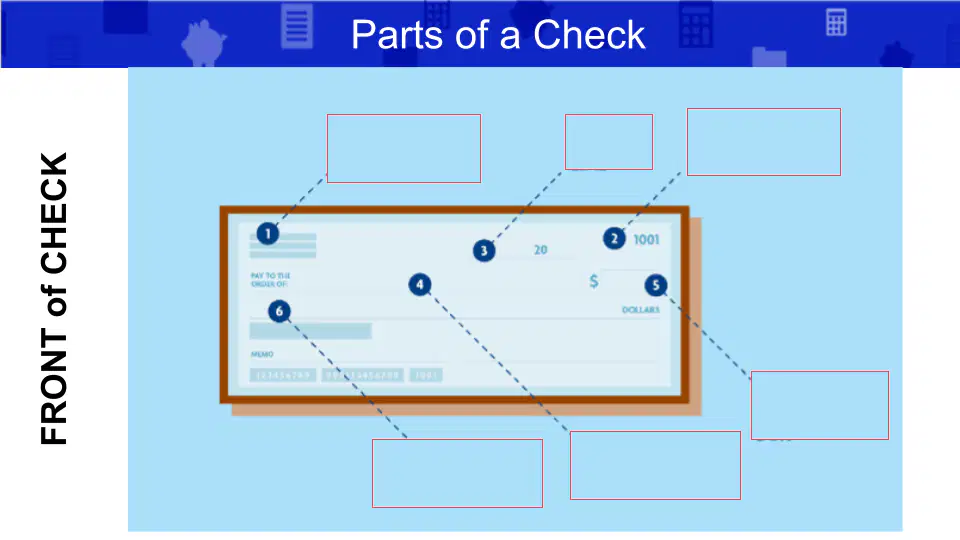
Number 5 is the...
a)
dollar line
b)
dollar amount box
c)
check number
d)
endorsement box
14.
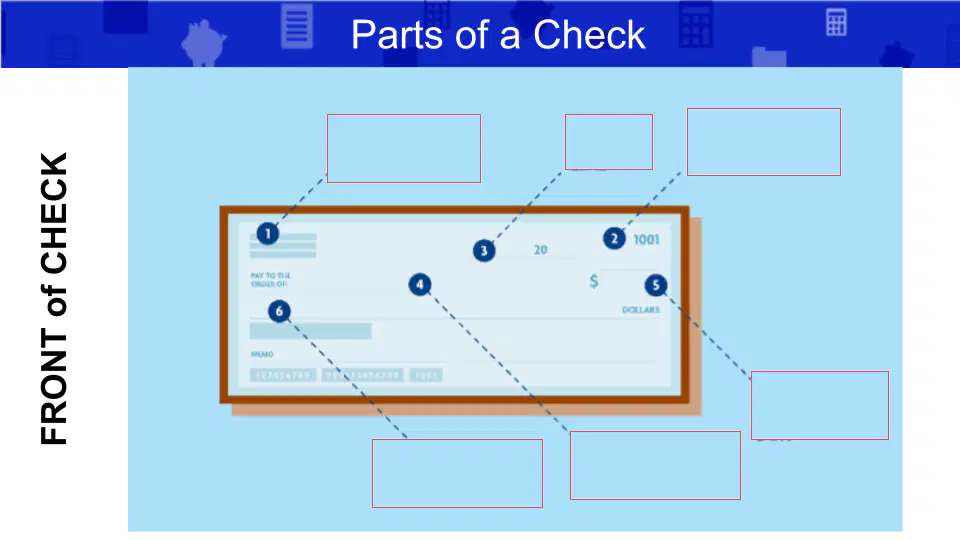
Number 6 is the...
a)
dollar line
b)
dollar amount box
c)
check number
d)
endorsement box
15.
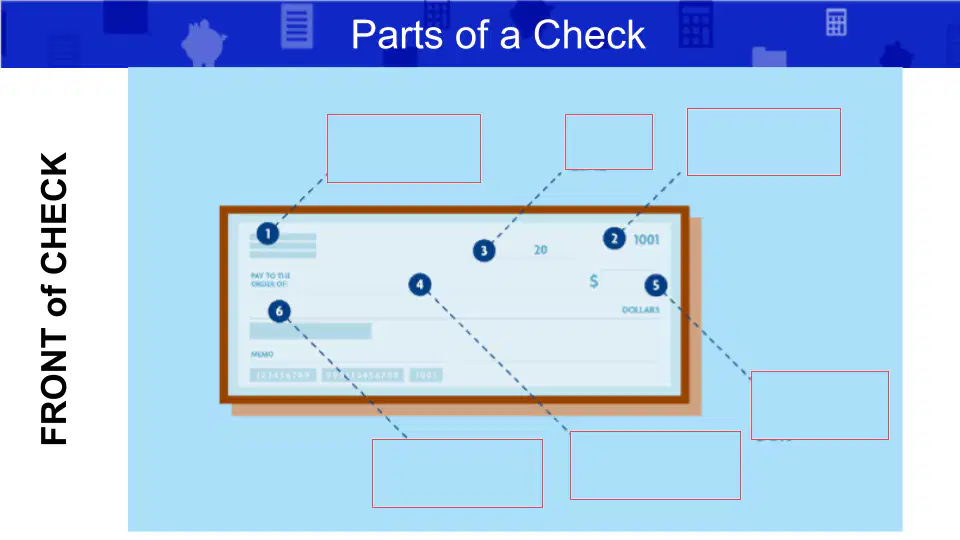
Number 4 is the...
a)
dollar line
b)
dollar amount box
c)
check number
d)
pay to the order of line
16.
The best place to earn the highest interest rate possible as long as you don't need access to your money for a number of years.
a)
Certificate of Deposit
b)
Regular Savings Account
c)
Money Market Account
d)
Checking Account
17.
Your money is safe in the bank even if the bank fails ...
a)
if the bank account is FDIC insured
b)
is in any bank
c)
is in a large national bank (local banks are not safe)
d)
never
18.
inflation
a)
The rate at which the prices for goods increases and consumers' purchasing power decreases.
b)
income not spent on consumption, for more short-term goals
c)
interest paid on the principal alone
d)
the rate charged for borrowing money usually expressed as a percent of the amount borrowed
19.
Many banks pay interest on
a)
the money you deposit into your savings account
b)
the money you deposit into your checking account
c)
the money you put in the stock market
d)
banks don't pay interest
20.
savings
a)
income not spent on consumption, for more short-term goals
b)
interest paid on the principal alone
c)
a relatively small amount of money lent at a high rate of interest on the agreement that it will be repaid when the borrower receives their next paycheck.
d)
The worth of someone's overall assets (Assets - Debt) or (How much a person own's - How much a person owes)
21.
minimum deposit
a)
The least amount of money a bank requires when opening an account.
b)
a relatively small amount of money lent at a high rate of interest on the agreement that it will be repaid when the borrower receives their next paycheck.
c)
The rate at which the prices for goods increases and consumers' purchasing power decreases.
d)
the rate charged for borrowing money usually expressed as a percent of the amount borrowed
22.
online savings account
a)
A type of savings account that is managed online - there is no physical branch at which you can manage your savings. These accounts typically offer higher interest rates and lower or minimal fees
b)
Money owed
c)
income not spent on consumption, for more short-term goals
d)
strategy for saving for the future by putting money aside before paying regular monthly bills
23.
money market savings account
a)
An account similar to a traditional savings account but that typically pays higher interest. It requires a higher minimum balance, and may allow check writing from the account
b)
a relatively small amount of money lent at a high rate of interest on the agreement that it will be repaid when the borrower receives their next paycheck.
c)
money and other valuables belonging to an individual or business
d)
A type of savings account that is managed online - there is no physical branch at which you can manage your savings. These accounts typically offer higher interest rates and lower or minimal fees
24.
50-20-30 Rule
a)
A popular savings rule of thumb in which 50% of your income goes towards necessities (groceries, rent, utilities), 20% goes towards savings, debt, and investments, and 30% goes towards flexible spending
b)
a certificate from a bank stating that the named party has a specified sum on deposit, usually for a given period of time at a fixed rate of interest
c)
The rate at which the prices for goods increases and consumers' purchasing power decreases.
d)
An automatic deposit of net pay to an employee's designated bank account
25.
direct deposit
a)
An automatic deposit of net pay to an employee's designated bank account
b)
A popular savings rule of thumb in which 50% of your income goes towards necessities (groceries, rent, utilities), 20% goes towards savings, debt, and investments, and 30% goes towards flexible spending
c)
interest paid on the principal alone
d)
the U.S. corporation insuring deposits in the U.S. against bank failure
26.
certificates of deposit (CDs)
a)
a certificate from a bank stating that the named party has a specified sum on deposit, usually for a given period of time at a fixed rate of interest
b)
A popular savings rule of thumb in which 50% of your income goes towards necessities (groceries, rent, utilities), 20% goes towards savings, debt, and investments, and 30% goes towards flexible spending
c)
The process of setting money aside to increase wealth over time for long-term financial goals such as retirement
d)
A type of account in which you can use pre-tax dollars to pay for out-of-pocket health care expenses.
27.
simple interest
a)
interest paid on the principal alone
b)
the rate charged for borrowing money usually expressed as a percent of the amount borrowed
c)
The worth of someone's overall assets (Assets - Debt) or (How much a person own's - How much a person owes)
d)
money and other valuables belonging to an individual or business
28.
principal
a)
original amount of money saved or invested, separate from interest or earnings
b)
strategy for saving for the future by putting money aside before paying regular monthly bills
c)
the U.S. corporation insuring deposits in the U.S. against bank failure
d)
The least amount of money a bank requires when opening an account.
29.
pay yourself first
a)
strategy for saving for the future by putting money aside before paying regular monthly bills
b)
original amount of money saved or invested, separate from interest or earnings
c)
An account similar to a traditional savings account but that typically pays higher interest. It requires a higher minimum balance, and may allow check writing from the account
d)
the U.S. corporation insuring deposits in the U.S. against bank failure
30.
Overdraft
a)
The result of making a withdrawal when there isn't enough money in your checking account to pay for it
b)
A monthly record of your account transactions provided by your bank electronically or on paper
c)
Money put into your account
d)
A written record that allows you to record checks you have written, ATM/debit card transactions, deposits, and withdrawals
31.
Personal Identification Number (PIN)
a)
Typically a 4-digit number required to use your debit card at a store or ATM
b)
An online process that allows you to send money directly from your account to another person via email or app
c)
An automatic electronic deposit of net pay to an employee's designated bank account
d)
A sum of money deposited into your account
32.
Balance
a)
The amount of money you have in your bank account
b)
Method of banking using your smartphone to conduct transactions rather than using a computer or a physical bank branch
c)
A sum of money deducted from your account
d)
A written record that allows you to record checks you have written, ATM/debit card transactions, deposits, and withdrawals
33.
Person-to-Person Payment
a)
An online process that allows you to send money directly from your account to another person via email or app
b)
A check you wrote and but that the bank has not yet paid
c)
Money taken out of your account
d)
A member-owned financial co-operative, similar to a bank, except it is created and operated by its members and profits are shared amongst the owners
34.
Unbanked
a)
An individual or household that does not utilize a checking or savings account and instead obtains financial services outside the traditional banking system
b)
To "balance" your checking account with your monthly statement from the bank
c)
The amount of money you have in your bank account
d)
A plastic card that enables you to do ATM transactions and make purchases by deducting money electronically from your checking account
35.
Withdrawal
a)
Money taken out of your account
b)
A bank or credit union account that allows easy (and usually unlimited) access to your funds via check, ATM, or debit card
c)
A check you wrote and that the bank has already paid
d)
A card that is loaded with a specific cash amount before you use it but then looks and works like a credit card until the full value is spent
36.
Check Cashing Store
a)
A non-bank business that charges a fee to cash physical checks and provide the check's owner with cash, on-the-spot
b)
A member-owned financial co-operative, similar to a bank, except it is created and operated by its members and profits are shared amongst the owners
c)
A bank or credit union account that allows easy (and usually unlimited) access to your funds via check, ATM, or debit card
d)
Method of banking where all the transactions take place electronically via the internet rather than at a physical bank branch
37.
Credit Union
a)
A member-owned financial co-operative, similar to a bank, except it is created and operated by its members and profits are shared amongst the owners
b)
Money put into your account
c)
A check you wrote and that the bank has already paid
d)
A bank or credit account that is shared between two or more individuals which allows everyone named on the account to access the funds
38.
Check
a)
A written order to the bank that tells it to take a stated amount of money from your account and pay it to someone else
b)
An automatic electronic deposit of net pay to an employee's designated bank account
c)
A non-bank business that charges a fee to cash physical checks and provide the check's owner with cash, on-the-spot
d)
An individual or household that has a checking and/or savings account but also obtains financial services outside the traditional banking system
39.
Checkbook
a)
A physical portfolio that holds your check register, checks, and deposit slips
b)
To "balance" your checking account with your monthly statement from the bank
c)
Money taken out of your account
d)
A bank or credit account that is shared between two or more individuals which allows everyone named on the account to access the funds
40.
Statement
a)
A monthly record of your account transactions provided by your bank electronically or on paper
b)
A written order to the bank that tells it to take a stated amount of money from your account and pay it to someone else
c)
A bank or credit union account that allows easy (and usually unlimited) access to your funds via check, ATM, or debit card
d)
A machine that allows a customer to deposit checks or withdraw physical cash (bills) from their account
41.
Underbanked
a)
An individual or household that has a checking and/or savings account but also obtains financial services outside the traditional banking system
b)
A written record that allows you to record checks you have written, ATM/debit card transactions, deposits, and withdrawals
c)
A monthly record of your account transactions provided by your bank electronically or on paper
d)
Method of banking where all the transactions take place electronically via the internet rather than at a physical bank branch
42.
Debit Card
a)
A plastic card that enables you to do ATM transactions and make purchases by deducting money electronically from your checking account
b)
A monthly record of your account transactions provided by your bank electronically or on paper
c)
A written record that allows you to record checks you have written, ATM/debit card transactions, deposits, and withdrawals
d)
A machine that allows a customer to deposit checks or withdraw physical cash (bills) from their account
43.
Checking Account
a)
A bank or credit union account that allows easy (and usually unlimited) access to your funds via check, ATM, or debit card
b)
A plastic card that enables you to do ATM transactions and make purchases by deducting money electronically from your checking account
c)
An online process that allows you to send money directly from your account to another person via email or app
d)
Money taken out of your account
44.
Prepaid Card
a)
A card that is loaded with a specific cash amount before you use it but then looks and works like a credit card until the full value is spent
b)
An online process that allows you to send money directly from your account to another person via email or app
c)
Money put into your account
d)
A sum of money deposited into your account
45.
Debit
a)
A sum of money deducted from your account
b)
An individual or household that does not utilize a checking or savings account and instead obtains financial services outside the traditional banking system
c)
A machine that allows a customer to deposit checks or withdraw physical cash (bills) from their account
d)
Typically a 4-digit number required to use your debit card at a store or ATM
46.
Mobile Banking
a)
Method of banking using your smartphone to conduct transactions rather than using a computer or a physical bank branch
b)
Money taken out of your account
c)
A monthly record of your account transactions provided by your bank electronically or on paper
d)
An individual or household that does not utilize a checking or savings account and instead obtains financial services outside the traditional banking system
47.
Automatic Teller Machine (ATM)
a)
A machine that allows a customer to deposit checks or withdraw physical cash (bills) from their account
b)
A check you wrote and that the bank has already paid
c)
An automatic electronic deposit of net pay to an employee's designated bank account
d)
Method of banking where all the transactions take place electronically via the internet rather than at a physical bank branch
48.
Check Register
a)
A written record that allows you to record checks you have written, ATM/debit card transactions, deposits, and withdrawals
b)
A sum of money deducted from your account
c)
The result of making a withdrawal when there isn't enough money in your checking account to pay for it
d)
An individual or household that does not utilize a checking or savings account and instead obtains financial services outside the traditional banking system
100 %

