
 Worksheets
Test Review: Ch. 8 Ancient Greece~
Total questions: 43
Worksheet time: 22mins
Name
Class
Date
1.
1. Which group of ancient Greek women had greater freedom?
a)
Slave women
b)
Athenian women
c)
Spartan women
2.
2. Government structure of Sparta where political power is held by a small group of people.
a)
Direct Democracy
b)
Oligarchy
c)
Socialism
3.
3. How did the aristocracy get its power?
a)
Birth
b)
Religion
c)
War
4.
4. What control did the ephors have over the city-state of ancient Sparta?
a)
They made and approved all laws
b)
They could mint coins
c)
They could remove kings that broke the law.
5.
5. Battle in which the Athenians used trickery to defeat the Persians during the first Persian War. A solider ran around 25 miles back to Athens to announce victory.
a)
Plataea
b)
Salamis
c)
Marathon
6.
The following primary source account and choose the best answer.
"Every man make up his mind to fight and move on his enemy! Strong as I am, it's hard for me to face so many men and fight with all at once...and yet I will!"
-Homer, The Iliad
What value was Homer portraying in this selection that helped shape Greek identify?
a)
Bravery
b)
Fairness
c)
Sportsmanship
7.
7. Ancient Greece was made up of many city-states. Each city-state was ____________________.
a)
Troy
b)
An independent state
c)
An open area in a polis
8.
8. What modern term was taken from the Greek idea of having governing ideas in a polis?
a)
Democracy
b)
Politics
c)
City Council
9.
9. Under democracy, who help power over the government?
a)
A single ruler
b)
A phalanx
c)
Adult free male citizens
10.
10. Where did Spartan boys live?
a)
In barracks
b)
With neighboring families
c)
With Helots
11.
11. Where were the government buildings of ancient Greek community?
a)
In the marketplace
b)
In the countryside
c)
On the acropolis
12.
12. Battle in which King Leonidas led a small Spartan army against the Persians. All 300 Spartans died, but were successful in stalling the Persian Army.
a)
Marathon
b)
Thermopylae
c)
Salamis
13.
13. In which kind of government do citizens elect other people to make decisions on their behalf?
a)
Aristocracy
b)
Oligarchy
c)
Representative Democracy
14.
14. According to the rule of law, a government leader:
a)
Has absolute authority to make decisions for everyone
b)
Must follow the law like everyone else
c)
Has more rights than everyone else
15.
15. Who ran a tyranny?
a)
a single ruler
b)
A phalanx
c)
Ordinary citizens
16.
16. Who were helots in ancient Sparta?
a)
Teachers in the military
b)
Armor worn for battle
c)
Slaves from military conquests
17.
17. What did not happen during the Dark Age of Ancient Greece?
a)
Alexander the Great conquered the Greeks
b)
People lost the ability to read and write
c)
Greeks migrated across the Aegean Sea
18.
18. How did Athens and most other city-states become rich?
a)
Natural Resources
b)
Investments
c)
Trade
19.
19. For protection and security against further attacks from Persia, Athens and other city-states formed the _____________?
a)
Delian League
b)
Ionian League
c)
Naxos League
20.
20. How did geography discourage Greek unity?
a)
Mountains and seas divided the Greeks
b)
Deserts divided the Greeks
c)
Greece has a cold climate
21.
21. Which development eventually led to the Peloponnesian War?
a)
Rivalry between Athens and Sparta for power in Greece.
b)
Athens' jealousy over Persian support of Sparta
c)
Persian attacks on Greek colonies in Ionia.
22.
22. Which of the following was not permitted of Spartan women?
a)
Participating in sports
b)
Voting
c)
Raising future soldiers for the state
23.
23. What describes a citizen in ancient Greece?
a)
A member of the community
b)
Someone who takes part in the government
c)
All of the above
24.
24. Where was the ideal site for a Greek Colony?
a)
On the coast
b)
In the mountains
c)
Along a river
25.
25. Which was NOT a part of the government structure in Athens?
a)
The courts
b)
The president
c)
The council
26.
26. Why did other Greek city-states both fear and admire Sparta?
a)
Because of their strength
b)
Because of their power
c)
All of the above
27.
27. Which of the following advancement of stay was created by the ancient Greeks?
a)
Separating fact from legend in writing history
b)
Creation of maps that included the 7
c)
Recognition that the Sun is the center of our solar system.
28.
28. Which of the following were not considered citizens in Ancient Greek Society?
a)
Woman and children
b)
small farmers
c)
Aristocrats
29.
29. Which of the following would be an example of Draconian Law?
a)
$70 for a speeding ticket for driving over 15 mph over the posted time
b)
Death penalty for stealing a pack of gum
c)
Lunch detention for sleeping class
30.
30. In what way was citizenship in Athens unique in the ancient world?
a)
People had to obey their rulers
b)
People had a say in government
c)
People went to church
31.
31. Why did Persia try to conquer Greece in 490 BC?
a)
Persia wanted control of trade routes
b)
Athenians helped rebelling Ionians
c)
Darius disliked Greek customs
32.
32. What idea that was created ancient Greek trade, revolutionized the economy and still in use today?
a)
First paper money
b)
First to make jewerly
c)
First gold and silver coins
33.

35. What is located at #1?
a)
Aegean Sea
b)
Sparta
c)
Marathon
34.
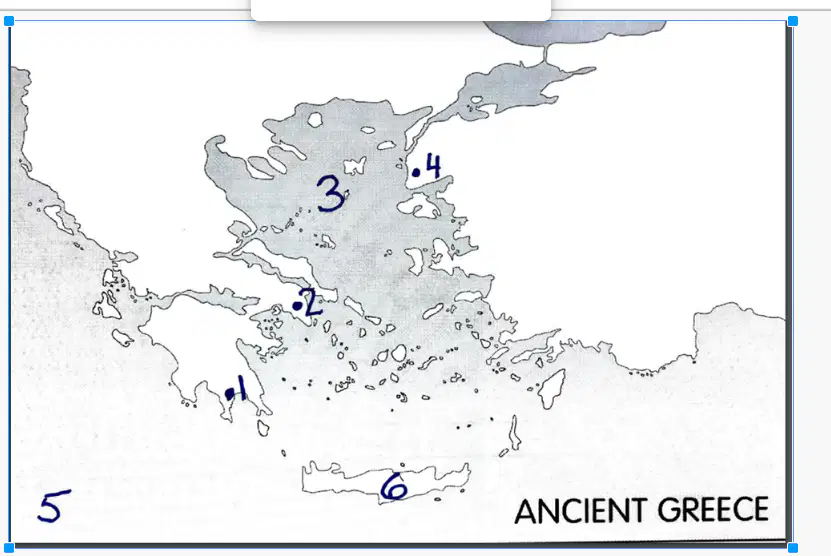
36. What is located at #2?
a)
Athens
b)
Sardis
c)
Crete
35.
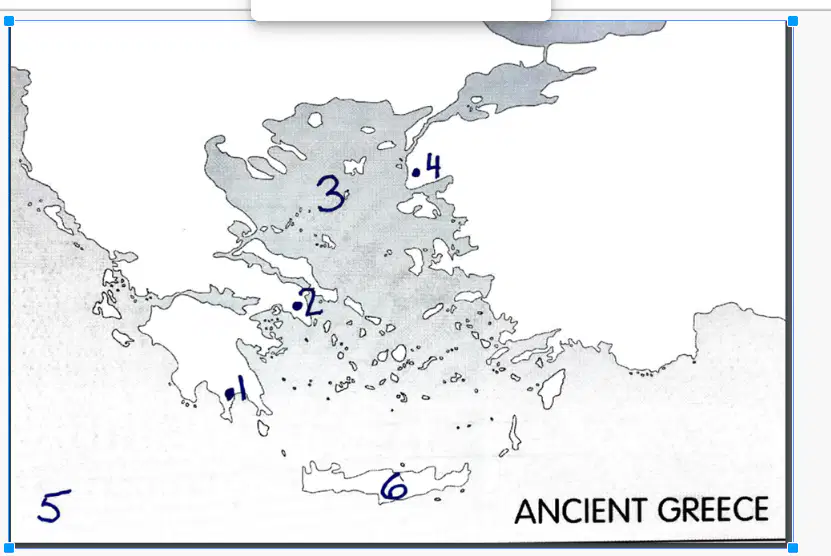
37. What is located at #3?
a)
Athens
b)
Aegean Sea
c)
Mediterranean Sea
36.
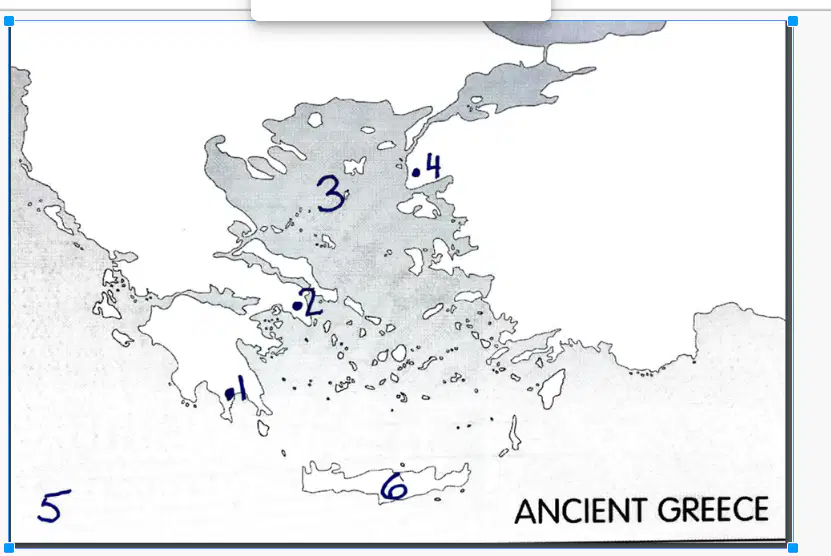
38. What is located at #4?
a)
Troy
b)
Athens
c)
Marathon
37.

39. What is located at #5?
a)
Atlantic Ocean
b)
Ionian Sea
c)
Black Sea
38.
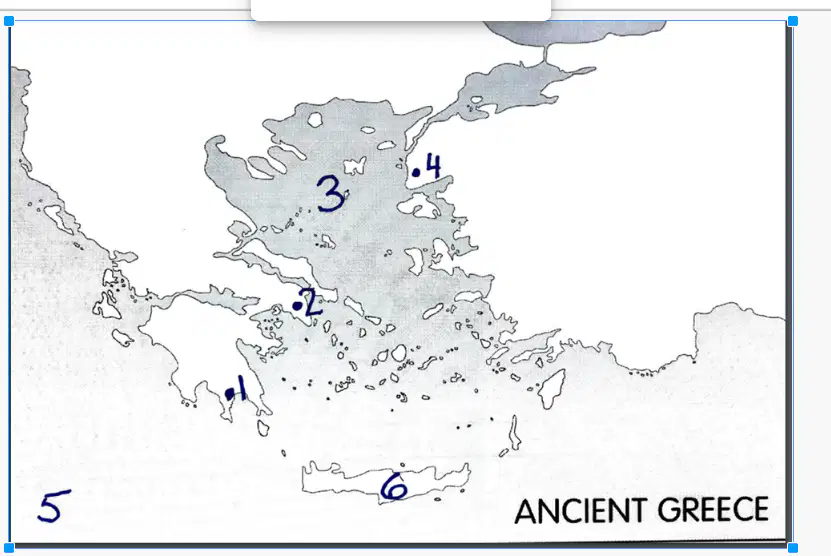
40. What is located at #6?
a)
Marathon
b)
Crete
c)
Sparta
39.
What was the role of women in Sparta?
a)
They had less freedom than Athenian women
b)
They could inherit property and manage family estates
c)
They were expected to stay home and take care of the household
d)
They were involved in government decisions
40.
Which statement is true about women in Greece?
a)
Spartan and Athenian women were treated the same way
b)
Spartan women had more rights and could own unlimited amounts of land, but Athenian women had no rights and could not own much for themselves.
41.

An agreement formed between groups to work together is a(n)
a)
alliance
b)
compliance
c)
allegiance
42.
The polis was different than a modern day city because it functioned like a _________
a)
tiny country
b)
tiny state
c)
tiny village
d)
tiny town square
43.
Which city-state was famous for its art, architecture and culture?
a)
Athens
b)
Sparta
c)
Both
100 %

