
 Worksheets
Science standard questions
Total questions: 46
Worksheet time: 23mins
Name
Class
Date
1.
SC.6.P.13.1
Luis rubbed a balloon on his hair and held the balloon next to the wall. He observed the balloon stick to the wall. Which of the following is responsible for the balloon sticking to the wall?
a)
A. gravity
b)
B. friction
c)
C. electric force
d)
D. magnetic force
2.
SC.6.L.15.1
Mushrooms, bread molds, and yeasts are classified together in the fungi kingdom. Specific characteristics are used to classify these organisms. Which of the following is a characteristic used to classify these organisms as fungi?
a)
A. They are parasites.
b)
B. They are unicellular.
c)
C. They are prokaryotes.
d)
D. They are heterotrophs.
3.
SC.7.L.15.3
A certain reptile species is a herbivore and exists only on an isolated island. Which of the following would most likely result in the extinction of the reptile species over a period of twenty thousand years?
A. The reptile species produces many offspring with many unique traits, and the vegetation remains constant.
B. The reptile species produces few offspring with some unique traits, and the vegetation remains constant.
C. The reptile species produces few offspring with no unique traits, and the vegetation changes quickly.
D. The reptile species produces many offspring with some unique traits, and the vegetation changes slowly.
a)
A.
b)
B.
c)
C.
d)
D.
4.
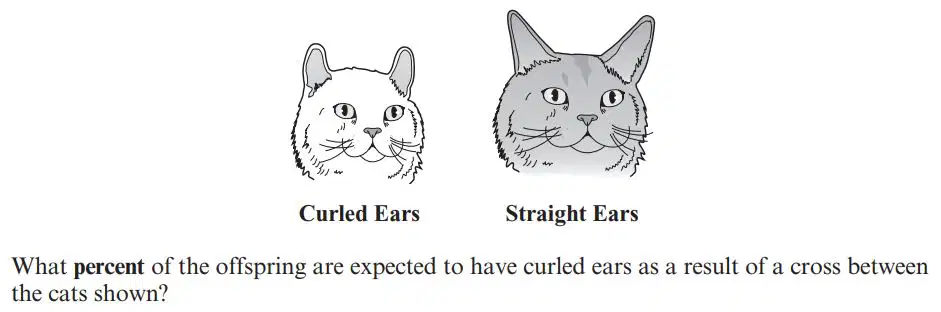
SC.7.L.16.2
The gene for curled ears (C) is dominant over the gene for straight ears (c). The picture below shows a cat with curled ears (Cc) and a cat with straight ears (cc).
a)
A. 100
b)
B. 75
c)
C. 50
d)
D. 25
5.

SC.7.L.17.2
Mangrove trees are common to the Florida Everglades. The tree roots serve as a place for freshwater oysters to attach when the tide is high, as shown in the picture below. The oysters are protected from predators when attached to the roots underwater.
a)
A. African ants living in acacia trees feed on leaf-eating insects found on the tree.
b)
B. Spider crabs are camouflaged by the green-brown algae growing on their shells.
c)
C. A whale is unaffected by the attached remora fish feeding on the whale’s leftover food.
d)
D. Bees fly from one flowering plant to another gathering nectar and pollinating the flowers.
6.
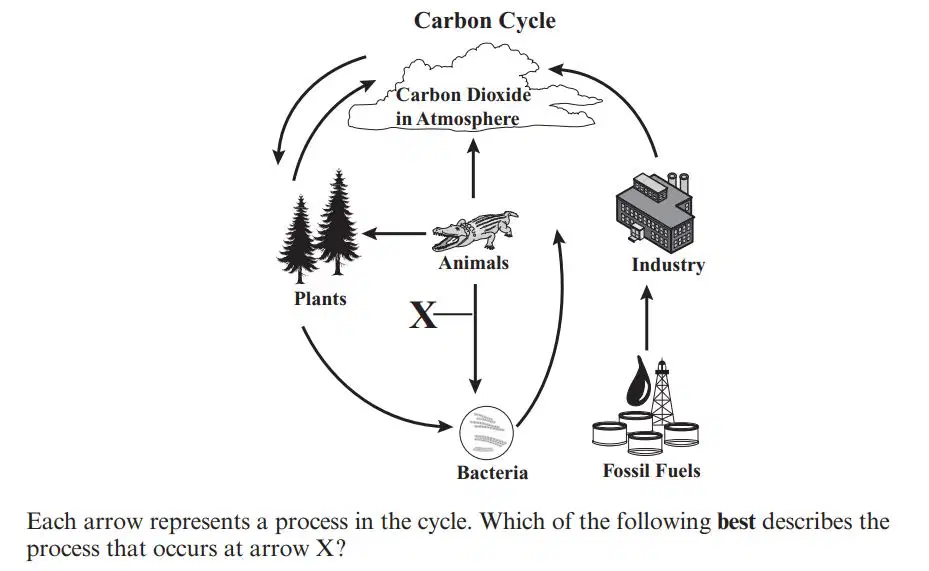
SC.8.L.18.3
A diagram of the carbon cycle is shown below.
a)
A. Bacteria break down molecules in animals into carbon-based soil nutrients.
b)
B. Animals release oxygen that is used by bacteria to produce carbon dioxide.
c)
C. Animals release carbon dioxide that is used by bacteria for growth and reproduction.
d)
D. Bacteria combine carbon-based nutrients from plants and animals to produce glucose.
7.
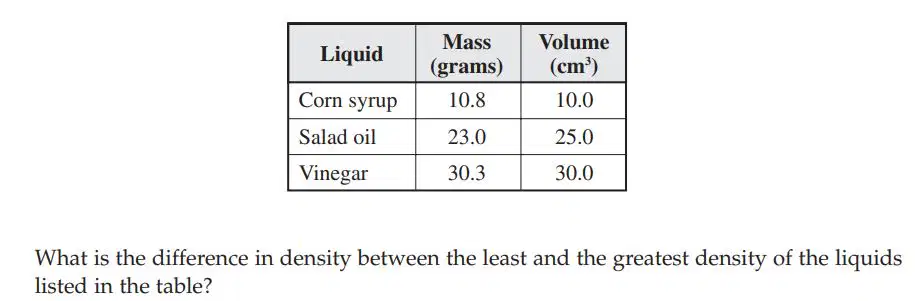
SC.8.P.8.4
Mr. Molina’s class studied the mass and volume of three liquids.
a)
A.
b)
B.
c)
C.
d)
D.
8.
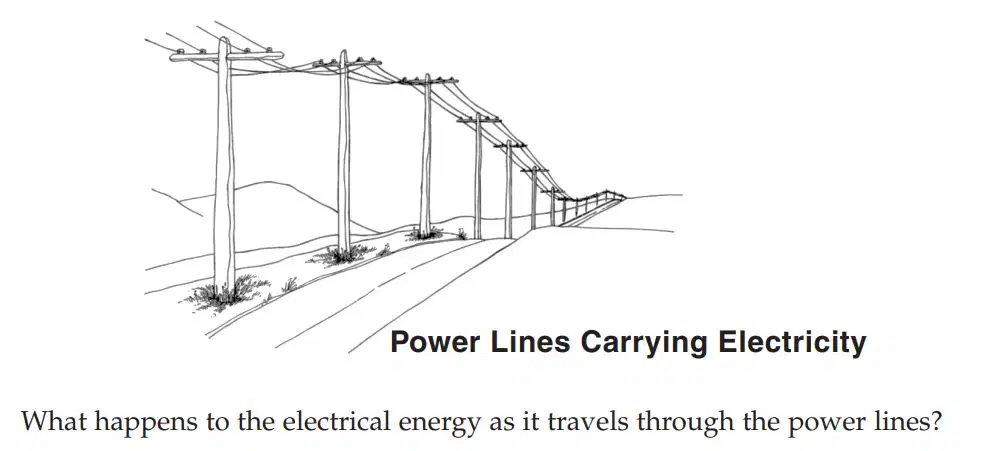
SC.7.P.11.2
When electric power is carried over long distances through power lines, the electrical energy decreases as the distance increases. This energy decrease occurs because the current encounters resistance in the wires.
a)
A. The energy converts into thermal energy and is released into the atmosphere.
b)
B. The energy converts into electromagnetic energy and is released as microwaves.
c)
C. The energy is transferred to the current’s electrons as the power lines are grounded.
d)
D. The energy is transferred to the air as light energy as it travels along the power lines.
9.
SC.6.P.12.1
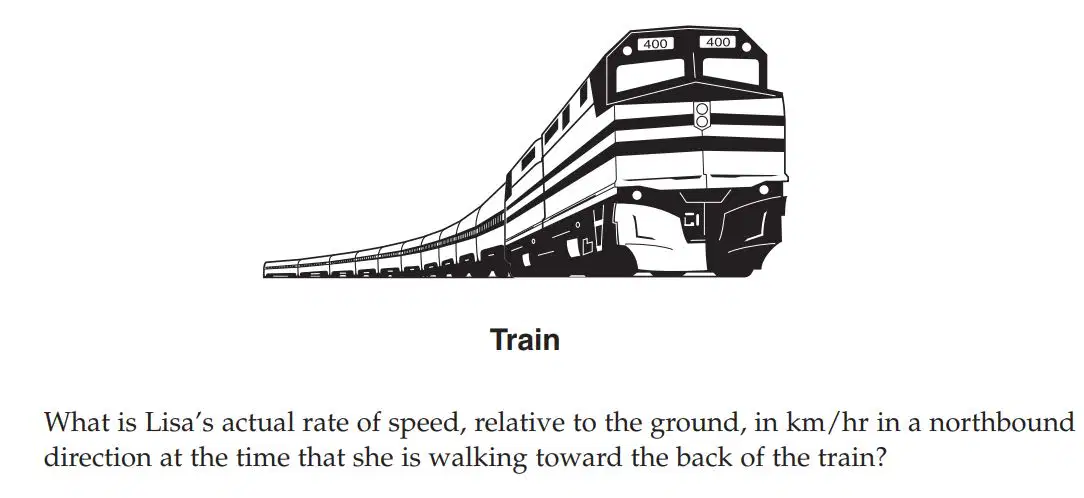
Lisa is seated at the front of a train. The train is traveling northbound at a steady speed of 40.2 kilometers/hour (km/hr). While the train is in motion, Lisa gets up from her seat and walks toward the back of the train at a steady rate of 2.4 km/hr.
a)
A. 40.2 km/h
b)
B. 37.5 km/h
c)
C. 2.4 km/h
d)
D. -2.4 km/h
10.
SC.7.E.6.7
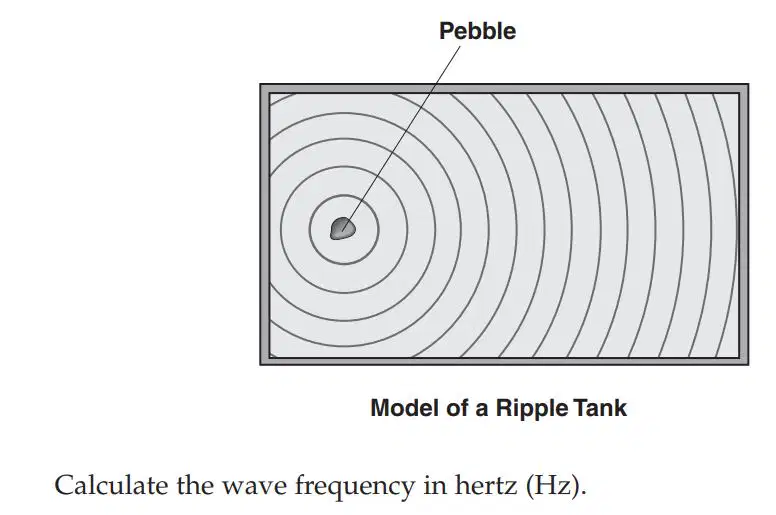
A ripple tank is a shallow container of water used to demonstrate the properties of a wave. Giselle tossed a pebble into the tank and counted the wave crests as they passed by a certain point. She counted 6 waves in 30 seconds.
a)
A. 30/6 Hz
b)
B. 1/5 Hz
c)
C. 4/5 Hz
d)
D. 5/1 Hz
11.
SC.8.L.18.3
A homeowner accidentally used a chemical treatment that eliminated the bacteria in the lawn. What would be the long term effect of such an action?
a)
A. an increase in nests in the lawn area
b)
B. a need to pull more weeds from the lawn area
c)
C. a need to fertilize the lawn area with plant nutrients
d)
D. an increase in the number of rodents in the lawn area
12.
SC.6.E.6.1
On flat open farmland, farmers often plant a row of trees as a method of soil conservation. Which statement best explains how a row of trees can help conserve soil?
a)
A. The trees provide shade, so the soil does not dry out.
b)
B. The tree branches protect the soil from the force of acid rain.
c)
C. The trees act as a windbreak, reducing soil erosion caused by blowing wind.
d)
D. The trees attract animals whose wastes add fertilizer to help prevent soil erosion.
13.
SC.8.E.5.7
A small satellite orbits Pluto. Eight satellites orbit Neptune, the closest planet to Pluto. Pluto is much smaller than Neptune. Why isn’t Pluto a satellite of Neptune?
a)
A. The Sun’s gravity is the primary influence on Pluto.
b)
B. Neptune is not large enough to capture Pluto as a satellite.
c)
C. Neptune’s gravitational pull is neutralized by its eight satellites.
d)
D. Pluto’s satellite’s gravitational pull keeps Pluto away from other planets.
14.
SC.6.L.14.5
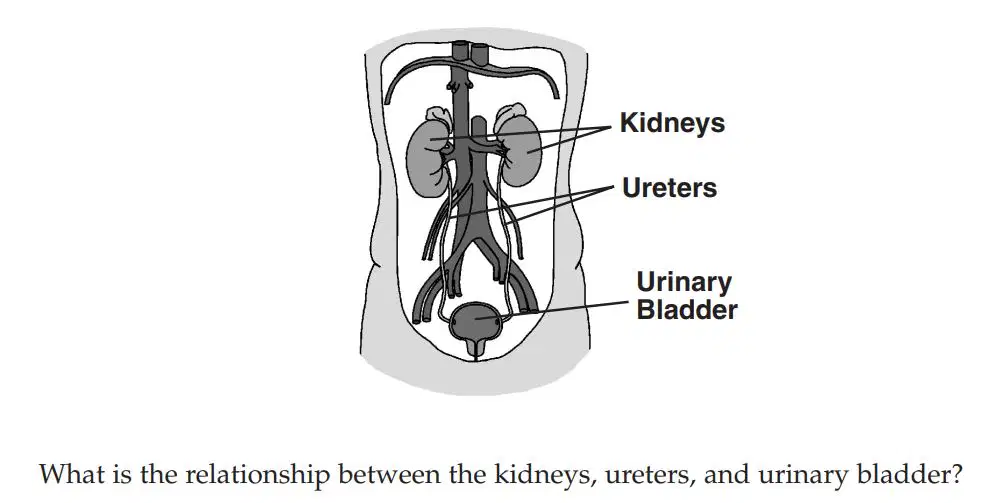
The excretory system in the human body has several components. Some of them are identified in the diagram below.
a)
A. They work together to transport blood.
b)
B. They work independently with specialized functions.
c)
C. They work together to maintain the chemical balance of blood.
d)
D. They work as storage organs for fluids to prevent dehydration.
15.
SC.7.L.16.2
In one species of guinea pig, the gene for black fur is dominant while the gene for brown fur is recessive. A male guinea pig with black fur and a female guinea pig with black fur produce a female offspring with brown fur. Which most likely describes the genes of the parent guinea pigs?
A. Both parent guinea pigs carry the recessive gene.
B. The male parent guinea pig carries the recessive gene, but the female parent does not.
C. The female parent guinea pig carries the recessive gene, but the male parent does not.
D. Neither parent guinea pig carries the recessive gene; the brown fur was a spontaneous mutation
a)
A.
b)
B.
c)
C.
d)
D.
16.
SC.7.L.17.1
Soil organisms, such as fungi, worms, and bacteria, are all biotic parts of the woodland ecosystem. What is the role of these organisms in the woodland ecosystem?
a)
A. to provide nitrogen for the animals
b)
B. to obtain dissolved oxygen from moisture
c)
C. to break down the remains of other living things
d)
D. to store chlorophyll for the photosynthesis process
17.
SC6.E.7.9
Earth’s stratosphere contains ozone. The ozone layer protects Earth from ultraviolet radiation. If the ozone layer is damaged, how will Earth be most affected?
a)
A. The ultraviolet radiation may result in damage to living organisms.
b)
B. The ultraviolet radiation may cause air conditioning systems to overheat.
c)
C. The ultraviolet radiation may rapidly increase the water temperature of the Pacific Ocean.
d)
D. The ultraviolet radiation may permanently destroy some satellite communication
e)
systems.
18.
SC.8.N.3.2
When speaking about his accomplishments and contributions to the progress of science, Isaac Newton said, “If I have been able to see further, it is because I stood on the shoulders of giants.” How does this statement apply to his scientific accomplishments?
A. His new theories were an outgrowth of Einstein’s general theory of relativity.
B. He invented the telescope to see further into the universe than had others before him.
C. His law of universal gravitation was very much like the Ptolemaic system of epicycles.
D. His new theories increased scientific knowledge by looking at old observations in a new way.
a)
A.
b)
B.
c)
C.
d)
D.
19.
SC.7.N.1.6
A microbiologist working at a pharmaceutical company is conducting a research project on a new medicine used to treat the common cold. Why is it important for the scientist to keep accurate notes about the research?
a)
A. Accurate notes are required to get the predicted results of the test.
b)
B. Accurate notes will help other scientists replicate and validate the results.
c)
C. Accurate notes are necessary for experiments conducted on human subjects.
d)
D. Accurate notes will help to ensure that no one uses the same experimental methods.
20.
SC.8.N.1.1
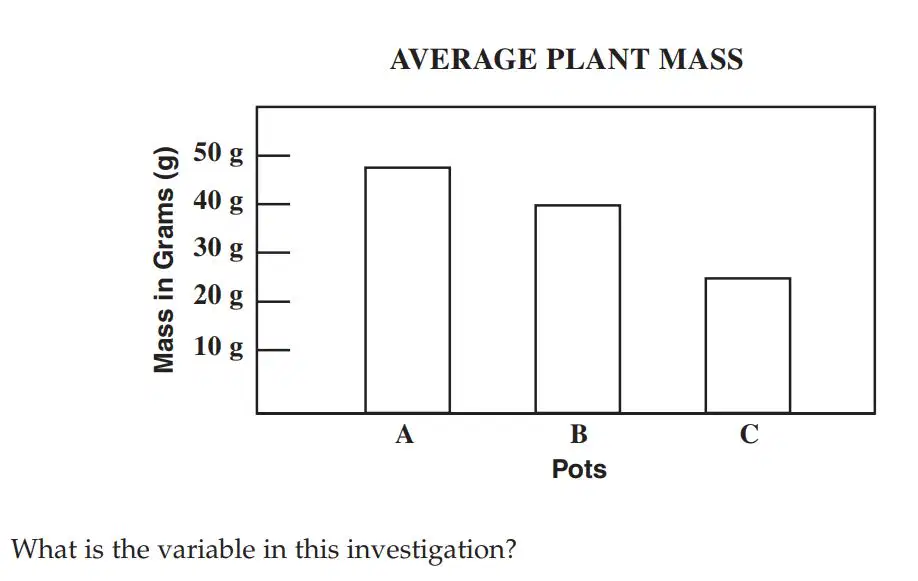
An equal amount of potting soil was placed in three identical pots. Twenty petunia seeds were used. Three seeds were planted in Pot A, seven seeds in Pot B, and ten seeds in Pot C. The pots were all placed on the same table, and after they grew to a height of about 10 centimeters (cm), the plants from each pot were cut off at soil level, dried overnight, and weighed. The chart below shows the average plant mass from each pot.
a)
A. the soil
b)
B. the temperature
c)
C. the mass of each plant
d)
D. the space available for each seed
21.

SC.7.N.1.4
Keesha did an experiment to study the rate of photosynthesis in the water plant Elodea. She placed a piece of Elodea in a beaker of water and set the beaker 10 centimeters (cm) from a light source. Keesha counted the bubbles released from the plant every minute for five minutes (min). She repeated the process two more times. First, she moved the light to 20 cm from the beaker, and then she moved the light to 30 cm from the beaker. Keesha’s setup and data are shown below.
a)
A. the number of bubbles produced
b)
B. the type of plant placed in the beaker
c)
C. the amount of time the bubbles were counted
d)
D. the distance of the light source from the plant
22.
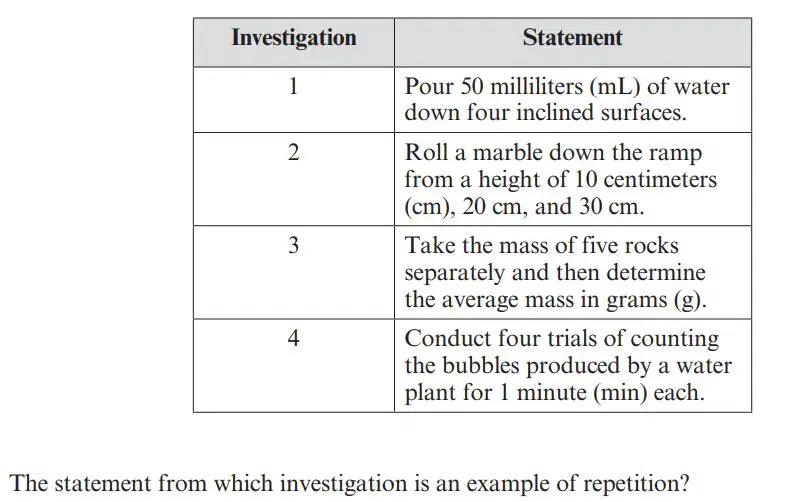
SC.7.N.1.2
The following statements were taken from the procedures of four different investigations.
a)
A. Investigation 1
b)
B. Investigation 2
c)
C. Investigation 3
d)
D. Investigation 4
23.
SC.6.N.2.2
Scientific knowledge may change as new evidence or information is discovered. Which of the following would NOT be a result of new scientific research and information?
a)
A. Binomial nomenclature is assigned to a recently identified plant species.
b)
B. An endangered monkey species is put in a reserve for protection from extinction.
c)
C. A newly discovered chemical element will be added to the periodic table of the elements.
d)
D. A nonnative plant species will begin to reproduce rapidly after being introduced into a swamp ecosystem.
24.

SC.7.N.3.2
Two types of models that can be used to show details of the structures of cells are shown below.
a)
A. It does not represent the main parts of a cell.
b)
B. It does not contain the correct number of nuclei.
c)
C. It cannot represent a living cell, since a true cell is three-dimensional.
d)
D. It cannot represent a living cell, since the cytoplasm should be in constant motion.
25.
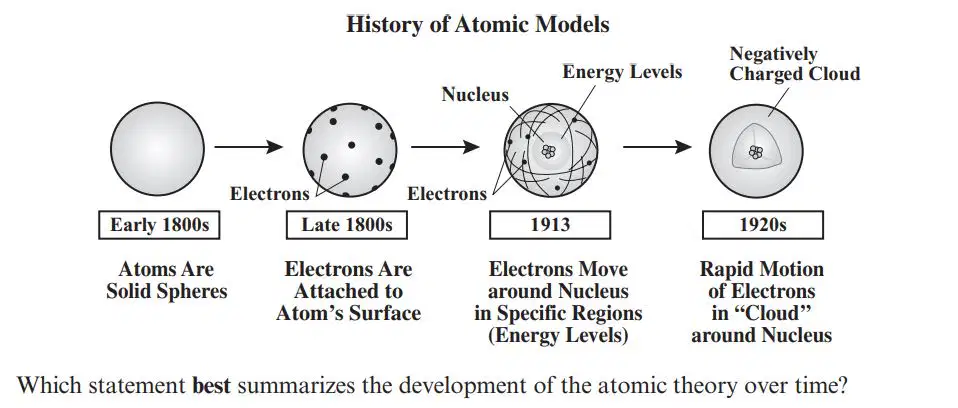
SC.8.N.3.2
A timeline of some models of atoms throughout history is shown below. These models have contributed to the formation of the atomic theory.
a)
A. The discovery of new evidence resulted in changes to the atomic theory.
b)
B. Advancements in atomic models proved the atomic theory was accurate.
c)
C. The atomic theory was modified with the discovery of every new element.
d)
D. Changes in atomic models showed that the atomic theory was based on opinion.
26.
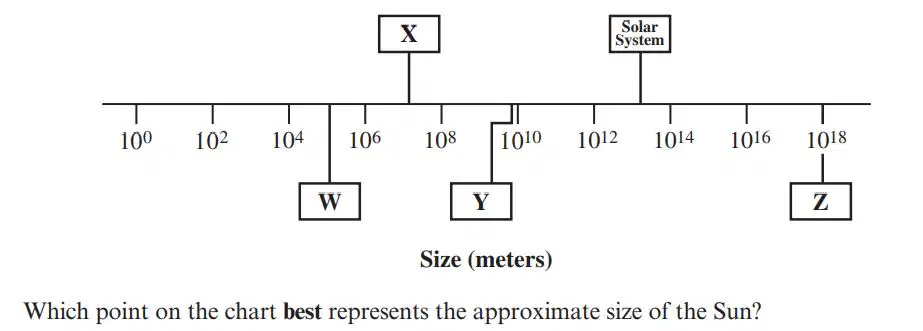
SC.8.E.5.3
The points labeled on the chart below represent the approximate size of Earth, the Milky Way, the Moon, and the Sun. The approximate size of the Solar System is also shown.
a)
A. W
b)
B. X
c)
C. Y
d)
D. Z
27.
SC.8.E.5.5
One physical property of a star is apparent magnitude. Which of the following is used in determining the apparent magnitude of a star?
a)
A. the constellation the star is in
b)
B. the distance the star is from Earth
c)
C. the number of times the star rotates
d)
D. the number of prominences the star makes
28.
SC.8.E.5.7
The surface of Mercury has many more craters than the surface of Earth has. Which of the following statements best explains why Mercury has many more craters than Earth has?
a)
A. Mercury rotates faster than Earth does.
b)
B. Mercury has a smaller mass than Earth has.
c)
C. Mercury is much closer to the Sun than Earth is.
d)
D. Mercury has a thinner atmosphere than Earth has.
29.
SC.8.E.5.9
The water level at the beach changes during the day. What causes the different water levels?
a)
A. Earth’s revolution
b)
B. the Moon’s rotation
c)
C. Earth’s magnetic field
d)
D. the Moon’s gravitational pull
30.
SC.7.E.6.6
Deforestation occurs when large areas of trees are cut down. Which of the following impacts on the environment would result from deforestation?
a)
A. increased erosion
b)
B. colder temperatures
c)
C. decreased carbon dioxide
d)
D. greater oxygen production
31.
SC.7.E.6.3
The oldest rock formation identified on Earth is found on the shoreline of Hudson Bay in Canada. This rock formed 4.28 billion years ago. Which information does a scientist need to most accurately determine the age of a rock?
a)
A. the percentage of each mineral that makes up the rock
b)
B. the thickness of younger rock layers that cover the rock
c)
C. the amount of each radioactive element present in the rock
d)
D. the amount of weathering present on the surface of the rock
32.
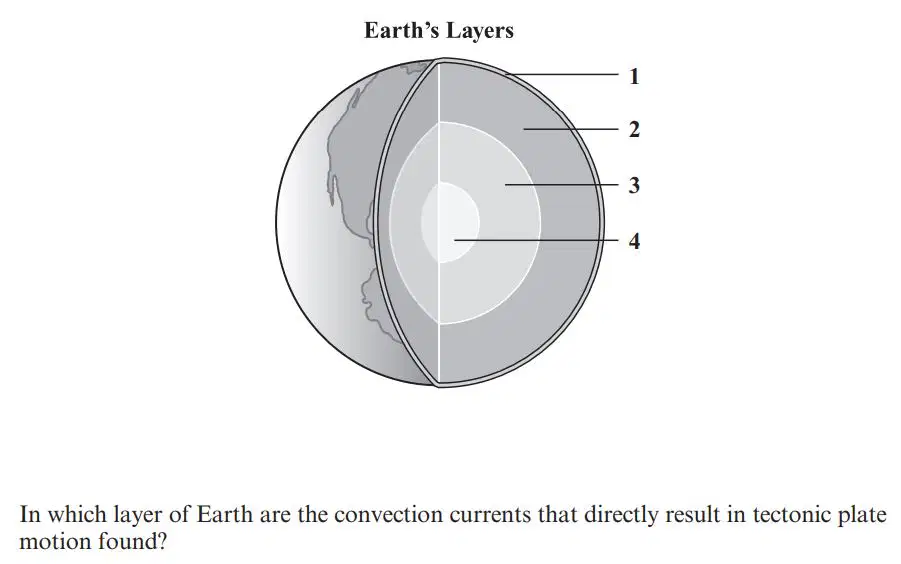
SC.7.E.6.1
Interactions between layers of Earth cause convection currents to move crustal plates. The diagram below shows four layers of Earth.
a)
A. 1
b)
B. 2
c)
C. 3
d)
D. 4
33.
SC.6.E.7.6
The climate of an area can be different from its weather. Which of the following statements describes the climate of an area?
a)
A. There should be heavy rains tomorrow morning.
b)
B. The rains next week are expected to cause some flooding.
c)
C. The average temperature from 1930–1996 was 23°C (74°F).
d)
D. The high temperature on September 4, 2009, was 32°C (89°F).
34.
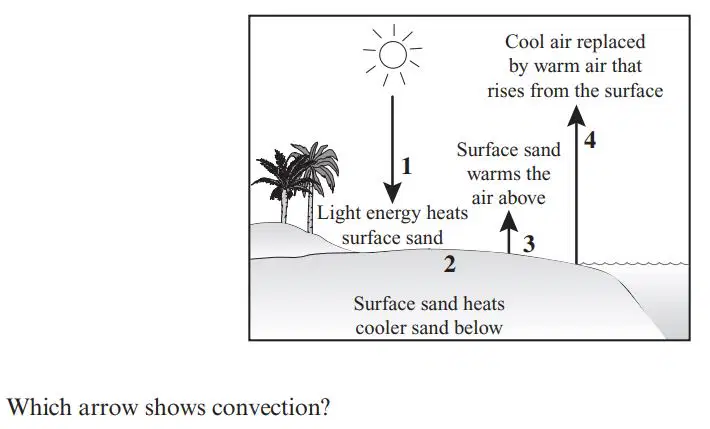
SC.6.E.7.1
The arrows in the picture below show several ways heat is transferred from the Sun as it strikes sand on the surface of a beach.
a)
A. 1
b)
B. 2
c)
C. 3
d)
D. 4
e)
Option 5
35.
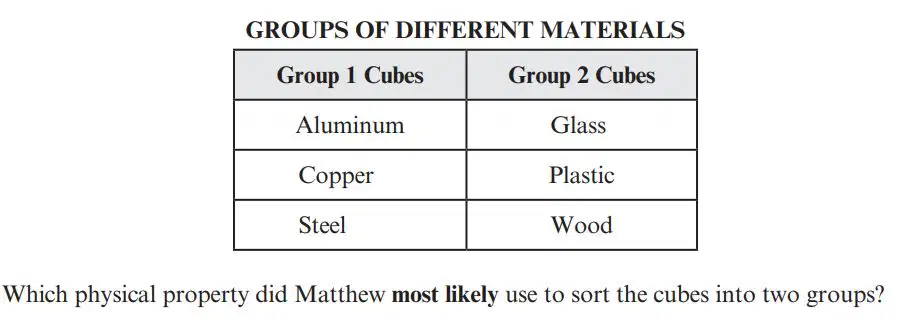
SC.8.P.8.4
Matthew has six cubes of different materials. Each cube has a mass of 10 grams (g). Matthew sorts the cubes into two groups using one physical property.
a)
A. density
b)
B. magnetism
c)
C. melting point
d)
D. electrical conductivity
36.
SC.8.P.8.6
Lithium (Li), Sodium (Na), Potassium (K), Rubidium (Rb), Cesium (Cs), and Francium (Fr) are in the same column in the periodic table. Why are these elements in the same column in the periodic table?
a)
A. They have similar properties.
b)
B. They have atoms of the same size.
c)
C. They have the same number of protons.
d)
D. They have the same number of neutrons.
37.
SC.8.P.9.2
When a candle is lit, the wick burns, the wax melts, the candle changes shape, and the air around the candle heats up. Which of the following is an example of a chemical change?
a)
A. the wick burning
b)
B. the wax melting
c)
C. the candle changing shape
d)
D. the air around the candle heating up
38.
SC.7.P.10.1
Sunlight is composed of energy that is visible to humans and energy that is not visible to humans. Which statement describes how the visible energy from the Sun is different from the nonvisible energy?
a)
A. It travels at a different speed through space.
b)
B. It travels a different distance through space.
c)
C. It has different wavelengths.
d)
D. It has different amplitudes.
39.
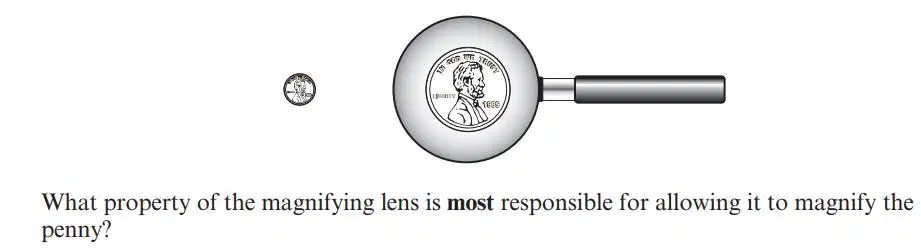
SC.7.P.10.2
The diagram below demonstrates how a magnifying lens can make a penny appear larger.
a)
A. It can reflect light.
b)
B. It can refract light.
c)
C. It can increase the intensity of light.
d)
D. It can increase the wavelength of light.
40.
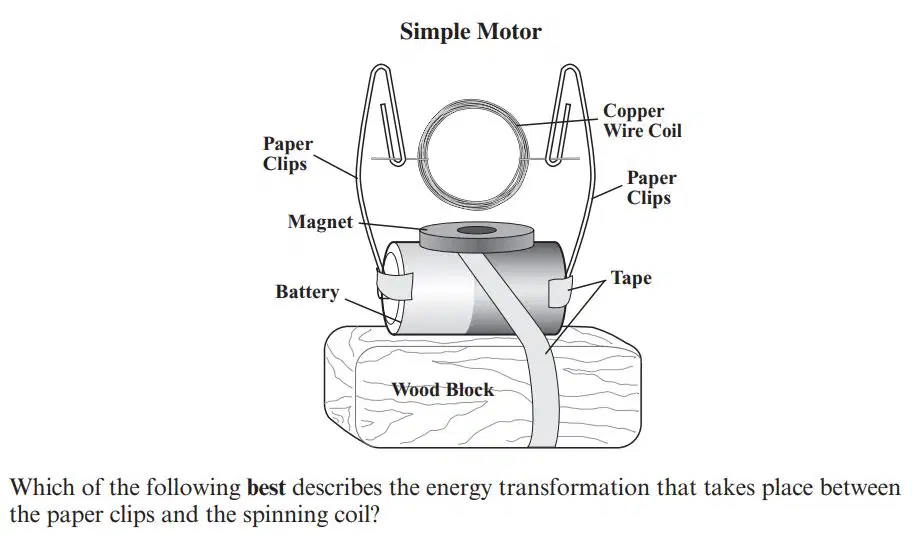
SC.7.P.11.2
Emma constructed a simple motor. When connected correctly, the coil of copper wire spins.
a)
A. Chemical energy transforms into electrical energy.
b)
B. Mechanical energy transforms into chemical energy.
c)
C. Mechanical energy transforms into electrical energy.
d)
D. Electrical energy transforms into mechanical energy.
41.
SC.7.P.11.4
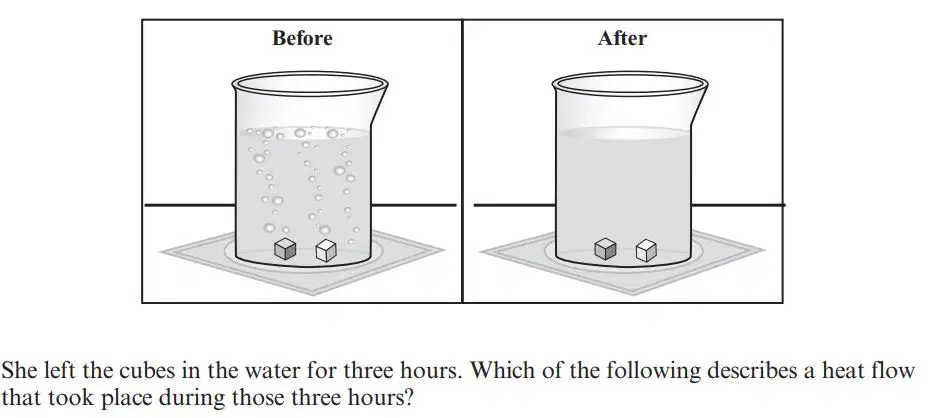
Mrs. Aldaco added a room-temperature copper (Cu) cube and an aluminum (Al) cube that she just removed from the freezer to a beaker of boiling water.
a)
A. from the aluminum cube to the beaker
b)
B. from the copper cube to the boiling water
c)
C. from the aluminum cube to the copper cube
d)
D. from the boiling water to the aluminum cube
42.
SC.6.P.13.3
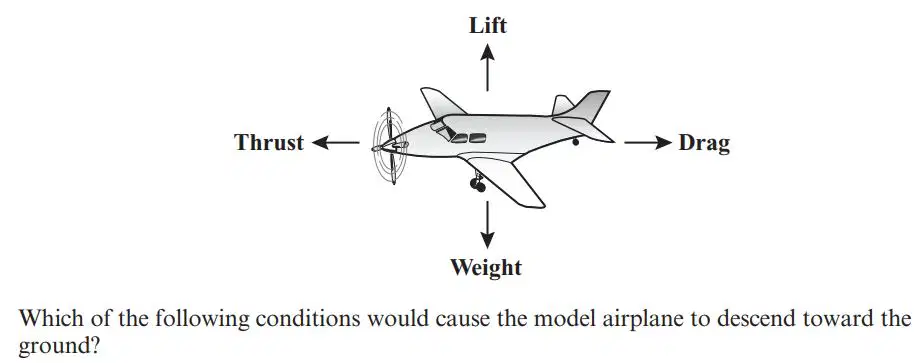
The diagram below shows forces acting on a model airplane. Both its speed and height above the ground are constant.
a)
A. The lift is equal to the drag.
b)
B. The lift is less than the weight.
c)
C. The thrust is equal to the weight.
d)
D. The thrust is greater than the drag.
43.
SC.6.L.14.1
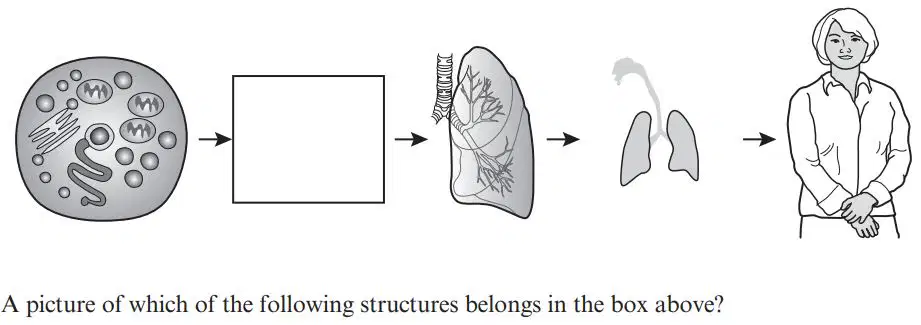
Structures in the human body work together to perform specific functions. The diagram below shows the organization of structures found in the human body.
a)
A. cell
b)
B. organ
c)
C. organelle
d)
D. tissue
44.
SC.6.L.14.2
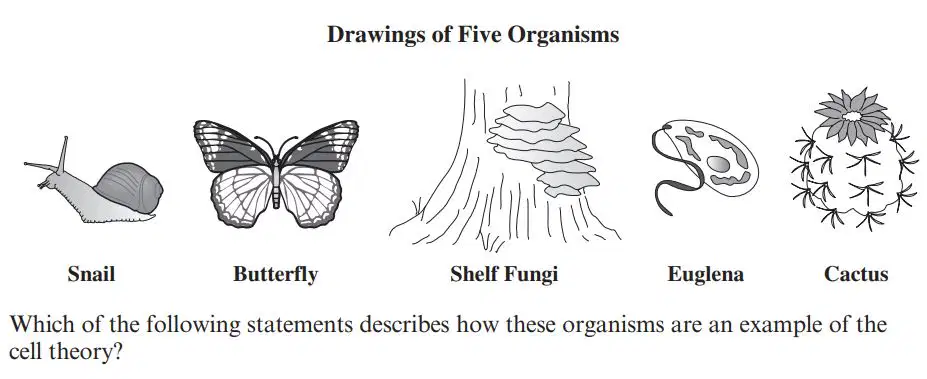
The cell theory applies to all organisms, including the five shown below.
a)
A. The organisms have cells that lack a nucleus.
b)
B. The organisms are made of one or more cells.
c)
C. The cells of the organisms undergo photosynthesis.
d)
D. The cells of the organisms are identical to each other.
45.
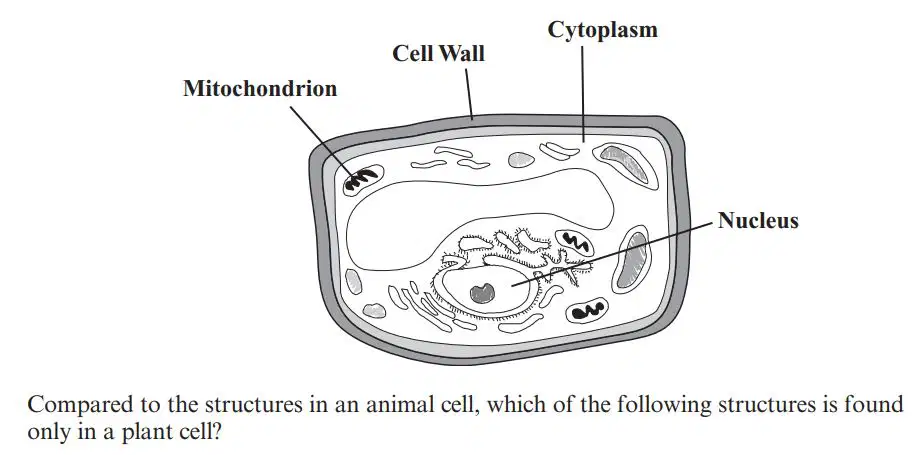
SC.6.L.14.4
Plant cells are different from animal cells. The diagram below identifies four different structures in a plant cell.
a)
A. Mitochondrion
b)
B. Cell Wall
c)
C. Cytoplasm
d)
D. Nucleus
46.
SC.6.L.14.5
In order to maintain homeostasis, the systems of the human body work together to keep a constant internal temperature. Which of the following best describes how the human body responds in a cold environment?
A. The digestive system produces more hormones to warm the body.
B. The nervous system signals the muscles of the muscular system to contract and warm the body.
C. The circulatory system delivers less carbon dioxide to the muscular system, resulting in stiffening of the muscles.
D. The skeletal system produces more blood cells that circulate through the blood vessels, increasing the warmth of the body.
a)
A.
b)
B.
c)
C.
d)
D.
100 %

