
 Worksheets
7th Grade Biology Review
Total questions: 43
Worksheet time: 22mins
Name
Class
Date
1.
What is the name of the jelly-like substance that is inside the cell?
a)
cytoplasm
b)
ectoplasm
c)
cytokinesis
2.
Which scientist was responsible for giving the cell its name?
a)
Robert Hooke
b)
Anton von Leeuwenhoek
c)
Rudolf Virchow
3.
What are two organelles all cells have?
a)
cell wall and cell membrane
b)
cell membrane and nucleus
c)
cell membrane and cytoplasm
4.
What cell organelle is responsible for powering the cell?
a)
endoplasmic reticulum
b)
Golgi bodies
c)
mitochondria
5.
Where in the cell is DNA found?
a)
ribosomes
b)
nucleus
c)
nucleolus
6.
What are two features that plant cells have that animals cells do not?
a)
lysosome and cell walls
b)
cell wall and chloroplasts
c)
cell membrane and nucleus
7.
What is the main function of the cell wall?
a)
to protect and provide support for the cell
b)
builds proteins
c)
convert sunlight to energy
8.
Which type of organisms are made of many different types of cells?
a)
unicellular
b)
multicellular
c)
cellular
9.
Eukaryotic cells include
a)
bacteria.
b)
only animals.
c)
only plants.
d)
plants and animals.
10.
Which organelle controls what enters and leaves the cell?
a)
nucleus
b)
cell membrane
c)
cell wall
11.
Which of the following is the best example of the characteristic of living things when organisms adapt and evolve?
a)
the food changes so the beak structure of the bird changes
b)
the weather changes so the clothes of the people change
c)
the food is not good so people make food that is good
12.
In which organism will you NOT find a cell wall?
a)
fungi
b)
plants
c)
animals
13.
Which organelle would you expect to find in a plant cell but not an animal cell?
a)
mitochondria
b)
ribosome
c)
chloroplast
14.
Which characteristic of living things is represented by the following statement: Most kids grow a lot in their early teens.
a)
reproduce
b)
evolve and adapt
c)
grow and develop
15.
Which of the following is NOT a statement of the Cell Theory?
a)
All living things are made up of cells.
b)
Cells are the basic units of structure and function of living things.
c)
Cells appear through crystallization.
d)
All cells come from pre-existing cells.
16.
Which scientist named the bacteria after looking at his own dental scrapings?
a)
Robert Hooke
b)
Anton von Leeuwenhoek
c)
Rudolf Virchow
17.
Which of the following is NOT a characteristic of living things?
a)
All living things are made of at least one cell.
b)
All living things obtain and use energy.
c)
All living things are very complex.
d)
All living things respond to their environment.
18.
Which of the following is a characteristic of responding to stimuli?
a)
you jump when someone slams the door
b)
flowers opening in sunlight
c)
jerking your hand away from a hot plate
d)
all of the above
19.
Which of the following types of cells do NOT have a nucleus?
a)
prokaryotes
b)
eukaryotes
20.
Which tool was created in order to see cells?
a)
telescope
b)
microscope
c)
barometer
21.
Which cells came first?
a)
prokaryotic cells
b)
eukaryotic cells
22.
Which cells are more complex?
a)
prokaryotes
b)
eukaryotes
23.

Identify #1 in the diagram above.
a)
nuclear membrane
b)
nucleus
c)
nucleolus
24.

Identify #5 in the diagram above.
a)
ER
b)
nucleus
c)
golgi body
25.
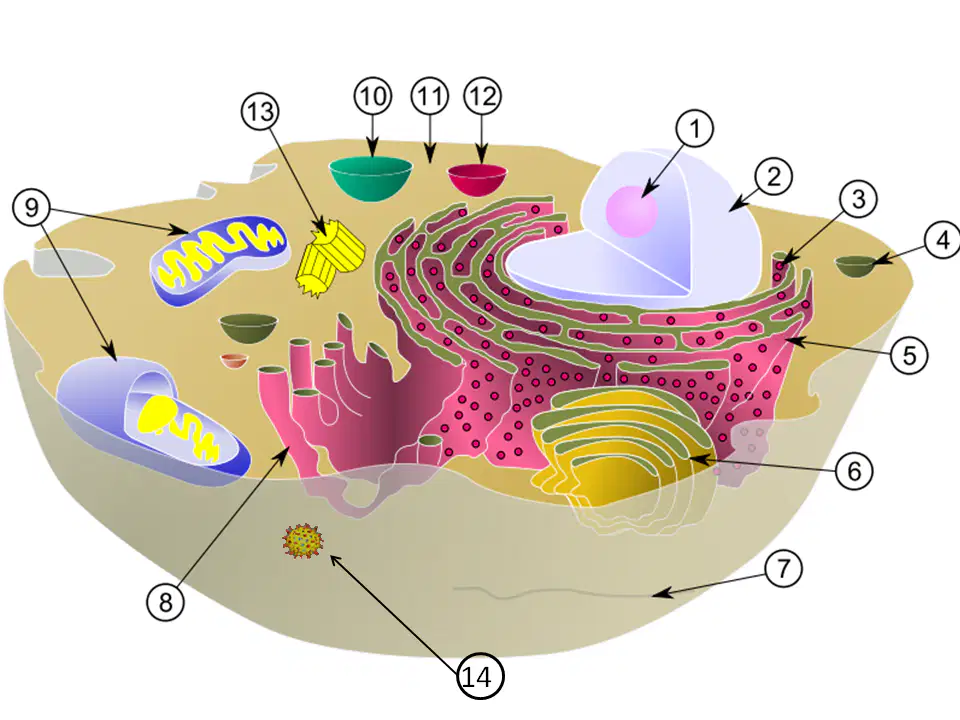
Identify #9 in the diagram above.
a)
chloroplast
b)
mitochondria
c)
vacuole
26.
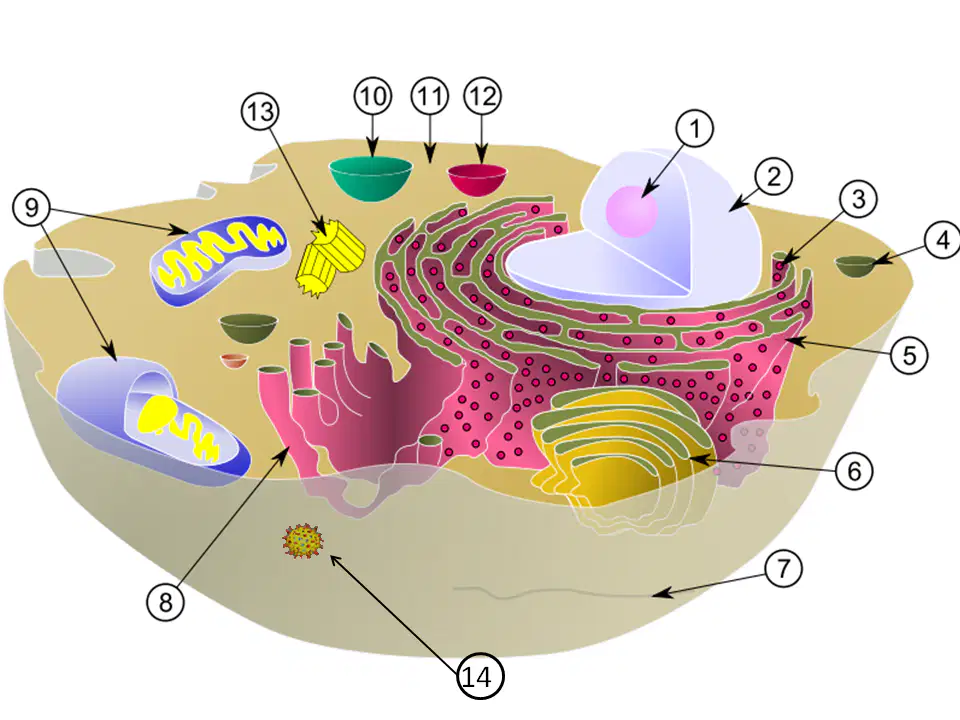
Identify #11 in the diagram above.
a)
chloroplast
b)
cell membrane
c)
cytoplasm
27.

Identify A in the diagram above.
a)
lysosome
b)
cytoplasm
c)
chloroplast
28.

Identify B in the diagram above.
a)
lysosome
b)
vacuole
c)
cytoplasm
29.

Identify BE in the diagram above.
a)
mitochondria
b)
chloroplast
c)
vacuole
30.

Identify AE in the diagram above.
a)
cell membrane
b)
cell wall
c)
cytoplasm
31.
Which of the following is an example of a response?
a)
a bacteria entering your body
b)
a bell ringing
c)
getting butterflies in your stomach before you shoot a free throw
32.
Which characteristic of living things is represented by the following statement: A cat eats a mouse.
a)
evolve and adapt to the environment
b)
obtain and use energy
c)
maintain homeostasis
33.
Which characteristic of living things is represented by the following statement: You shake when your body temperature drops below your normal temperature.
a)
respond to the environment
b)
maintain homeostasis
c)
evolve and adapt
34.
Which type of cells make up humans?
a)
prokaryotes
b)
eukaryotes
35.
Who was responsible for the part of the cell theory that stated, "all living things are composed of one or more cells?"
a)
Hooke and Leeuwenhoek
b)
Virchow and Schleiden
c)
Schleiden and Schwann
36.
What is the cell mostly made of?
a)
water
b)
organelles
c)
cytoplasm
37.
Which of the following scientist was NOT involved in developing the cell theory?
a)
Virchow
b)
Sagan
c)
Schwann
38.
Which organelle contains digestive enzymes which breaks things down inside the cell?
a)
lysosomes
b)
ribosomes
c)
vacuoles
39.
Which organelle packages and moves materials around inside the cell?
a)
endoplasmic reticulum
b)
chloroplasts
c)
Golgi bodies and vesicles
40.
Which organelle is much larger in a plant cell so that it can store water?
a)
nucleus
b)
mitochondria
c)
vacuole
41.
Which part of the cell is responsible for producing ribosomes?
a)
nucleolus
b)
cytoplasm
c)
endoplasmic reticulum
42.
What is the primary function of mitochondria in the cell?
a)
protein synthesis
b)
photosynthesis
c)
energy production
43.
Which structure is responsible for maintaining the shape of a plant cell?
a)
cytoplasm
b)
cell wall
c)
cell membrane
100 %

