
 Worksheets
Food Chains, Webs, and Trophic Levels
Total questions: 40
Worksheet time: 1hrs 29mins


Where do animals get their energy?
by eating plants
by eating other animals
from the sun
from nutrients in the ground


What is the fruit fly's highest trophic level?
Primary
Secondary
Tertiary
Quaternary
In the food chain below, which is the producer?
grass --> mouse --> snake --> hawk
grass
mouse
snake
hawk

The diagram shows a food web for an ocean ecosystem.
How would an increasing shark population most likely affect this ecosystem?
The algae population would decrease.
The limpet population would decrease.
The seagull population would decrease.
The octopus population would decrease.
This term describes the order in which matter and energy move through an ecosystem:
food chain
photosynthesis
producer
tertiary

Examine the energy pyramid. Which organism best represents a secondary consumer?
grass
rabbit
snake
eagle
Food chains in an ecosystem overlap to form:
bacteria and decomposers
food webs
nutrient cycling
photosynthesis
What is your role in an ecosystem?
producer
consumer
decomposer
answer not listed

A forest ecosystem food web is shown below. If additional wrens (small birds) are introduced into this ecosystem, there will most likely be an immediate decrease in the
frog population
snake population
falcon population
grasshopper population

The picture below shows an energy pyramid. What will most likely happen to the foxes and the wolves if the rabbits are removed?
The foxes will eat more wolves.
The foxes will eat fewer wolves.
There will be more foxes and wolves.
There will be fewer foxes and wolves.

The picture below shows an ocean bay food chain.Sea otters move into the ocean bay. They eat all the sea urchins. This change will cause the
kelp to have less food.
crabs to have more food
sea ducks to have less food
arctic faxes to have more food

A marine food web is shown below. Which chart correctly shows three of the organisms according to their roles in cycling matter in the marine food web?


The picture below shows the energy flow through a meadow community. Which of the following would most likely occur to the populations within the community of organisms immediately after a wildfire burns the environment?
Hawks would increase and foxes would increase
Hawks would decrease and foxes would increase
Meadow plants would increase and rabbits would decrease
Meadow plants would decrease and rabbits would decrease

The diagram below shows a simple food web. Which animal is classified as an omnivore?
red fox
deer
black bear
rabbit

The diagram below shows a marine food chain. The zooplankton in this food chain are
primary producer
primary consumer
secondary consumer
tertiary (third) consumer
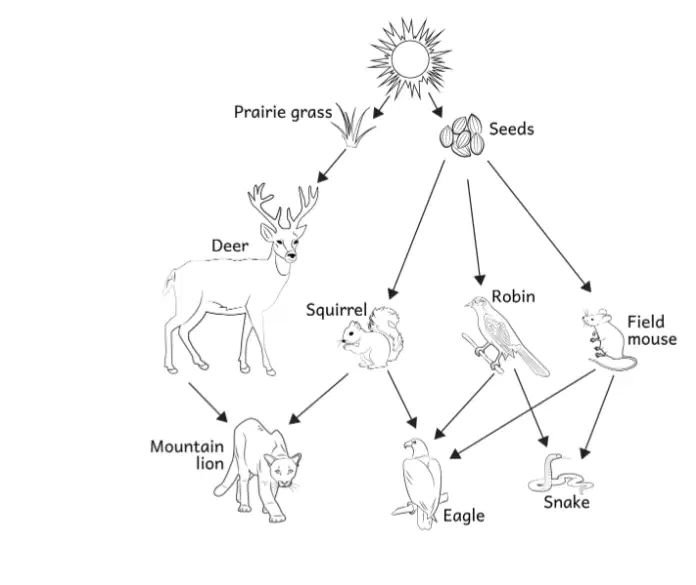
A food web diagram is provided. Based on the diagram, which three consumers all get their energy directly from the same producer?
Plant seeds, field mouse, and snake
Prairie grass, deer, and mountain lion
Squirrel, deer, and mountain lion
Squirrel, robin, and field mouse
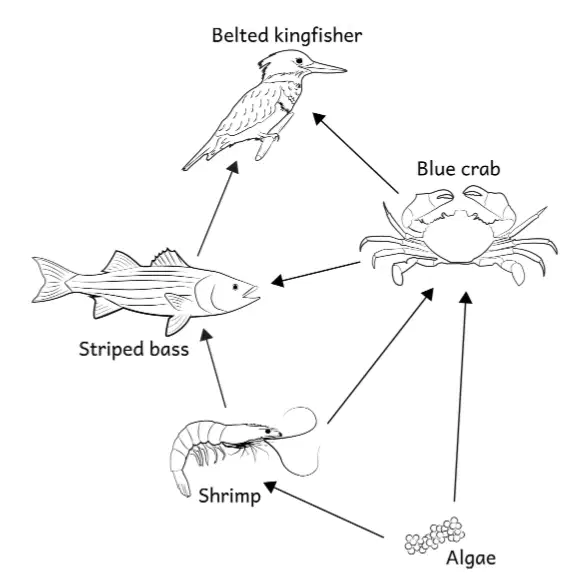
The diagram shows part of an ocean food web. Which statements are true about this food web?
The kingfisher receives its energy from the blue crab and the striped bass.
The arrows show how one organism changes to another.
The blue crab provides energy for the shrimp.
The arrows show the flow of energy from one organism to another.
Producers, like shrimp, are organisms that depend on other organisms for food.

Look at the image. Name the producers.
(a)
Look at the image. Name the producers.
Mushroom
Plants and Mushroom
Plants
Mouse, Owl, Snake, Fox, and Hawk
Look at the image. Name the Decomposer.
Mushroom
Plants and Mushroom
Plants
Mouse, Owl, Snake, Fox, and Hawk
Look at the image. Name the Consumers.
Mushroom
Plants and Mushroom
Plants
Mouse, Owl, Snake, Fox, and Hawk
In a food web the arrow always points to
the consumer
the prey
producer
autotroph


In this food web, the berries would be a _________.
Producer
Primary Consumer
Secondary Consumer
Tertiary Consumer
In this food web, the bird would be a _________ and a _________.
Producer
Primary Consumer
Secondary Consumer
Tertiary Consumer
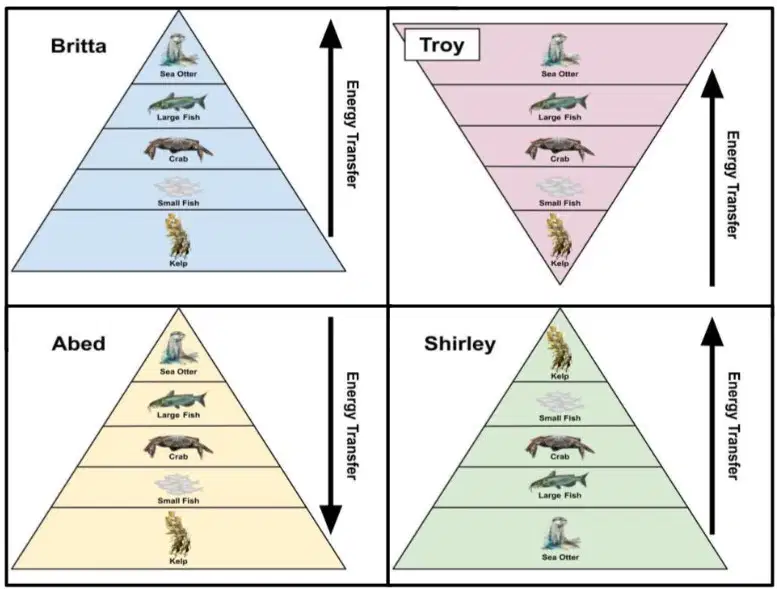
Which student's model best represents available energy at each level of the food web and how it is transferred?
Shirley
Abed
Troy
Britta
In a predator-prey relationship, which of the following is the predator?
Mouse
Grasshopper
Owl
Leaf

