
 Worksheets
Weather Review 23-24
Total questions: 43
Worksheet time: 47mins
Name
Class
Date
1.
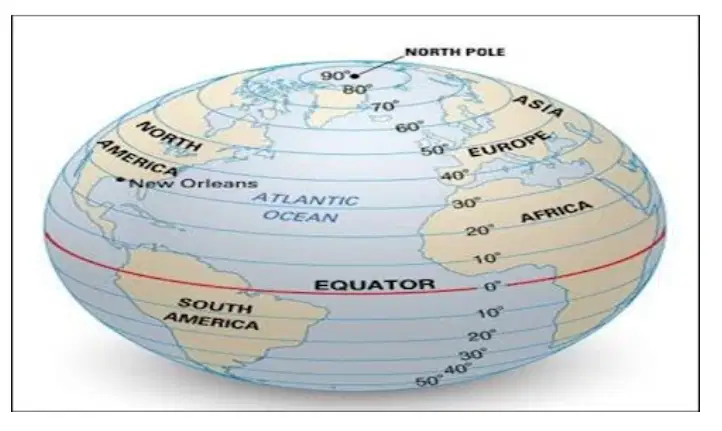
1. Look at the picture below. What do the lines represent
a)
A) Latitude
b)
B) Longitude
c)
C) Altitude
d)
D) Aptitude
2.
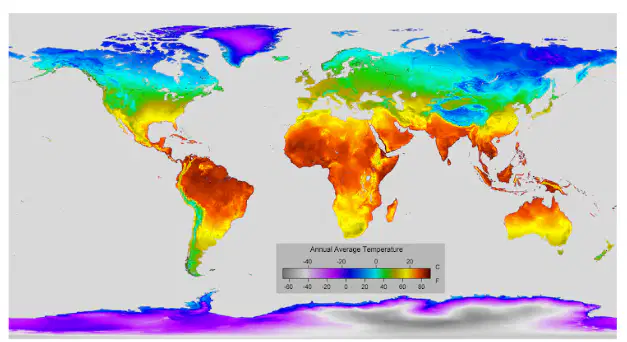
2. Look at the picture below. What can you tell about the temperatures around the Earth? (Red = Hot)
a)
A. Temperatures tend to be colder around the middle and warmer at the North and South poles.
b)
B. Temperatures tend to be warmer around the middle and colder at the North and South poles.
c)
C. Temperatures are the same around the entire world.
3.
3. How will heating up the temperature of the air change the density?
a)
A. It will become less dense.
b)
B. It will become more dense.
c)
C. The density will not change.
4.
4. Humidity is the measure of how much ________ is in the air?
a)
A. Water Vapor
b)
B Air Pressure
c)
C. Wind
d)
D. Salt
5.
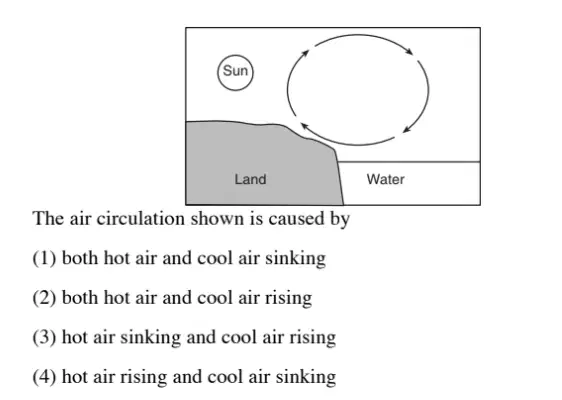
5. The arrows in the diagram below show the circulation of air on a sunny day.
a)
A.
b)
B.
c)
C.
d)
D.
6.
6. Which temperature and moisture conditions describe an air mass that originates over the Atlantic Ocean near the equator?
a)
A. warm and dry
b)
B. warm and humid
c)
C. cool and dry
d)
D. cool and humid
7.
7. Low-pressure systems generally move across the United states from
a)
A. North to south
b)
B. East to west
c)
C. West to East
d)
D. South to north
8.
8. What factors affects the type of climate that will occur at different latitudes
a)
A. The amount of direct sunlight.
b)
B. The ocean currents
c)
C. The wind
d)
D. All of the above
9.
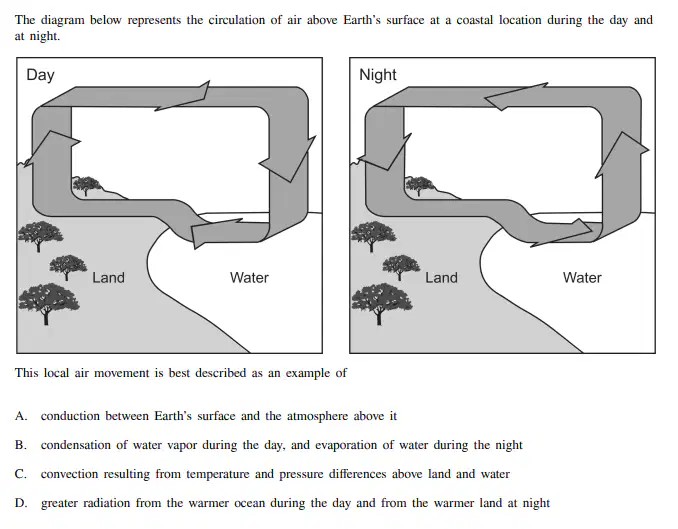
9.
a)
A.
b)
B.
c)
C.
d)
D.
10.
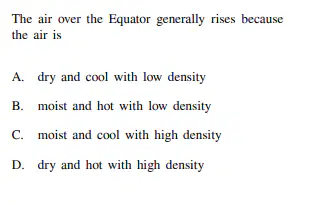
10.
a)
A.
b)
B.
c)
C.
d)
D.
11.
11. What tool or instrument is used to measure wind speed?
a)
A. Thermometer
b)
B. Compass or wind vane
c)
C. Barometer
d)
D. Hygrometer or sling psychrometer
e)
Anemometer
12.
12. What tool or instrument is used to measure humidity?
a)
A. Thermometer
b)
B. Compass or wind vane
c)
C. Barometer
d)
D. Hygrometer or sling psychrometer
e)
Anemometer
13.
13. What tool or instrument is used to measure air pressure?
a)
A. Thermometer
b)
B. Compass or wind vane
c)
C. Barometer
d)
D. Hygrometer or sling psychrometer
e)
Anemometer
14.
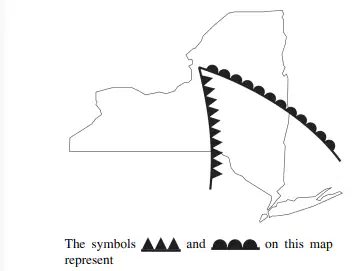
14. The diagram below shows two symbols commonly found on a weather map.
a)
A. winds
b)
B. fronts
c)
C. latitude and longitude
d)
D. climatic conditions
15.
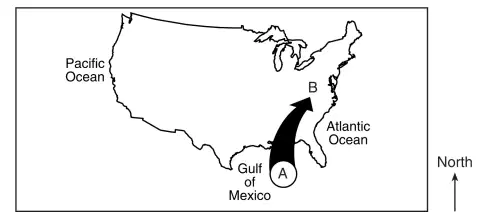
15. The map below shows an air mass that formed over the Gulf of Mexico at location A. Once air mass A reaches location B, the weather conditions at location B will most likely become
a)
A. warmer and drier
b)
B. warmer and more humid
c)
C. colder and more humid
d)
D. colder and drier.
16.
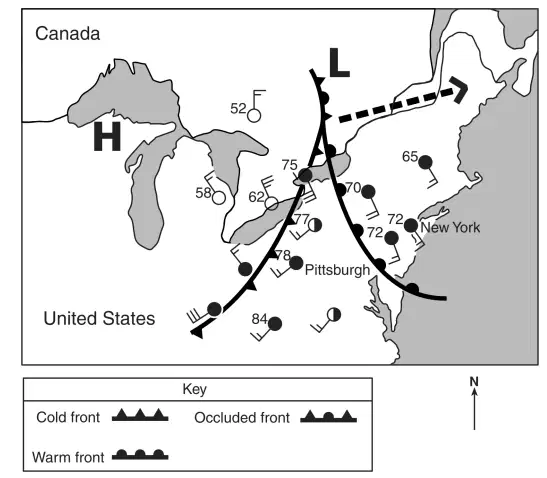
16. Base your answers to the questions on the weather map below, which shows a typical low-pressure system located over part of North America in May. The numbers on the map indicate the air temperature in degrees Fahrenheit. The fronts shown on the weather map are best described as
a)
A. boundaries between different air masses
b)
B. boundaries between different wind belts
c)
C. areas experiencing clear skies with light winds
d)
D. areas experiencing extremely warm air temperatures.
17.
17. The movement of an air mass over Earth's surface causes
a)
A. earthquake activity
b)
B. local weather changes
c)
C. global warming
d)
D. ecological succession
18.
18. A sudden change in the weather at a certain location is most likely caused by
a)
A. the arrival of an air mass
b)
B. a severe earthquake
c)
C. a high ocean tide
d)
D. an eclipse of the moon.
19.
19. Which temperature and moisture conditions describe an air mass that originates over the Atlantic Ocean near the equator?
a)
A. warm and dry
b)
B. warm and humid
c)
C. cool and dry
d)
D. cool and humid
20.
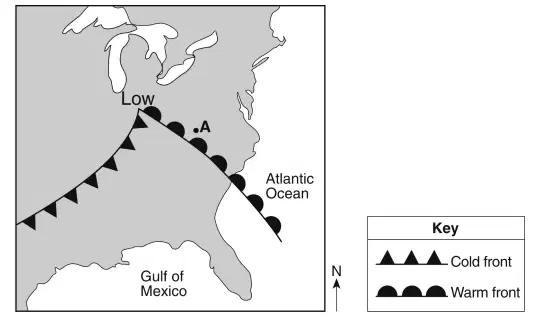
20. Base your answers to the questions on the weather map below an on your knowledge of science. The center of a storm system (Low) over part of the United States and the frontal boundaries associated with this system are shown. Point A represents a location on the map. The word Low on the map refers to:
a)
A. air temperature
b)
B. air pressure
c)
C. relative humidity
d)
D. amount of cloud coverage
21.
21. Precipitation is most likely occurring at A because it is located
a)
A. on a cold surface
b)
B. on a warm land surface
c)
C. near the cold front
d)
D. near the warm front
22.
22. Which weather condition commonly occurs along a cold front?
a)
A. clear skies
b)
B. precipitation
c)
C warm temperature
d)
D dry air
23.
23. Low-pressure systems generally move across the United states from
a)
A. North to south
b)
B. East to west
c)
C. West to East
d)
D. South to north
24.
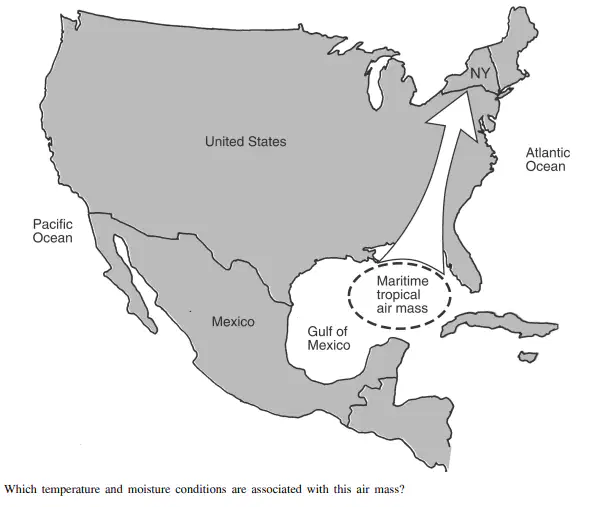
24. Which temperature and moisture conditions would be associated with this air mass?
a)
A. cold and dry
b)
B. warm and humid
c)
C. cold and humid
d)
D. warm and dry
25.
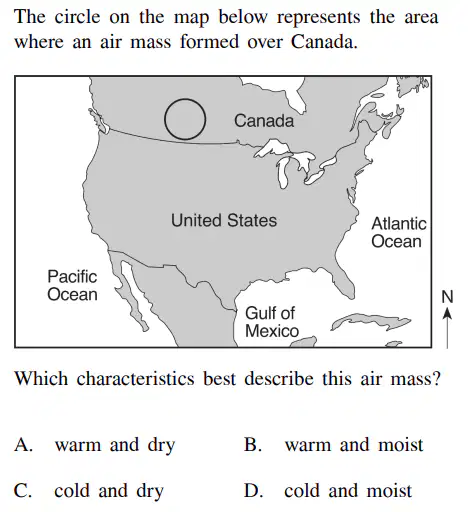
25
a)
A. warm and dry
b)
B. warm and moist
c)
C. cold and dry
d)
D. cold and moist
26.
What causes winds to form on Earth?
a)
solar energy
b)
ocean currents
c)
elevation differences
d)
uneven heating of the Earth by the sun
27.
A student states the weather is the same as the climate. Which response BEST tells the student the difference between weather and climate?
a)
Weather is about the wind and the rain, but climate is about the clouds.
b)
Weather is the conditions in one day, but climate is the conditions over a long time.
c)
Weather is measured with tools like thermometers, but climate is measured with tools like forecasts.
d)
Weather is recorded on charts, but climate is recorded on world maps.
28.
Weather refers to the conditions of Earth’s atmosphere at a particular ____________.
a)
Location
b)
Time
c)
Place
d)
Time and Place
29.

This is the symbol for a...
a)
Cold Front
b)
Warm Front
c)
Stationary Front
d)
Occluded Front
30.

This is the symbol for a...
a)
Occluded Front
b)
Stationary Front
c)
Warm Front
d)
Cold Front
31.

Identify the type of front that is shown in the image.
a)
Occluded Front
b)
Cold Front
c)
Stationary Front
d)
Warm Front
32.

Identify the type of front that is shown in the image.
a)
Occluded Front
b)
Cold Front
c)
Stationary Front
d)
Warm Front
33.

Identify the type of front that is shown in the image.
a)
Occluded Front
b)
Cold Front
c)
Stationary Front
d)
Warm Front
34.
This weather tool measures wind speed
a)
thermometer
b)
barometer
c)
anemometer
d)
psychrometer
35.
Which weather tool measures air pressure?
a)
thermometer
b)
barometer
c)
anemometer
d)
psychrometer
36.
Humidity is the...
a)
Amount of Water Vapor in the Air
b)
Amount of Wind in the Air
c)
Amount of Precipitation in the Air
d)
Amount of Pressure in the Air
37.
__________ a two-thermometer instrument slung around a rod or pole that is also referred to as a wet dry bulb used to measure relative humidity.
a)
thermometer
b)
barometer
c)
sling psychrometer
d)
anemometer
38.
Warm air near the Earth’s surface rises and then cools and drops, this creates a _________________ in the atmosphere.
a)
run-off
b)
Greenhouse Effect
c)
convection current
d)
water cylce
39.
Because the earth is spinning on its axis, the global winds appear to curve. This is known as the __________ ________.
a)
Coriolis Effect
b)
Greenhouse Effect
c)
Climate Effect
d)
Atmosphere Effect
40.
What kind of weather is usually associated with a low pressure system?
a)
Sunny weather
b)
Precipitation (rain, snow, etc.)
41.
What kind of weather is usually associated with a high pressure system?
a)
Sunny weather
b)
Precipitation (rain, snow, etc.)
42.
In what direction do winds always blow?
a)
From areas of high pressure to areas of low pressure
b)
From areas of low pressure to areas of high pressure
43.
What measures temperature?
a)
barometer
b)
anemometer
c)
thermometer
d)
psychrometer
100 %

