
 Worksheets
Test Prep: The Earth-Sun-Moon System
Total questions: 46
Worksheet time: 23mins
Name
Class
Date
1.
daytime + nighttime always =
a)
2 days
b)
24 hours
c)
12 hours
2.
The sun always rises in the:
a)
north
b)
south
c)
east
d)
west
3.
The sun always sets in the:
a)
north
b)
south
c)
east
d)
west
4.
At what time of day is the sun at it's highest point?
a)
8am
b)
12pm
c)
3pm
d)
12am
5.
What shape pattern does the sun follow throughout the day?
a)
circle
b)
square
c)
sphere
d)
arc
6.
Stars shine:
a)
at night
b)
during the day
c)
day and night
7.
A group of stars in a specific pattern are called:
a)
constellation
b)
orion
c)
bunch-o-stars
d)
star cluster
8.
What is a path that a body follows as it travels around another body in space?
a)
the moon
b)
an orbit
c)
a star
d)
a constellation
9.
The _______ orbits _________ which orbits the ________.
a)
sun/ earth/ moon
b)
earth/ moon/ sun
c)
moon/earth/ sun
10.
How many days are in a year?
a)
365.25
b)
365.50
c)
365.00
d)
365.75
11.
How do we see the moon?
a)
the light is reflected from inside the moon
b)
the light is reflected from Earth
c)
the light is reflected from the sun
12.
The change in the sunlit area of one celestial body as seen from another celestial body.
a)
orbit
b)
constellation
c)
phase
d)
shape
13.
Which is the fifth phase of the moon?
a)
gibbous moon
b)
crescent moon
c)
full moon
d)
new moon
e)
quarter moon
14.
Which is the third phase of the moon?
a)
waning gibbous moon
b)
waning crescent moon
c)
full moon
d)
new moon
e)
first quarter moon
15.
Which is the fourth phase of the moon?
a)
waxing gibbous moon
b)
waxing crescent moon
c)
full moon
d)
new moon
e)
third quarter moon
16.
Which is the first phase of the moon?
a)
gibbous moon
b)
crescent moon
c)
full moon
d)
new moon
e)
quarter moon
17.
How many days does it take for the moon to complete one cycle of phases?
a)
29 days
b)
29.25 days
c)
29.5 days
d)
29.75 days
e)
30 days
18.
An event in which the shadow of one celestial body falls on another:
a)
rotation
b)
orbit
c)
eclipse
d)
shadow
19.
During a solar eclipse, which celestial body is in the middle?
a)
Sun
b)
Earth
c)
Moon
20.
During a lunar eclipse, which celestial body is in the middle?
a)
Sun
b)
Earth
c)
Moon
21.
The darker, inner shadow that extends behind the moon:
a)
umbra
b)
penumbra
22.
During a solar eclipse, the sun appears to go either fully or partially dark. Which of the following does NOT explain why solar eclipses can only be observed on certain parts of Earth?
a)
The moon is smaller than Earth
b)
People in the penumbra will see the sun go partially dark
c)
Solar eclipses only occur once every few years
d)
Only people in the penumbra will see the sun go partially dark.
23.
Which of the following is not a type of solar eclipse:
a)
annular solar eclipse
b)
partial solar eclipse
c)
total solar eclipse
d)
penumbral solar eclipse
24.
Occurs when the moon is farther away from Earth in its orbit, and the umbra shadow does not quite reach Earth.
a)
annular solar eclipse
b)
partial solar eclipse
c)
total solar eclipse
d)
penumbra solar eclipse
25.
Occurs when the sun appears to be completely blocked except for a bright halo of light:
a)
annular solar eclipse
b)
partial solar eclipse
c)
total solar eclipse
d)
penumbra solar eclipse
26.

Name the type of eclipse:
a)
uneclipsed sun
b)
partial solar eclpse
c)
annular solar eclipse
d)
total solar eclipse
27.
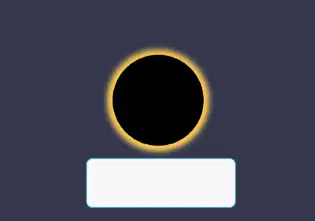
Name the type of eclipse:
a)
uneclipsed sun
b)
partial solar eclpse
c)
annular solar eclipse
d)
total solar eclipse
28.
Which of the following is not a type of lunar eclipse:
a)
partial lunar eclipse
b)
penumbral lunar eclipse
c)
annular lunar eclipse
d)
total lunar eclipse
29.
What phase will the moon be in during a solar eclipse?
a)
new moon
b)
first quarter moon
c)
full moon
d)
third quarter moon
30.
When the sun sets in the Central Time Zone, in which time zones will it be night?
a)
Pacific and Mountain
b)
Mountain and Eastern
c)
Eastern and Central
d)
Central and Pacific
31.
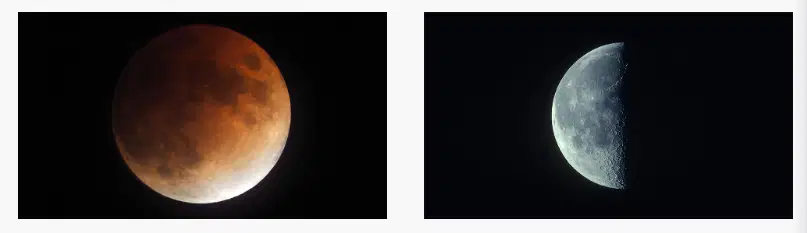
Which of the following is NOT true about the appearance of the moon in the 2 photos:
a)
The moon in the photo on the left only occurs when the moon is in Earth's shadow.
b)
The photo on the left shows an eclipse and the photo on the right shows a phase
c)
The moon in the photo on right occurs about once every month.
d)
Both photos show the same phase of the moon
32.
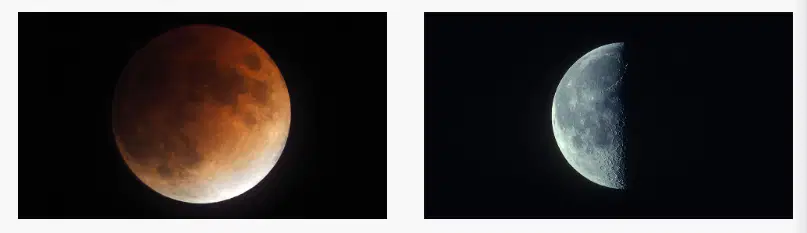
The moon in the photo on the right is in its third quarter. How will the moon look after it moves another quarter of the way through its orbit?
a)
It will look the same as it looks in the photo.
b)
The moon will be completely dark.
c)
The full circle of the moon will be lit.
d)
The quarter moon will be lit on the other side.
33.
The sun, stars, and moon appear to rise on the _______ as Earth rotates towards the east.
a)
western horizon
b)
eastern horizon
c)
all of the above
d)
none of the above
34.
The sun, stars, and moon appear to set on the _______.
a)
western horizon
b)
eastern horizon
c)
all of the above
d)
none of the above
35.
What is the difference in appearance between a full moon and a new moon?
a)
A new moon looks dark because the side of the moon facing Earth is not lit by the sun.
b)
The entire sunlit side of the moon is visible to Earth during a full moon
c)
all of the above
d)
none of the above
36.
The sun is just one of the 100 billion stars in our galaxy known as the:
a)
Earth-Moon-Sun System
b)
Hershey's Galaxy
c)
Eclipses
d)
Milky Way
37.
The ________ side(s) of the moon always faces Earth
a)
same
b)
different
c)
alternating
d)
back
38.
The sun is the center of our
a)
Milky Way
b)
universe
c)
rotation
d)
solar system
39.
Changes in the appearance of the moon throughout the month are known as:
a)
lunar eclipses
b)
moon phases
c)
solar eclipses
d)
solar phases
40.
The titled axis and Earth's revolutions result in:
a)
longer summer days
b)
shorter winter days
c)
all of the above
d)
none of the above
41.
What causes day and night?
a)
the moon's shadow
b)
the sun's rotation
c)
Earth's rotation on its axis
d)
Earth's orbit around the sun
42.
Why does the sun appear to move across the sky?
a)
movement of the stars
b)
Earth's rotation on its axis
c)
Earth's orbit around the sun
d)
the sun's rotation
43.
What does the Foucault pendulum provide evidence for?
a)
the rotation of Earth on its axis
b)
the movement of the stars
c)
the orbit of the Earth around the sun
d)
none of the abve
44.
How long does it take for the Earth to orbit around the sun?
a)
24.5 hours
b)
1.5 month
c)
29.5 days
d)
365.25 days
45.
What causes different constellations to be visible from Earth at different times of year?
a)
Earth's rotation on its axis
b)
Earth's orbit around the sun
c)
Movement of the stars
d)
none of the above
46.
What causes the need for time zones?
a)
Earth's rotation on its axis
b)
Earth's orbit around the sun
c)
shadows
d)
sun dials
100 %

