wayground logo

Free Printable Worksheets

Font size

S
M
L
XL
Worksheets

SY25 Civics Review Pre-Test

Total questions: 38

Worksheet time: 20mins
Name
Class
Date
1.
SS.7.CG.1.1 Which statement identifies an important public influence that Ancient Greece had on the American Constitutional Republic?
a)
American believed in the equality of humankind
b)
Americans believed that religious liberty was a protect right
c)
Americans believed that ordinary citizens should participate in government
d)
Americans believed that a separation of powers would protect individual rights
2.
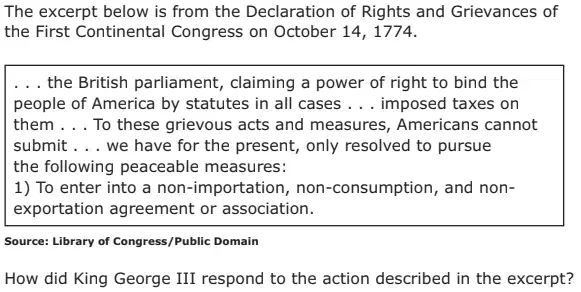
SS.7.CG.1.3 What was the significance of Thomas Paine’s pamphlet Common Sense?
a)
It was a published document outlining personal rights in Great Britain.
b)
It was an influential work calling for independence from Great Britain.
c)
It was a popular almanac instructing colonial farmers.
d)
It was a written framework of colonial government.
3.
SS.7.CG.1.4
a)
The Constitution establishes a two-house legislature.
b)
The Constitution grants executive power over foreign policy.
c)
The Constitution makes the legislature the strongest branch of government.
d)
The Constitution distributes power among the three branches of government.
4.
SS.7.CG.1.5
a)
He approved the colonists’ decision to use a trade boycott.
b)
He supported the election of colonial representatives to Parliament.
c)
He ignored the colonists’ demands for change in government policy.
d)
He repealed the law declaring Parliament could pass laws for the colonies.
5.
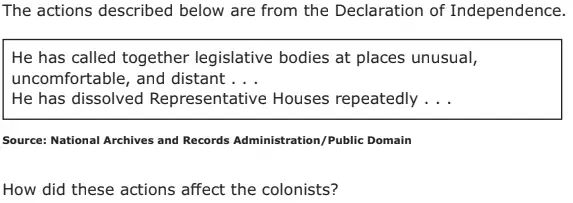
SS.7.CG.1.6
a)
Colonists were unable to pay their taxes.
b)
Colonists were unable to petition the king.
c)
Colonists were unable to participate in their government.
d)
Colonists were unable to play a part in community service.
6.
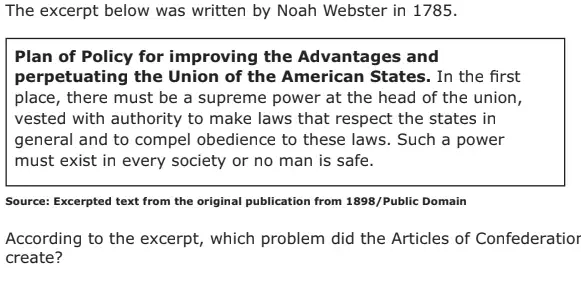
SS.7.CG.1.7
a)
a lack of checks on legislative powers
b)
a lack of powers given to state legislatures
c)
the lack of authority to enforce congressional acts
d)
the lack of authority to apportion congressional districts
7.
SS.7.CG.1.8 The passage below is from the Preamble to the U.S. Constitution. "We the People of the United States, in Order to form a more perfect Union, establish Justice, insure domestic Tranquility, provide for the common defense, promote the general Welfare, and secure the Blessings of Liberty to ourselves and our Posterity, do ordain and establish this Constitution for the United States of America." In 1957, President Eisenhower sent the National Guard into Little Rock, Arkansas, in order to prevent violence. Which goal of government, listed in the Preamble, did the action illustrate?
a)
to ensure domestic tranquility
b)
to form a more perfect union
c)
to secure the blessings of liberty
d)
to provide for the common defense
8.
SS.7.CG.1.9 Which statement describes the intent of checks and balances?
a)
The government receives revenue from the people.
b)
The government receives authority from the people.
c)
No branch of government can become too powerful.
d)
No branch of government can apply concurrent powers.
9.
SS.7.CG.1.10 During the ratification process, which complaint did the Anti-Federalists have with the U.S. Constitution?
a)
It failed to protect individual rights.
b)
It failed to recognize regional differences.
c)
It failed to provide for fair local representation.
d)
It failed to create a strong central government.
10.
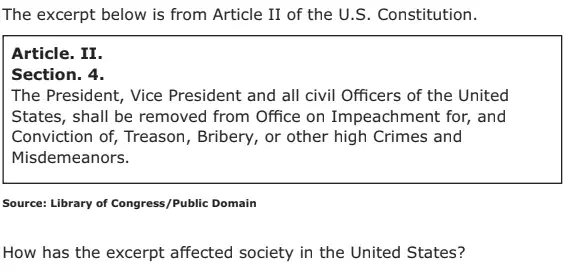
SS.7.CG.1.11
a)
No one is outside the law.
b)
No one is without legal representation.
c)
Everyone is subject to a grand jury indictment.
d)
Everyone is guaranteed equal representation in government.
11.
SS.7.CG.2.1 Why are people required to pass a U.S. citizenship test as part of the naturalization process?
a)
to create a safer society
b)
to create a healthier society
c)
to encourage a more informed citizenry
d)
to encourage a more privileged citizenry
12.
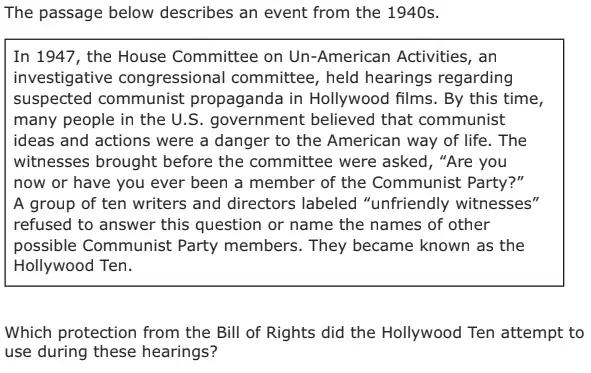
SS.7.CG.2.3
a)
No person shall be compelled to testify against himself or herself.
b)
The accused shall be confronted with the witnesses against him or her.
c)
No person shall be subject for the same offense to be twice put in jeopardy.
d)
The accused shall have the compulsory process for obtaining witnesses in his or her favor.
13.
SS.7.CG.2.4 Which rationale was offered by government authorities for the forced internment of a large number of Japanese Americans during World War II?
a)
The Bill of Rights did not apply to ethnic minorities
b)
Japanese Americans would be safer in internment camps
c)
Japanese Americans posed an immediate threat to national security
d)
Not enough Japanese Americans were volunteering for military service
14.
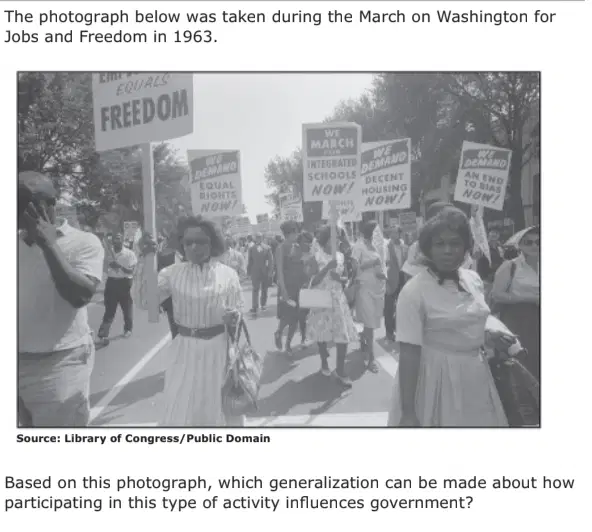
SS.7.CG.2.8
a)
Participation demonstrates public concerns to elected officials.
b)
Participation restricts civil rights through organized assemblies.
c)
Participation discourages multiple perspectives about pending legislation.
d)
Participation increases money spent on advertising during election campaigns.
15.
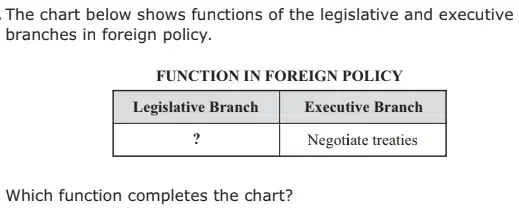
SS.7.CG.3.3
a)
Coin money
b)
Declare war
c)
Regulate pollution
d)
Punish counterfeiters
16.
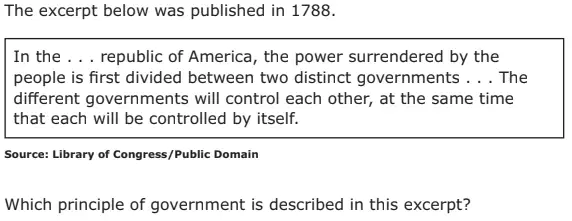
SS.7.CG.3.4
a)
direct democracy
b)
judicial review
c)
rule of law
d)
federalism
17.
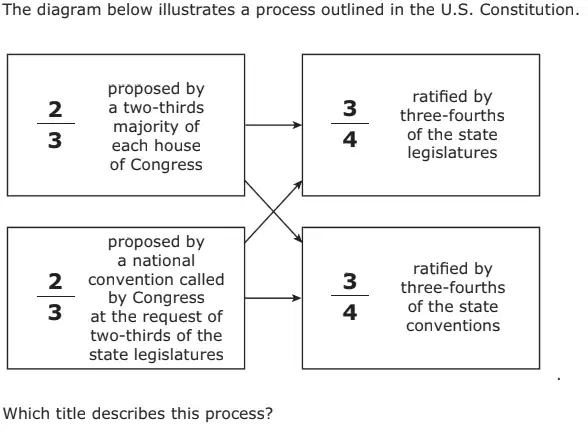
SS.7.CG.3.5
a)
The Amendment Process
b)
The Nomination Process
c)
The Lawmaking Process
d)
The Appellate Process
18.
SS.7.CG.3.6 How was the demand for women’s suffrage settled?
a)
A petition was addressed to the U.S. Supreme Court.
b)
An amendment was added to the U.S. Constitution.
c)
The U.S. President issued an executive order.
d)
The U.S. Congress passed a law.
19.
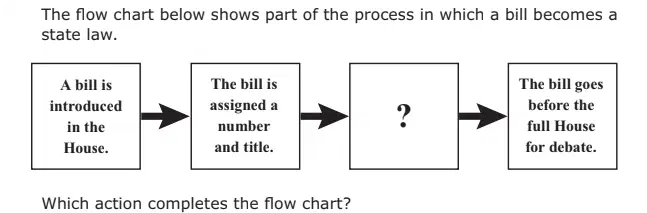
SS.7.CG.3.7
a)
The bill is sent to committee for study.
b)
The bill is sent to the governor for support.
c)
The bill is published in newspapers for comment.
d)
The bill is reviewed by a judge for constitutionality.
20.
SS.7.CG.3.8 What role does the Cabinet serve at the federal level?
a)
It advises the president on national issues and assists in operating the government.
b)
It works with the political party in power to ensure members support the president’s agenda.
c)
It works with the major news organizations to ensure public support for upcoming legislation.
d)
It advises government leaders on procedural matters and assists in the passage of legislation.
21.
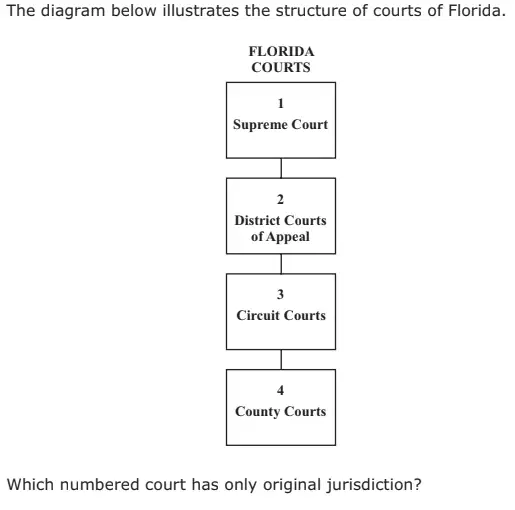
SS.7.CG.3.9
a)
1
b)
2
c)
3
d)
4
22.
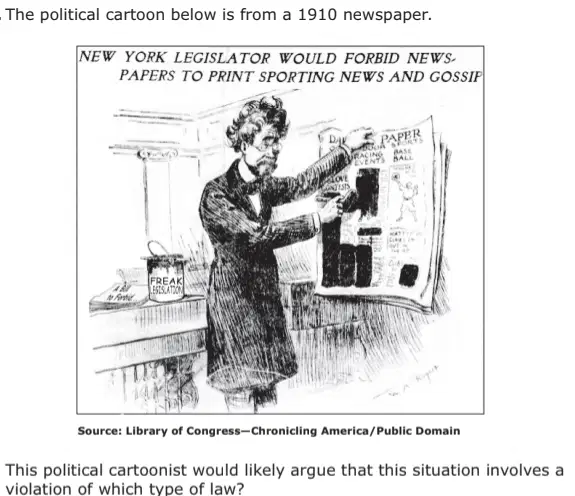
SS.7.CG.3.10
a)
civil law
b)
juvenile law
c)
constitutional law
d)
administrative law
23.
SS.7.CG.3.11
a)
It provides defendants a jury of their peers.
b)
It allows lawyers to call witnesses for defendants.
c)
It allows defendants to set aside fines they cannot pay.
d)
It provides defendants legal representation if they cannot afford it.
24.
SS.7.CG.3.12
a)
They both include the sharing of powers.
b)
They both include the separation of powers.
c)
They both are examples of government processes.
d)
They both are examples of government regulations.
25.
SS.7.CG.3.13 Which statement describes a difference between the duties of state and federal governments?
a)
The federal government builds roads.
b)
The federal government mints coins.
c)
State governments establish courts.
d)
State governments levy taxes.
26.

Place the checked and balances on the right spot in the chart

27.

The ​ (a)   branch is checking the ​ (b)   branch.

Choose from the below words
legislative
executive
28.

Match the power to the branch of government that holds that power.

a)

appoints new judges/justices

1.

executive

b)

declares executive actions unconstitutional

2.

judicial

c)

approves or rejects presidential nominations

3.

legislative

29.

What two ideas came from the Magna Carta?

a)
Centralized power and autocracy
b)
Unrestricted trade and free markets
c)
Limited government and the rule of law.
d)
Absolute monarchy and divine right
30.

Which describes an impact of Magna Carta on the American colonists in the 1770's?

a)
It led to the establishment of a monarchy in the colonies.
b)
It encouraged colonists to abandon their legal rights.
c)
It had no influence on colonial governance.
d)
It inspired the colonists to demand rights and legal protections against arbitrary government.
31.

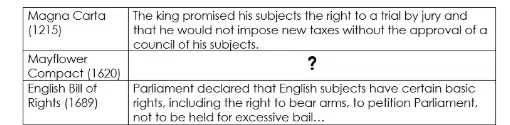
What big idea came from the Mayflower Compact?
a)
The principle of self-governance.
b)
The establishment of a national religion.
c)
The concept of divine right.
d)
The idea of monarchy.
32.

Which phrase completes the chart?

a)
The signers agreed to form a government and abide by its laws for the good of the colony.
b)
The signers agreed to ignore the laws of the colony.
c)
The signers pledged to support the monarchy without question.
d)
The signers promised to establish a monarchy in the colony.
33.

What big ideas came from the English Bill of Rights?

a)
Separation of church and state, mandatory military service, and state ownership of property.
b)
Supremacy of Parliament, individual rights, and limits on government power.
c)
Universal suffrage, freedom of speech, and government control of religion.
d)
Absolute monarchy, divine right, and unchecked government power.
34.

Which document that we have in America is very similar to the English Bill of Rights?

a)
Declaration of Independence
b)
Magna Carta
c)
Constitution of the United States
d)
United States Bill of Rights
35.

Which phrase complete the diagram?

a)
Direct Democracy
b)

Guarantees of individual rights

c)
Absolute Monarchy
d)
Constitutional Dictatorship
36.

What idea came out of Common Sense?

a)
Promotion of international trade agreements
b)
Advocacy for colonial loyalty
c)
Support for British monarchy
d)
Independence from British rule and the promotion of self-governance.
37.

What influence did Thomas Paine's Common Sense (1776) have on the colonists?

a)
It promoted the idea of a monarchy in America.
b)
It inspired colonists to seek independence and reject British rule.
c)
It had no significant impact on colonial attitudes.
d)
It encouraged colonists to remain loyal to the British crown.
38.

The following quote is from Common Sense. There is something exceedingly ridiculous in the [form] of monarchy; it first excludes a man from the means of information.." How did Paine's reasoning in this passage influence the colonists' views of government?

a)
Paine's reasoning had no impact on colonists' views of government.
b)
Paine's reasoning led colonists to view monarchy as flawed and to support democratic governance.
c)
Paine argued that monarchy was the best form of government.
d)
Colonists believed monarchy provided better information access.