
 Worksheets
Lesson 29-30 PRACTICE TEST
Total questions: 40
Worksheet time: 20mins
Name
Class
Date
1.
In the 15th century, the Inca empire was _________.
a)
the smallest empire in the world
b)
the largest empire in the world
c)
the poorest empire in the world
d)
the richest empire in the world
2.
The capital of the Inca empire was in _________.
a)
Cusco
b)
Macchu Picchu
c)
Sapa Inca
d)
Lima
3.
The Inca Empire lasted ________ years
a)
about 1,000
b)
about 50
c)
about 500
d)
about 100
4.
Who was Pachacuti?
a)
The Inca sun god, who was the main god the Inca believed in
b)
A famous "chosen woman"
c)
The first Inca emperor, who defeated the Chanca and started expanding
d)
The last Inca emperor, who was captured by the conquistador Pizarro
5.
What led to end of the Inca empire?
a)
civil war and political divisions
b)
the Spanish invasion and murder of Inca leaders
c)
illnesses like smallpox killing many people including a Sapa Inca
d)
all of the above
6.
What was the land like in Inca Empire?
a)
A desert full of sand
b)
A rainforest full of trees
c)
Fertile farmland as far as the eye could see
d)
A mix of environments that changed the higher up in elevation one goes
7.
How did the Inca conquer so many places?
a)
By force, invading with a large army using surprise attacks
b)
By explaining the benefits of their empire, and only use force as a last resort
c)
By writing letters asking other lands to join their empire
d)
By buying the lands with their great wealth in gold and silver
8.
Why did the Incas build so many roads?
a)
to move goods, people, and messages across their large empire
b)
to make it easier to travel by horse across the many types of environments
c)
to help trade with people outside the empire in Mesoamerica and the Caribbean
d)
to get people to publically funded schools paid for by the government.
9.
What happened to the Sapa Inca when he died?
a)
he was mummified, treated as if alive, and kept all his wealth
b)
he was burned on a funeral pyre and the people worhsipped him
c)
he was buried and the people elected a new leader
d)
a large temple was built on top of his body for people to come pay their respects
10.
What was the ECONOMY like in the Inca Empire?
a)
They relied on large markets for trade with faraway places
b)
The Sapa Inca produced gold and silver coins to use for payment instead of bartering
c)
Everyone just made or grew what they needed for themselves, with no need for an economy
d)
The Sapa Inca owned everything, and there was no money
11.
What were taxes like for commoners in the Inca Empire?
a)
They paid 30% of their income to the emperor each year
b)
They paid in luxory items like gold, jade, and obsidian
c)
They paid with both goods they produced and labor
d)
10% was taken out of their paychecks every month for their local government.
12.
What is an "ayllu"?
a)
The Inca word for freeze-dried potatoes
b)
a pattern of knots used for communication
c)
the word for an Inca noble
d)
a group of families that work communally
13.
Which of the following is an Inca achievement?
a)
The Inca invented paper
b)
The Inca ended hunger
c)
The Inca ended crime
d)
The Inca invented the wheel
14.
Which of the following unusual move did the Inca Emperor (Sapa Inca) actually do?
a)
Force people to move to faraway parts of the empire
b)
Pay all workers in potatoes
c)
Provide free llamas for every family in the empire to use for travel
d)
Force commoners to marry multiple wives to populate the empire more
15.
What were "quipu"?
a)
a group or clan of people who worked together
b)
the name given to the priests who led ceremonies
c)
special laws that applied in all areas of the empire
d)
knotted cords used to communicate information like accounts
16.
How did the Inca leaders communicate across such a large empire?
a)
using specially trained runners along roads
b)
using psychic abilities
c)
sending small scrolls tied to pigeons
d)
sending fast riders on horseback, using a relay system
17.
How did people read "quipu"?
a)
By memorizing the hieroglyphic patterns and their sounds
b)
By looking at and touching them
c)
By touch only
d)
By sound only
18.
Which of the following was NOT an important product in the Inca Empire?
a)
cotton
b)
potatoes
c)
rice
d)
alpaca wool
19.
Which of the following countries today was NOT part of the Inca Empire at all?
a)
Peru
b)
El Salvador
c)
Argentina
d)
Ecuador
20.
What happened to all the food and goods collected by the government?
a)
They were kept by the nobles so they could enjoy more wealth
b)
They used it all as sacrifices to the sun god, Inti
c)
They threw it all away, because no one really needed it
d)
They were kept in storehouses, then redistributed to those who needed them.
21.
Which of these sources best helps scholars learn about the cultures of the Maya, Aztec, and Incan people?
a)
paintings by recent Spanish painters
b)
artifacts from the sites of modern cities
c)
accounts written by English authors
d)
traditions found among descendants
22.
Which describes the solar year calculated by the Maya?
a)
the year of 260 days on the sacred calendar
b)
the number of days in a single Calendar Round
c)
the time it takes Earth to go once around the sun
d)
the period from one full moon to the next
23.
What was one way the medieval Maya system of numbers was DIFFERENT from ours here today?
a)
It lacked a way to show zero.
b)
B. It was based on 20 rather than 10.
c)
C. It could not be used to do subtraction.
d)
D. It used symbols to represent different amounts.
24.
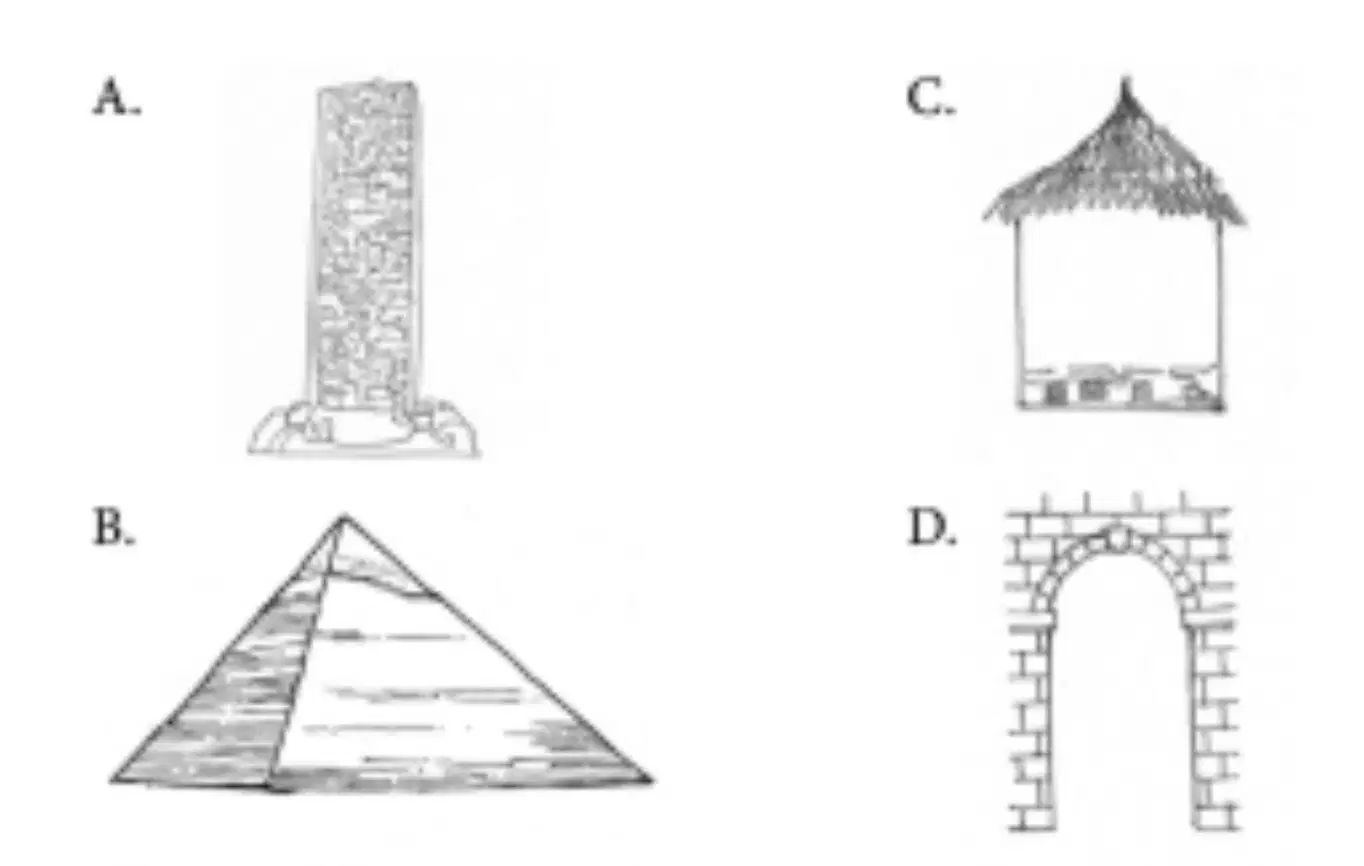
Which picture shows a Maya stele?
a)
A
b)
B
c)
C
d)
D
25.
A Maya sees a stranger and knows what town he or she is from. What traditional Maya art makes this possible?
a)
weaving cloth in complex patterns
b)
making jewelry from silver and gold
c)
carving sculptures in animal shapes
d)
making hats out of grasses and feathers
26.
Why did the Maya create hundreds of glyphs?
a)
to raise crops on steep mountain slopes
b)
to communicate sounds, words, and ideas
c)
to teach men, women, and children their duties
d)
to protect themselves from attack by foreign invaders
27.
How can tourists in Mexico observe Aztec technology skill in use?
a)
ride to the top of a skyscraper built with steel
b)
walk into the lobby of a typical downtown hotel
c)
take a boat to see flowers grown on artificial islands
d)
hire a horse-drawn carriage for a ride through the park
28.
What achievement did the Aztecs adapt from the Maya?
a)
floating gardens
b)
use of roads
c)
chariots with wheels
d)
system of two calendars
29.

What does this translation of a short Aztec verse tell about Aztec culture?
a)
Poetry was highly valued.
b)
Emeralds were quite common.
c)
Men sang while women danced.
d)
Long-distance traders got wealthy.
30.
Suppose you are an archaeologist and find an old, overgrown temple. You know it is Aztec because it has ____________.
a)
a domed roof.
b)
a double stairway.
c)
carved pillars by the door.
d)
beautiful stained-glass windows.
31.
The Aztec system of writing made use of ____________.
a)
knots.
b)
weaving.
c)
pictographs.
d)
an alphabet.
32.
What challenge did the Incas face to a much larger extent than other civilization in the Americas mentioned in Lesson 30?
a)
speaking many dialects
b)
surviving a severe climate
c)
building homes in wetlands
d)
controlling a very large empire
33.
How did travelers on Incan roads cross rivers?
a)
hey rode across on llamas.
b)
They swam with a strong stroke.
c)
They paid a ferry boatman to row them.
d)
They walked on suspension bridges.
34.
Why did Incan farmers terrace their fields?
a)
to keep wild animals away
b)
to increase available cropland
c)
to get enough water in the desert
d)
to do required labor for the emperor
35.

What material is described below?
a)
gold
b)
bone
c)
copper
d)
mahogany
36.
The sets of strings called quipus helped solve what problem of the Incas?
a)
shortage of water
b)
lack of transportation
c)
lack of a written language
d)
shortage of administrators
37.
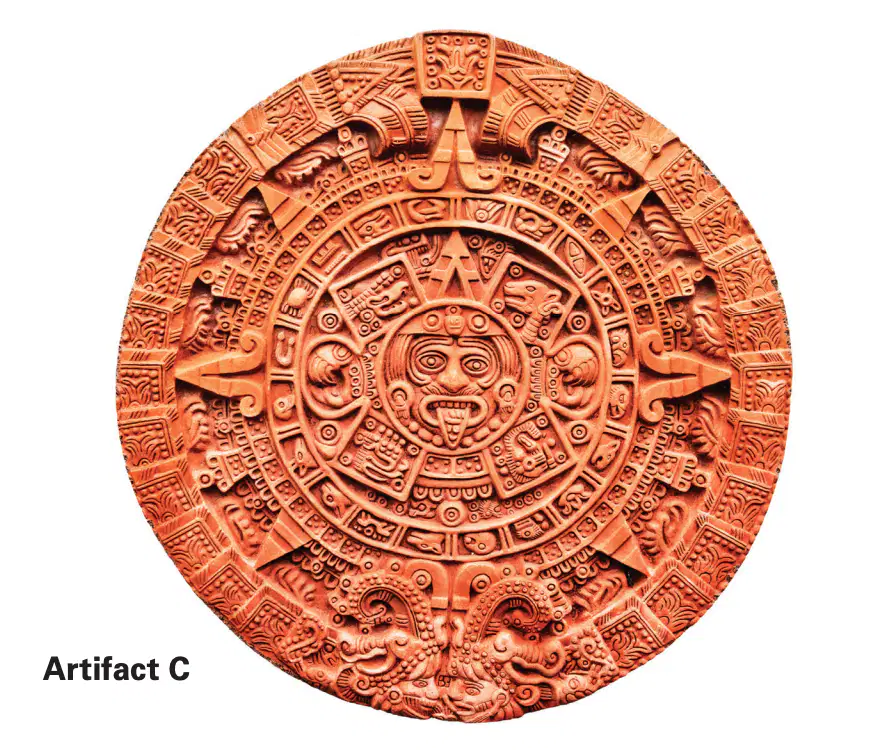
Which civilization is the following artifact from?
a)
Maya
b)
Aztec
c)
Inca
38.

Which civilization is the following artifact showing "trephination" surgery from?
a)
Maya
b)
Aztec
c)
Inca
39.

Which civilization is the following artifact (of strings with knots in certain places) from?
a)
Maya
b)
Aztec
c)
Inca
40.

Which civilization is the following type of architecture (the corbel vault) from?
a)
Maya
b)
Aztec
c)
Inca
100 %

