
 Worksheets
TEST REVIEW CHINA
Total questions: 35
Worksheet time: 18mins
Name
Class
Date
1.
1. Which helped the early development of civilization in China?
a)
A. Copper Deposits
b)
B. River Systems
c)
C. Vast Deserts
d)
D. Rugged Mountain Terrain
2.
2. What are the names of the two rivers that were especially important in China's early history?
CHOOSE 2 ANSWERS
a)
Huang He River
b)
Euphrates River
c)
Tigris River
d)
Yangtze River
e)
Nile River
3.
3. How did Loess from the Gobi Desert help the early Chinese settlers in the Huang He River Valley also known as the Yellow Valley be successful in agriculture?
a)
Loess was collected and used for medicine to treat sick animals.
b)
Loess was used when mixing the metals to make bronze.
c)
Loess naturally helped form fertile soil for farming.
d)
Loess helped shape the path of the Huang He River.
4.
4. What type of villages emerged in the Huang He River Valley?
a)
Mining Villages
b)
Farming Villages
c)
Trading Villages
d)
Whaling Villages
5.
5. Over time villages in the Huang He River Valley were merged together by powerful tribal elders and developed into which of the following?
a)
City-States
b)
Ziggurats
c)
Fortresses
d)
Nomadic Tribes
6.
6. Which type of government did the early Chinese population conform to?
a)
Democracy
b)
Oligarchy
c)
Theocracy
d)
Monarchy
7.

7. Use the image below:
During the development of China's civilization what was the social structure that all city-states followed?
a)
Division of Labor
b)
Social Hierarchy
c)
Ancestor Worship
d)
Irrigation
8.
8. In ancient China, communities of people worshiped many different gods. Which term is used to describe worshiping many gods?
a)
Polytheism
b)
Montheism
c)
Division of Labor
d)
Irrigation
9.
9. In China, besides worshiping many gods, people also practiced another form of worship involving their dead family members. Which type of worship is this?
a)
Agriculture Worship
b)
Dynasty Worship
c)
Ancestor Worship
d)
Clan Worship
10.
10. How did the settlers in the Huang He River Valley stop water from flooding into their villages and fields of crops?
a)
By setting fires to control trees and brush.
b)
By building large open water tower barrels to catch rain water.
c)
By digging huge holes in the ground to catch water.
d)
By building dikes against rivers.
11.
11. Which was the earliest form of Chinese writing found on?
a)
Paper
b)
Clay Tablets
c)
Papyrus
d)
Oracle Bones
12.
12. What form of written language did the Chinese use for communicating with each other?
a)
Hieroglyphics
b)
Pictographs
c)
Phoenician Alphabet
d)
Cuneiform
13.
13. Use the quote below:
“Agriculture is the foundation of the world. No duty is greater.”
Emperor Wen, Hanshu
Which occupation did the Emperor believe was the most important?
a)
Scholar
b)
Farmer
c)
Soldier
d)
Merchant
e)
Artisian
14.
14. What were the major achievements of the Shang Dynasty? CHOOSE 3 ANSWERS
a)
Irrigation and dike building to control water flows
b)
Creating tools and weapons made of Bronze
c)
Creating gun powder for rockets
d)
Writing using pictograph characters
15.
15. Which leader established the Qin Dynasty?
a)
Hammurabi
b)
Shi Huangdi
c)
Siddhartha Gautama
d)
Kong Qiu
16.
16. Qin Shi Huangdi ruled his people with an iron fist or very harshly. Which policies did he enforce that deprived people of their rights? CHOOSE THREE
a)
He forced labor on people.
b)
He banned religion and the worship of gods
c)
He did not allow freedom of speech.
d)
He censored written material.
17.
17. How did Qin Shi Huangdi unify all the kingdoms of China after he conquered them?
a)
He went to war with every village and city state in the Empire
b)
He paid tribute to royal families around the empire to be loyal to him.
c)
He provided new agriculture secrets to Chinese farmers creating a bigger surplus.
d)
He created 36 providences and assigned a governor to each that reported to him.
18.
18. Which philosophy did Qin Shi Huangdi use to create a social order throughout his Empire?
a)
Legalism
b)
Confucianism
c)
Daoism
d)
Buddhism
19.
19. Qin Shi Huangdi and his government completed the task of making the Chinese empire's currency, measuring system, transportation products, and language all the same. What is this called?
a)
Centralized Power
b)
Standardized Culture
c)
Hammurabi's Code of Law
d)
Ancestor Worship
20.
20. What was it called when the Chinese Emperor sent a representative(s) (ambassadors) to kingdoms in the West to build political relationships?
a)
merchants
b)
patrons
c)
missionaries
d)
envoys
21.
21. The Qin Dynasty is considered the first to establish a _______________ government in China, where the power was concentrated in the hands of the emperor and divided among 36 provinces with a governor assigned to each territory.
a)
neutralized
b)
organized
c)
centralized
d)
urbanized
22.
22. What is infrastructure?
a)
Mountains, Deserts, Flood Plains, and Woodlands
b)
Irrigation Canals, Dikes, Bridges, Roads, and CIty Walls
c)
Rice, Wheat, Barley, Oats, Corn, and Millet
d)
Dao, Spear, Axe, Staff, Qiang, and Rope Dart
23.
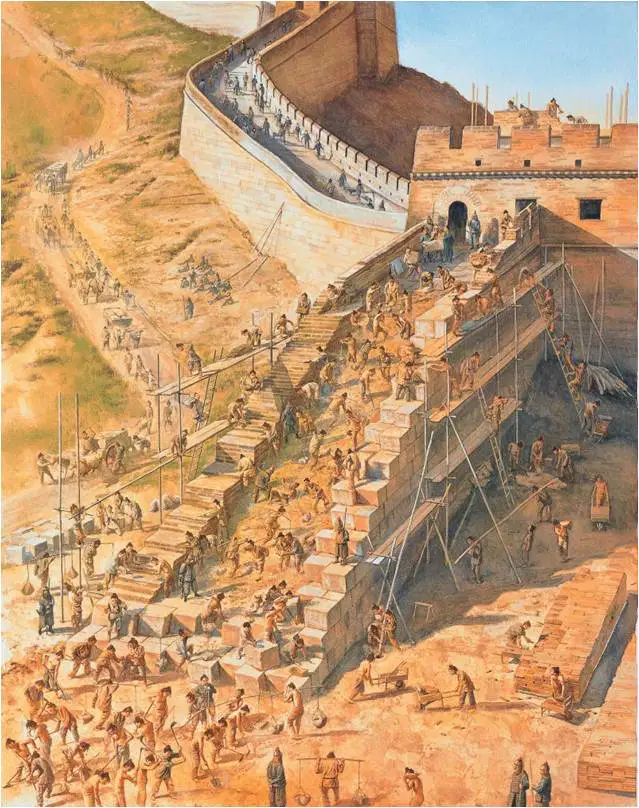
23. How did the leaders of construction projects assign the work that was to be done so that the public work projects were completed faster and more efficiently?
a)
Using only prisoners of war to build projects.
b)
Using an essembly line to build projects.
c)
Using priests to manage and bless the workers.
d)
Using the division of labor strategy for workers.
24.
24. Which was NOT a natural barrier that isolated early Chinese civilization?
a)
Gobi Desert
b)
Fertile Crescent
c)
Himalaya Mountains
d)
Taklamakan Desert
25.
25. What was the the most monumental public works project of the Qin Dynasty?
a)
The Great Wall of China
b)
The Grand Canal
c)
The Yangtze River Dam
d)
The Forbidden Palace
26.
26. By what method did Qin Shi Huangdi apply to have the Great Wall of China built?
a)
He payed the workers a standardized wage.
b)
He forced the labor of peasants and of prisoners.
c)
He forced the labor of children.
d)
He created advanced machine that did the work.
27.
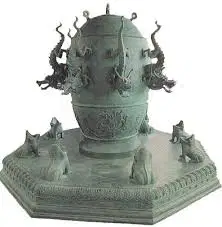
27. What was the purpose of this innovation from the Han Dynasty?
a)
It was a machine that helped process bamboo to create paper.
b)
It was a medical device used to cure sickness and stop pain.
c)
It was a scientific device used to measure the strength and direction of an earthquake.
d)
It was a device used to transport food and supplies to the front line in battle.
28.
28. Why was the Great Wall of China constructed?
a)
It was built to seperate the 36 provinces of China.
b)
It was built to help merchants travel safer and quicker.
c)
It was build to keep the nomadic barbarian tribes out of China.
d)
It was built to be a monument to the 300,000 who died building it.
29.
29. What is the lasting IMPACT of the Silk Road?
(Think BIG)
a)
It allowed merchants to become extremely wealthy by selling exotic goods.
b)
It helped to connect civilizations and diffuse ideas, technology, religion, etc.
c)
It helped the Chinese army to move much quicker to get reinforcements.
d)
It created many natural barriers that effectively isolated China from others.
30.
30. What did the Han Dynasty do to clean up corruption in China's government and make it work more efficiently.
a)
They only hired those who passed the civil service test and proved their skills.
b)
They only hired those who were directly related to the Royal Family.
c)
They only hired close friends of the Emperor so everyone would know each other.
d)
They only hired wealthy merchants who payed them a bribe of gold.
31.
31. Use the quote below:
“I am the Emperor; my descendants will be numerous. From the second generation to the ten thousandth, my line will not end.”
Qin Shi Huangdi
Which term is this referring?
a)
Nomadic
b)
Polytheism
c)
Dynasty
d)
Agriculture
32.
32. What was the most valuable export from China that made the Han Dynasty both prosperous economically?
a)
Bronze
b)
Silk
c)
Paper
d)
Loess
e)
Jade
33.
33. What economic crimes were punishable by death in China? CHOOSE TWO
a)
The sale of silk worms
b)
The trading of rice seeds
c)
Educating the nomadic barbarians who got into China
d)
Sharing the silk production methods with foreigners
34.
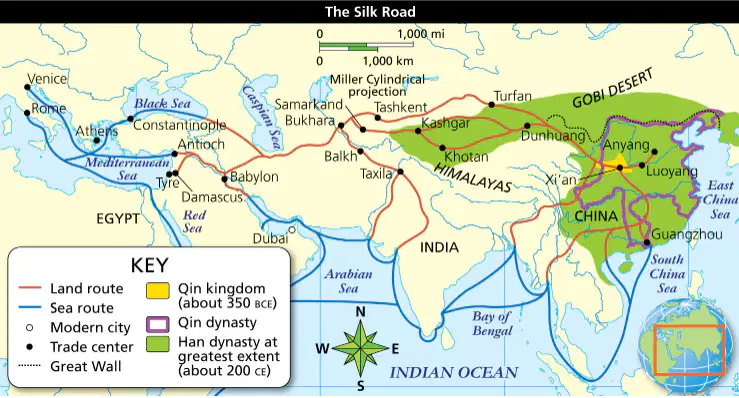
34. Which THREE continents did the Silk Road connect by land and water trade routes?
a)
Austraila, Asia, and Africa
b)
Asia, Africa, and Europe
c)
Europe, Africa, and Antarctica
d)
North America, South America, and Africa
35.
35. What concept justified a ruler's right to rule based on the belief that they had the divine approval of the gods, allowing them to be overthrown if they lost this favor?
a)
The Crown of the Dragon
b)
The Divine Right of Kings
c)
The Jade Promise of Rule
d)
The Mandate of Heaven
100 %

