
 Worksheets
Unit 8 Rationals Test Review
Total questions: 75
Worksheet time: 7hrs 34mins
State the vertical asymptote: f(x)=x+5x−2
x = -2/5
x = -5/2
x = -5
x = 2
State the horizontal asymptote: f(x)=x2−x2x2−5x+1
y = 2
y = 1
y = 0
There is no HA
State the vertical asymptotes: y=(x+3)(x−5)(x+4)(x+2)
x = -3
x = -3 and x = 5
x = 3 and x = -5
x = -4 and x = -2
What is the x-intercept: y=(x+3)(x+4)(x+4)(x+2)
(-4, 0)
(2, 0)
(-2, 0)
(-3, 0)
Find the x-intercept (zero) of the function y=xx−7
(0, 0)
(0, -7)
(7, 0)
there is no x- intercept

Find the horizontal asymptote.
None
y = 0
y = -1/3
y = -3

What is the x-value of the hole?
No Hole
x = 4
x = -5
x = -6

Find the vertical asymptote(s) and hole if there is one.
V.A.: x = -1
Hole: (2, 35)
V.A.: x = 1
Hole: (2, 35)
V.A.: x = -1
Hole: (−2, −1)
What is the vertical asymptote of
f(x)=x2−7x−18x2+11x+18x=9
x=−2
x=9 and x=−2
x=−9
What is the hole of
f(x)=x2−7x−18x2+11x+18
(2, 112)
(−2, −117)
(−2, −114)
Factor and determine the x-intercept:
f(x)=x2−7x−18x2+11x+18
f(x)=(x−9)(x−2)(x+9)(x−2) x-int: (9, 0)
f(x)=(x−2)(x−10)(x+6)(x−3)
x-int: (-6, 0)
f(x)=(x−9)(x+2)(x+9)(x+2) x-int: (-9, 0)
f(x)=(x−9)(x+2)(x+9)(x+2) x-int: (-2, 0)
What is the horizontal asymptote of
f(x)=x2−7x−189x2+11x+18
y=1
y=0
y=9
There is no horizontal asymptote.
What is the horizontal asymptote of
−4x2−36x+40x+10y=4−1
y=4x−1
y=0
There is no horizontal asymptote.

What are the asymptotes?
x=1, x= 2, y =1, y= 2
x= 2, x=-2, y = 1
x=2 y =-1
x=1 y =2, y =-2
How do you determine the Horizontal Asymptote?
replace all x-values with 0
replace the y-value with 0 or make the numerator equal 0
set denominator equal to 0
compare the degrees of the numerator and denominator
When finding the H.A., if the numerator degree is greater than the denominator degree, the answer is...
y = 0
There is no HA
y =a / b
What's an H.A.?

What are the x and y intercepts of the rational function?
x-int: (6, 0)
y-int: (0, -2)
x-int: (-2, 0)
y-int: (0, 6)
x-int: (0, -2)
y-int: (6, 0)

What is the horizontal asymptote?
x = 2
y = 2
x =-2
y=-2
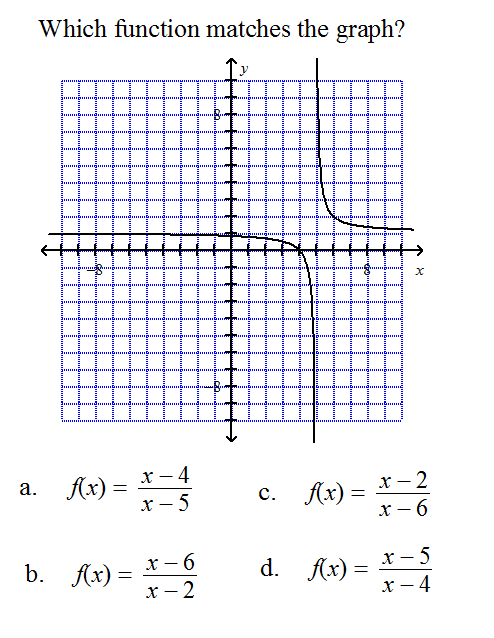
What are the domain restrictions of f(x)=x2−16x+3 ?
x=4,−4
x=0
x≥16
(−4,4)

Determine if this function will have a horizontal asymptote or a slant asymptote.
Horizontal
Neither
Slant
Both
What is the horizontal asymptote for the following function?
f(x)=x2−44x+3y=4
y=41
y=0
No Asymptote

What is the equation of the slant asymptote?
y = x + 1
y = x + 2
y = x + 3
y = x

What is the equation of the slant asymptote?
y = x - 4
y = 4x - 4
y = 4x + 16
there isn't one

For which value is the expression undefined?
-4
-3
3
0
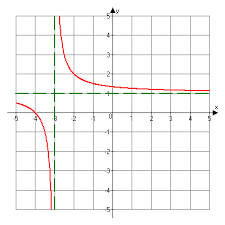
Identify the vertical and horizontal asymptotes.
VA: x = -3
HA: y = 1
VA: x = 3
HA: y = 1
VA: x = -3
HA: y = -1
VA: x = 3
HA: y = -1

How is this function transformed from the parent function?
Shifted left and up
Shifted right and up
Shifted left and down
Shifted right and down
Which rational function has been shifted 5 units left and 7 units up?
y=x−71−5
y=x+51+7
y=x−51−7
y=x+71+5
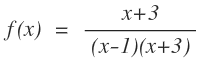
Find the vertical asymptotes and holes of the function.
Holes: None;
VA: x = 1, -3
Holes: x = -3;
VA: x = 1
Holes: x = -3, 1
VA: None
Holes: x = 1
VA: x = -3

Graph the function.


Find the DOMAIN of the Rational Function:
(−∞, 6)∪(6, ∞)
(−∞, 0)∪(0, ∞)
(−∞, 4)∪(4, ∞)
(−∞, 8)∪(8, ∞)

Find the DOMAIN of the Rational Function:
(−∞, 0)∪(0, ∞)
(−∞, −4)∪(−4, ∞)
(−∞, −3)∪(−3, ∞)
(−∞, 2)∪(2, ∞)
What is the DOMAIN of y=x+8−1 ?
(−∞, 8)∪(8, ∞)
(−∞, 0)∪(0, ∞)
(−∞, −8)∪(−8, ∞)
(−∞, −1)∪(−1, ∞)

What is the RANGE of the graph?
(−∞, 2)∪(2, ∞)
(−∞, 1)∪(1, ∞)
(−∞, −1)∪(−1, ∞)
(−∞, 0)∪(0, ∞)
Select all the functions that have a slanted asymptote?


What is the end behavior as x approaches negative infinity?
y approaches negative infinity
y approaches positive infinity
y approaches 1
y approaches 2

What is the end behavior of this rational function?
As x goes to the left, y approaches 2 from below the asymptote.
As x→−∞, y→2−
As x goes to the left, y approaches 2 from above the asymptote.
As x→−∞, y→2+
As x goes to the right, y approaches 2 from below the asymptote.
As x→+∞, y→2−
As x goes to the right, y approaches 2 from above the asymptote.
As x→+∞, y→2+

What is the asypmtotic behavior of this rational function?
As x approaches 3 from the left, y goes down
As x→3−, y→−∞
As x approaches 3 from the left, y goes up
As x→3−, y→+∞
As x approaches 3 from the right, y goes down
As x→3+, y→−∞
As x approaches 3 from the right, y goes up
As x→3+, y→+∞

What is the range of this rational function?
[0,∞)
(−∞,+∞)
(0,∞)
Find the LCD (Least Common Denominator): 9x2−12x5
36x2
108x5
36x5
3x2
Find the LCD (Least Common Denominator): (x+2)(x−3)+(x−4)(x+2)
(x+2)
(x+2)(x−3)(x−4)(x+2)
(x+2)(x−3)(x−4)
24
Add: x−52x+x+75x
x2+2x−357x2−35x
x2+2x−357x2+49x
x2+2x−357x2−11x
(x−5)(x+7)x(7x−35)
Subtract: 3x2−41
125
12x5
12x−3x+8
3x−41
Subtract: x2−3x−10x−x−52
x2−3x−10−x+2
(x−5)(x+2)−x+4
x2−3x−10x−2
x2−3x−10−x−4
Solve: x+16x−2=x+14x
x=1
x=−1
No solution
x=2
Solve: x−3x−1+21=x−35
No solution
x=7
x=5
x=29

Solve.
x = 5
x = -3
x = 3
x = -5

Solve!
x = 2
x = 0.5
x = -2
x = 5

Solve and check for extraneous solutions
x=5
x= -5
No Solution

Identify the LCD.
x2(x - 2)
x(x - 2)
x
(x - 2)

Katherine can paint a room in 4 hours. Joe needs 6 hours to paint the same room. Which equation would you use to determine how long it takes them to paint the room if they work together?
41+61=t1
41+t1=61
61+t1=41
t=24

A boat goes 10 miles downstream in the same time it can go 3 miles upstream. The speed of the current is 2 miles per hour. Which equation could you use to find the speed of the boat in still water?
2−x10=2+x3
x−210=x+23
x+210=x−23
2+x10=2−x3

A plane flies 1225 miles with a tailwind in the same time it can go 1100 miles against the wind. The speed of the plane in still air is 575 miles per hour. Which equation would you use to find the speed of the wind?
575−x1225=575+x1100
575+x1225=575−x1100
x+5751225=x−5751100
x−5751225=x+5751100

The time it takes for a canoe to go 4 miles upstream and back 4 miles downstream is 5 hours. The current in the lake is 2 mile per hour. Find the average speed (rate) of the canoe in still water.
x+24+x−24=5
2+x4+2−x4=5
x+24=x−25
2+x4=2−x5
Joan can clean the store in five hours. If Dan helps, it takes them four hours. Without help, how long would it take Dan to complete this job ?
10
25
20
15
Keith and Melanie were able to reupholster furniture in three hours together. It takes Melanie five hours to do this job alone. Without help, how long would it take Keith to do this job ?
5.5
6.5
7.5
8.5
Which of the following has a slant (oblique) asymptote?
y=x−2x2−3x−4
y=x2−13
y=x3+x2−12x−3
What is the equation of the slant asymptote of the rational equation below? y=x2+4x+42x3+7x2+3x
y=2x−1
y=−2x+1
y=−9x−4
y=2
What is the vertical asymptote?
y=(x−5)(x+4)(x−5)(x+5)x= 4
x= -4
x= 5
x= -5
Check whether the function has a Horizontal, Slant, or No Asymptote
f(x)=4x−36x2−81Horizontal
Slant
neither

What is the end behavior of the graph? (Click on the graph to enlarge)
As x ⟶ −∞, f(x) ⟶ 2 As x ⟶ ∞, f(x) ⟶ 2
As x ⟶ −∞, f(x) ⟶ −∞ As x ⟶ ∞, f(x) ⟶ ∞
As x ⟶ −∞, f(x) ⟶ −1 As x ⟶ ∞, f(x) ⟶ −1
f(x)=4x2+2x+12x−3 Find the y-intercept of the rational function
(21,0)
(−3,0)
(0,21)
(0,−3)

Which is the domain of the following?
(−∞, 3) and (3, +∞)
(−∞, -3) and (-3, +∞)
(−∞, 2) and (2, +∞)
(−∞, 6) and (6, +∞)

Which is the range of the following?
(−∞, -2) and (-2, +∞)
(−∞, 7) and (7, +∞)
(−∞, -7) and (-7, +∞)
(−∞, 2) and (2, +∞)
What is the domain and range of:
y=x2+2x−15x2+3x−10 .
Domain: (−∞, ∞)
Range: (−∞, ∞)
Domain: (−∞, −5)∪(−5, 3)∪(3, ∞)
Range: (−∞, 1)∪(1, ∞)
Domain: (−∞, 87)∪(87, 1)∪(1, ∞)
Range:
Domain: (−∞, 0)∪(0, 1)∪(1, ∞)
Range:
Which of the following is the domain of g(x)=2x2−8x2−9 ?
(−∞,−2)∪(−2,2)∪(2,+∞)
(−∞,−2)∪(2,+∞)
(−2,2)∪(2,+∞)
(−∞,−2)∪(−2,2)
Which of the following does not have a horizontal asymptote?
y=x2+4x+42x3+7x2+3x
y=x2+x−12x−3
y=2−xx−4
they all have a horizontal asymptote

What is the domain and range?
D : (−∞,−3)∪(−3,∞)
R: (−∞,1)∪(1,∞)
D : (−∞,1)∪(1,∞)
R: (−∞,−3)∪(−3,∞)
D : (−∞,3)∪(3,∞)
R: undefined
D: (−∞,−1)∪(−1,∞)
R: (−∞,3)∪(3,∞)

(-2, 1)
(-oo, -2) u (1,2)
(1,2) u (2, oo)
(-oo, -2] u [1,2]
Solve for x:
x+3−x−6>0
(−6,−3)
[−6, −3)
(−∞, −6)∪(−3, ∞)
(−∞, −6]∪[−3, ∞)

[-1, 1]
(-oo, -1) u (1, oo)
(-1, 1)
[1, oo)

(-2,2)
(−∞, −2)∪(2, ∞)
[-2,2]
(∞, −2)∪(2, −∞)

A
B
C
D
E
Solve the rational inequality and state your solution in interval notation.
x+23x−7>0
(−2, 37)
( 37, +∞)
(−∞,−2)∪(37, +∞)
(−∞,−2)∪[37, +∞)

