
 Worksheets
Chapter 9 - 12 Review
Total questions: 51
Worksheet time: 21mins
A bond issue with a face amount of $495,000 bears interest at the rate of 10%. The current market rate of interest is also 10%. These bonds will sell at a price that is:
Equal to $495,000
The answer cannot be determined from the information provided.
Less than $495,000
More than $495,000
Which of the following is not a primary source of corporate debt financing?
Leases
Stockholders
Bonds
Notes
A bond issue with a face amount of $495,000 bears interest at the rate of 7%. The current market rate of interest is 8%. These bonds will sell at a price that is:
More than $495,000
The answer cannot be determined from the information provided
Equal to $495,000
Less than $495,000
A bond issue with a face amount of $500,000 bears interest at the rate of 7%. The current market rate of interest is 6%. These bonds will sell at a price that is:
The answer cannot be determined from the information provided
Less than $500,000
Equal to $500,000
More than $500,00
For a bond issue that sells for more than the bond face amount, the stated interest rate is:
The actual yield rate
The prime rate
More than the market rate
Less than the market rate
For a bond issue that sells for less than the bond face amount, the stated interest rate is:
Less than the market rate
More than the market rate
The prime rate
The actual yield rate

Seaside Industries issues a bond with a stated interest rate of 10%, face amount of $50,000, and due in 5 years. Interest payments are made semiannually. The market rate for this type of bond is 12%. What is the issue price of the bond (rounded to nearest whole dollar)? (Use PV of $1 and PVA of $1)
$83,920
$46,320
$53,605
$50,000
A corporation is an entity that is (1) legally separate from its owners and (2) not required to pay its own income taxes.
True
False
Limited liability means that even in the event of bankruptcy, stockholders in a corporation can lose no more than the amount they invested in the company.
True
False
Owners in a sole proprietorship or a partnership can be held personally liable for debts the company has incurred, over and beyond the investment they have made.
True
False
Authorized stock is the number of shares that have been sold to investors
True
False
Treasury stock is the purchase of a company's own issued stock
True
False
Outstanding common stock refers to the total number of shares:
Issued
Issued less treasury stock
Issued plus treasury stock
Authorized
If a company issued 1,000 shares of $1 par value common stock for $20 per share, what would be the effect on the balance sheet?
Increase assets and increase revenue
Increase assets and decrease stockholders' equity
Increase assets and increase liabilities
Increase assets and increase stockholders' equity
If a company issues 1,000 shares of $1 par value common stock for $20 per share, which of the following accounts would be recorded?
Treasury stock
Retained Earnings
Dividends
Additional Paid-in Capital
A company issued 1,100 shares of $5 par value preferred stock for $6 per share. What is true about the journal entry to record the issuance?
Credit Additional Paid-in Capital $1,100
Credit Cash $6,600
Credit Preferred Stock $6,600
Debit Preferred Stock $6,600
Treasury Stock is normally reported as a(n):
Reduction of total stockholders' equity
Expense account
Asset account
Liability account
On December 2, Coley Corporation acquired 1,000 shares of its $3 par value common stock for $23 each.
On December 20, Coley Corporation resold 600 shares for $12 each. Which of the following is correct regarding the journal entry for the resold shares?
Credit Treasury Stock $7,200
Debit Cash $12,000
Credit Treasury Stock $13,800
Credit Additional Paid-in Capital $5,400
A company resells 400 shares of its own common stock for $20 per share. The company had acquired these shares two months before for $15 per share. The resale of this stock would be recorded with a:
Credit to Treasury Stock for $8,000
Debit to Common Stock for $8,000
Debit to Additional Paid-in Capital for $2,000
Credit to Additional Paid-in Capital for $2,000
Financing activities include cash receipts and cash payments for transactions relating to revenue and expense activities.
True
False
Investing activities include cash transactions involving the purchase and sales of long-term assets and current investments.
True
False
We report interest and dividends received from investments with investing activities.
True
False
We report interest paid on bonds or notes payable with operating activities rather than financing activities.
True
False
The purchase of land is classified in the statement of cash flow as a(n):
Noncash activity
Financing activity
Operating activity
Investing activity
The cash collection from the sale of a good or service is classified in the statement of cash flows as a(n)
Operating activity
Noncash activity
Investing activity
Financing activity
The purchase of treasury stock is classified in the statement of cash flow as a(n)
Operating activity
Financing activity
Investing activity
Noncash activity
Dividends received from an investment are classified as a(n)_______________ cash flow, and paying dividends on stock issued is classified as a(n)___________ cash flow on the statement of cash flows.
Financing; Operating
Operating; Operating
Operating; Financing
Investing; Financing
In preparing a statement of cash flows under the direct method, which of the following requires an adjustment to net income as a nonoperating gain?
Receiving interest on a note receivable.
Receiving dividends on an equity investment in another company
Selling inventory above its original purchase cost
Selling land above its original purchase cost

How many of these items would be subtracted from net income when using the indirect method to prepare the operating activities section of the statement of cash flows?
5
4
1
2
A bond issued at a discount indicates that at the date of issue
Its stated rate was lower than the prevailing market rate of interest on similar bonds.
The bonds must be non-interest bearing.
Its stated rate was higher than the prevailing market rate of interest on similar bonds.
The bonds were issued at a price greater than their face value.
Hayes Corporation issues 100 shares of its $1 par value common stock for $15 per share. The entry to record the issuance will not include a:
Debit to cash $1,500
Credit to Additional Paid-In Capital $1,400
Credit to Common Stock of $100
Debit Dividends for $1,500
Three of the above answers are correct
A company declares a dividends of $1 per share on December 1 for stockholders and record on December 15. Dividends are paid on December 31. What will happen on December 31?
The company will debit dividends
The company's stock price will increase by $1 (all else equal)
The company will debit dividends payable
A larger estimation of the allowance for uncollectible accounts, the write-down of overvalued inventory and the use of a shorter useful life for depreciation are all examples of conservative accounting.
True
False
Aggressive accounting practices result in reporting higher income, higher assets, and lower liabilities.
True
False

The table provided above is an example of:
Horizontal analysis
Diagonal analysis
Vertical analysis
Both vertical and horizontal analysis

The table provided above is an example of:
Horizontal analysis
Both vertical and horizontal analysis
Diagonal analysis
Vertical analysis
The net increase/decrease in cash reported in the Statement of Cash Flows equals:
The change in the balance of the Cash account reported in the Balance Sheet
Stockholders' Equity reported in the Balance Sheet
Net income reported in the Income Statement
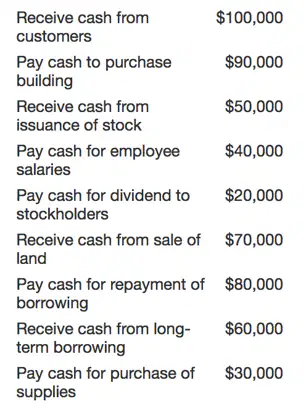
Calculate the amount of financing cash flows?
$10,000
-$20,000
$160,000
$90,000
-$50,000
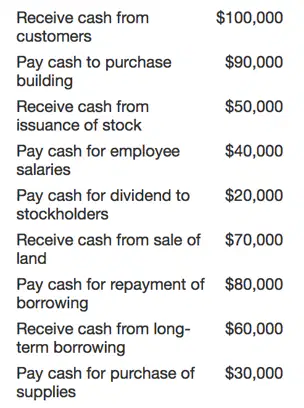
Calculate the amount of Investing cash flows?
$10,000
-$20,000
$160,000
$90,000
-$50,000

Calculate the amount of operating cash flows:
$27,000
$57,000
$30,000
$35,000
$18,000
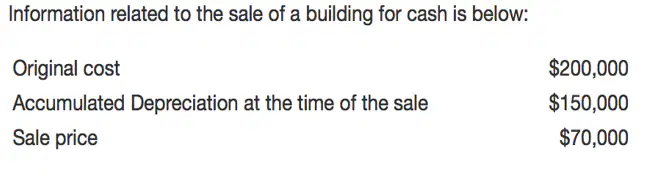
How would the sale of the building be reported in the Statement of Cash Flows using the indirect method?
Add $70,000 for investing cash inflow
Subtract $200,000 for investing cash outflow
Subtract $20,000 from net income for operating cash flows
Add $70,000 for financing cash inflow
Both A and C
Which of the following is allowed under international accounting rules but not allowed under U.S. accounting rules?
Capitalization of product development
Reversal of previous inventory write down
Recording an increase in the fair value of property and equipment
Reporting cash flows from interest paid as a financing activity
All of the above are allowed under international accounting rules and not allowed under U.S accounting rules
According to the conceptual framework, relevant information possesses which qualitative characteristics?
Completeness and freedom from error
Freedom from error and predictive value
Predictive value and freedom from error
Predictive value and confirmatory value
Neutrality and completeness
Using the allowance method to account for uncollectible, the write-off of an actual bad debt results in:
An increase in total assets
An increase in total expenses
A decrease in total assets
No change to the accounting equation
Two of the other answers are correct
A company shipped the wrong shade of paint to a customer. The customer agreed to keep the paint upon being offered a 15% price reduction. The price reduction is an example of a:
Sales revenue
Sales discount
Sales return
Sales allowance
Trade discount

How many of the items listed above are generally reported as current assets?
Four
Two
Five
Three

What amount will be reported in the balance sheet for the allowance for uncollectible accounts, assuming the balance of this account is $400 (credit) before adjustment?
$400
$480
$1,510
$1,910
A company sells soccer goals to customers over the Internet. History shows that 2% of the company's goals will need repair under the warranty program. For the year, the company has sold 4,100 goals and 48 have been repaired. If the estimated cost to repair a goal is $140, what would be the Warranty Liability at the end of the year?
$0
$11,480
$4,760
$4,810
On January 23, a company purchases inventory for $100. On February 12, the inventory is sold on account. Which of the following is recorded on February 12?
Debit cost of goods sold for $100
Credit inventory for $150
Debit sales revenue for $150
Debit accounts receivable for $100
Which depreciation method generally results in the lowest net income in the first year of an asset's life?
Double Declining Balance
LIFO
Activity-Based
FIFO
Straight-line
When a company earns revenue from current operations but has not received cash for that revenue in the current period, the account equation would be affected as follows:
Assets increase and stockholders' equity increase
Liabilities decrease and stockholders' equity increases
Assets decrease and liabilities increase
Liabilities increase and stockholders' equity decreases

