
 Worksheets
Atoms and Elements Quiz
Total questions: 10
Worksheet time: 10mins

Based on the periodic table arrangement, which set of elements should be grouped together?
O, He, and Ar because they are all noble gases
K, Na, and Mg because they form similar compounds
F, Cl, and I because they have similar chemical properties
H, O, and C because they are all elements in the same column
Which of the following diagrams has the parts of an atom correctly labeled?


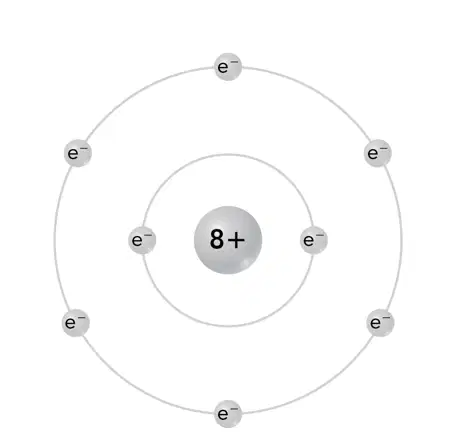
Scientists often use diagrams to model the atom. Which model of the atom is represented in this diagram and how is it different from the current model of the atom?
A. This is Bohr's model of the atom. It shows that electrons may be found in a cloud around the nucleus, not circular orbits.
B. This is Dalton's model of the atom. It does not include neutrons, which are part of the modern model of the atom.
C. This is Rutherford's model of the atom. It does not include neutrons, which are part of the modern model of the atom.
D. This is Thomson's model of the atom. It shows that electrons may be found in a cloud around the nucleus, not circular orbits.
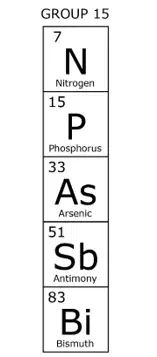
Nitrogen is a gas at room temperature and standard pressure. It is also a Group 15 element, as shown below. Which statement about the other elements in Group 15 is true?
A. They look similar to nitrogen.
B. They react in a way similar to how nitrogen reacts.
C. They have the same density as nitrogen when under the same conditions.
D. They are, like nitrogen, gases at room temperature and standard pressure.
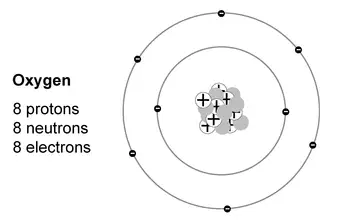
A model of the most basic unit of oxygen is shown below. Which of the following is true of oxygen?
A. Oxygen is an element because its most basic unit is a single type of atom.
B. Oxygen is a compound because its most basic unit is a single type of atom.
C. Oxygen is a mixture because its most basic unit contains more than one particle.
D. Oxygen is a compound because its most basic unit contains more than one type of particle.

Modern atomic theory is based on evidence gathered by several scientists, including Ernest Rutherford. Rutherford aimed rays of positively-charged alpha particles at a thin piece of gold foil. The results of his experiment are presented in the diagram. What did Rutherford conclude about atomic structure from this evidence?
A. The nucleus includes both neutrons and protons.
B. The atom is mostly empty space, with a dense, positively-charged center.
C. Atoms contain electrons embedded within positively-charged spheres.
D. The nucleus of an atom is surrounded by a cloud of positively-charged particles.

Section 4 of the diagram contains
A. metalloids.
B. nonmetals.
C. alkali metals.
D. alkali earth metals.

Which of the following is in section 2?
A. metals
B. metalloids
C. noble gases
D. nonmetals

Which type of elements are in section 3?
A. metalloids
B. alkali metals
C. transition metals
D. alkali earth metals
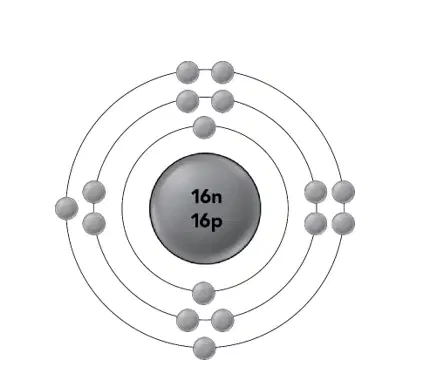
Scientists use models to help them represent things in nature that they cannot observe directly. They can also use models to make predictions. For example, scientists use Bohr models of atoms to predict chemical reactions between atoms. You can use models in the same way, but you must first understand what each model component represents. Which element is represented by this Bohr model?
A. chlorine (Cl)
B. oxygen (O)
C. selenium (Se)
D. sulfur (S)

