
 Worksheets
Waves in Action
Total questions: 63
Worksheet time: 1hrs 11mins
The highest point of the wave is called the ____________.
crest
trough
wavelength
amplitude
The lowest point of the wave is called the ______________.
crest
trough
wavelength
amplitude
The distance from one crest or trough to the next crest or trough is called the _____________.
amplitude
wavelength
circular
The distance from the resting point of the wave to the crest or trough is called the _________________.
wavelength
amplitude
circular
What is wavelength?
is the bottom part of the wave.
the distance from one crest to another crest or one trough to the next.
is the distance from the middle point of a wave to a crest or a trough.
the strength or height of a wave.
What is a trough?
the distance from one crest to another crest or one trough to the next.
the strength of a wave or height of a wave.
the middle point of a wave to a crest.
the bottom part of a wave.
What is amplitude?
the bottom part of a wave.
the distance from the middle point of a wave to a crest or a trough.
the distance from one crest to another crest or one trough to the next.
1. What is the back and forth motion of an object?
Pitch
Vibration
Amplitude
1. What is a sound that has been reflected off of a surface?
Echo
Amplitude
Pitch
1. What is the highness and lowness of a sound?
Volume
Wavelength
Pitch

1. What is the loudness or softness of a sound?
Sound wave
Wavelength
Volume

1. The distance from the top of one wave to the top of another is ______________.
Amplitude
Wavelength
Pitch
Amplitude is the amount of __________.
Energy
Wavelength
Volume
1. Sound waves cannot travel through__________.
A solid
Gases
Empty space
Liquids

What is labeled "A" in Gabriella's model?
Amplitude
Crest
Trough
Wavelength

What is labeled "B" in Gabriella's model?
Amplitude
Wavelength
Trough
Crest

What is labeled "C" in Gabriella's model?
Amplitude
Wavelength
Trough
Crest

What is labeled "D" in Gabriella's model?
Amplitude
Wavelength
Trough
Crest

Andy drew a diagram of a transverse wave. Which part of the wave is labeled X?
rarefaction
crest
trough
compression
When a ruler is hit against a desk it creates _________________.
calibration
seismic waves
sound waves
compression
Through which material do sound waves travel the fastest?
steel
water
space
air
Through which material do sound waves travel the slowest?
steel
water
plastic
air
When you watch fireworks, you always hear the bang after you see the flash. This is because:
when something explodes, the sound always happens after the flash.
sound travels faster through the air than light.
sound travels slower through the air than light.
your ears take longer to send messages to your brain than your eyes do.
Which type of matter does sound travel through the slowest?
solid
liquid
gas
plasma

Label the Wave. What part of the wave is labeled "A"?
Crest or Peak
Trough
Wave Length
Line of Origin
Label the Wave. What part of the wave is labeled "B"?
Crest or Peak
Trough
Wavelength
Amplitude
Label the Wave. What part of the wave is labeled "D"?
Crest or Peak
Trough
Wavelength
Amplitude
Label the Wave. What part of the wave is labeled "C"?
Crest or Peak
Trough
Wavelength
Amplitude
Label the Wave. What part of the wave is labeled "E"?
Crest or Peak
Trough
Wavelength
Amplitude

Which wave has the highest frequency or pitch?
Wave 1
Wave 2
Wave 3
Which wave has the lowest frequency or pitch?
Wave 1
Wave 2
Wave 3

Which wave is the loudest?
Wave 4
Wave 5
Wave 6

1.1 According to the graph, through which medium will a sound wave travel slowest?
iron
glass
oxygen
water

What type of frequency does this wave have?
No frequency
High
Low
Slow
How does gas make sound waves travel?
Slowest
Fastest
Vertical
Horizontal
Dolphins and porpoises communicate using what type of frequencies?
Long
Deep
Lower
Higher
A tuba has a low pitch sound. Which sound wave would represent a tuba?


Which wave has a louder sound?


Which sound wave has the lowest pitch?


If you are playing outside and can hear a football game a few blocks away, how can you explain this?
The sound is traveling through the people at the game.
The sound vibrations are traveling from the speakers, through the air, to your ears.
You can not explain this.
The sound vibrations are not able to travel that far.
What could happen to a glass that is placed next to a speaker with the volume turned up, at a very high pitch?
The glass will only shake.
The glass will fall over because the vibrations push through the air.
Nothing will happen to the glass.
The glass will shatter or break because the vibrations push through the air and push on the glass, breaking it.
Is it possible to hear a sound in outer space?
No, because there is no air for the vibrations to travel through.
No, because it is too far away.
Yes, because sound travels through the air.
Yes, because you can hear it if you listen closely.
Which sound waves represent the sound of a high pitched whistle?


What substance would sound waves travel fastest through?
soda
bricks
oxygen
Material some waves travel through, such as the type of solid, liquid, or gas.
Trough
Peak
Wavelength
Medium
The number of times the wavelength occurs in one second, measured in units called hertz.
Amplitude
Wavelength
Medium
Frequency
All waves carry ______________.
Sound
Light
Water
Energy

Which of these waves would produce a high pitch sound?
Low frequency wave
High frequency wave
Which picture shows a wave vibrating slowly?


Which picture shows a softer sound?


A disturbance that travels in a pattern and carries energy or information
wave
frequency
boat
pitch

Armando used yarn to create waves on sheets of graph paper. He recorded his wave data in the table. Which heading in the table describes wavelength?
wave
number of crests
distance between crests
height of crests
Which of the following is NOT an example of a disturbance?
a boat moving through water
the wind blowing
a bike sitting in a puddle
a boy jumping into a pool

Wave B's frequency is...
the same as wave A's frequency.
higher than wave A's frequency.
lower than wave A's frequency.
Wave A's wavelength is...
the same as wave B's wavelength.
longer than wave B's wavelength.
shorter than wave B's wavelength.

Wave A's amplitude is...
the same as wave B's amplitude.
larger than wave B's amplitude.
smaller than wave B's amplitude.

Wave B's frequency is...
the same as wave A's frequency.
higher than wave A's frequency.
lower than wave A's frequency.

Wave A's wavelength is...
the same as wave B's wavelength.
longer than wave B's wavelength.
shorter than wave B's wavelength.

The bell makes a sound when it is hit by the clapper because the bell
vibrates
rotates
releases heat
produce electricity

According to this chart, sound travels fastest through which form of matter?
solid
liquid
gas
none

Jennie’s class has a small tuning fork, a medium tuning fork, and a large tuning fork. Their teacher tells them to strike the tuning fork and place the fork in a bowl of water. They observe the pitch created and measure the vibrations of the tuning fork in Hertz.
The size of the tuning fork affects the volume of a sound.
Higher pitches produce more vibrations
Lower pitches produce more vibrations
Larger objects produce more vibrations
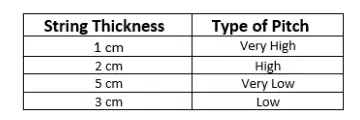
15. Jennie’s class has a small tuning fork, a medium tuning fork, and a large tuning fork. Their teacher tells them to strike the tuning fork and place the fork in a bowl of water. They observe the pitch created and measure the vibrations of the tuning fork in Hertz.
a. The size of the tuning fork affects the volume of a sound.
b. Higher pitches produce more vibrations
c. Lower pitches produce more vibrations
d. Larger objects produce more vibrations

The picture shows 4 kids around a radio that is playing a song.
Who would hear the song at the lowest volume?
Child 1
Child 2
Child 3
Child 4

