
 Worksheets
Semester 1 Review 23-24
Total questions: 56
Worksheet time: 40mins

This picture of the chromosomes from one cell of an organism is called a...
karyptype
gene map
genotype
allelic frequency

Why are there two copies of every chromosome in this picture?
Organisms receive one chromosome from the mother, one from the father.
So that there is a back-up copy in case one gets damaged.
There are too many genes to fit on one chromosome.
One copy gives organisms traits, the other gets passed on to their offspring.
What do we call sections of DNA that are the code for producing traits of organisms?
Gene
Chromosome
Nucleus
Genome
Which of the following ways for a lion to hunt is the most energy efficient?
Hunting smaller prey less often
Hunting smaller prey more often
Hunting larger prey less often
Hunting larger prey more often
What is net energy gain?
Energy gained by eating the prey
Energy gained by eating the prey minus the energy lost by hunting the prey
Energy gained by eating the prey plus energy lost by hunting the prey
Number of prey hunted multiplied by the energy available from the prey
Which of the following is true about how many of each prey a lion hunts per day?
The more energy available from the prey the more of that prey they must hunt.
The less energy cost to hunt the prey the less of that prey they must hunt.
The more net energy the prey provides the more of that prey they must hunt.
The energy cost to hunt the prey must be less than the energy the lion has stored.

Does the genetic data support the geographic data for the lion prides?
Yes, in general, prides that live closer geographically are more genetically similar.
No, most of the prides that live close geographically are genetically different.

How can this DNA evidence be used when comparing lion prides?
It can be used to determine relatedness among prides to see which prides are the most genetically similar.
It can be used to determine whether individuals are members of the same species.
It can be used to determine if a species is extinct.
It can be used to determine the number of lions in a pride.
Which of the following best explains why Lulu benefited from raising cubs that were not her own?
Lulu was a very generous and loving lion that just wanted to care for everyone in her pride.
Lulu was most likely related to the other females in the pride and taking care of their cubs would increase the chances that the cubs survived and passed genes from their family on to a new generation of cubs.
Lulu was the dominant female and she had to take the cubs, even if it meant she would be risking her life.
Lulu had a mate in another pride that she wanted to raise the cubs with.
Should scientists use only 1 gene when determining relatedness among individuals or prides?
Yes
No

Who could be the mom of a new cub with two O alleles for gene FCA45?
none of the females listed could be the mom
629
630
687

Which of the following is true for gene FCA45 for cub 710?
They received one M allele from one parent and one N from the other.
They received an M allele from both parents.
They received an A allele from one parent and a B allele from the other parent.
They received two M alleles from one parent and two N alleles from the other.
Location of a gene on a chromosome
Allele
DNA
Locus
A complex molecule containing the genetic information that makes up the chromosomes
Chromosomes
DNA
Gene
Allele
allele
a sequence of DNA that codes for a heritable trait
alternate forms of a gene that lead to different traits
the DNA in a cell organized by size and staining pattern
a threadlike structure of DNA packaged with proteins
Which biomolecule helps form muscles?
Nucleic Acid
Carbohydrate
Protein
Lipids
The more bonds a molecule has, the more....
water is stored
force is stored
energy is stored
oxygen is stored
What kind of bond is formed between 2 amino acids?
Double bond
Peptide bond
Hydrogen bond
Hydrolysis bond
Lions are carnivores which means their diet consists only of meat, which macromolecule is most prevalent in meat?
Carbohydrate
Protein
Lipid/Fat
Proteins are made up of chains of bonded
DNA
Nucleic Acids
Amino Acids
mRNA
When the lion consumes a zebra, it is digesting the proteins found in the flesh of the zebra. During digestion, the bonds of the old proteins _____________ and ____________ is released.
break; energy
break; glucose
stay; energy
stay; glucose
When all the bonds of the protein break (from the zebra), individual amino acids are floating around. These amino acids will _____________ new proteins needed by the lion.
destroy
breakdown
reform

The physical & chemical breakdown of food is called?
Digestion
Absorption
Swallowing
Excretion
Source of quick energy
carbohydrates
lipids
proteins
nucleic acids
The more bonds a molecule has, the more....
water is stored
force is stored
energy is stored
oxygen is stored

This section of the gut is responsible for aiding in the digestion of plant matter (like cellulose).
Small Intestine
Cecum
Large Intestine
None of these
An animal that eats mainly plants to survive is a...
Omnivore
Herbivore
Carnivore
An animal that MAINLY eats other animals to survive is a...
Omnivore
Carnivore
Herbivore
This section of the gut is responsible for water reabsorption.
Small Intestine
Cecum
Large Intestine
None of these
This section of the gut is usually the longest and absorbs nutrients (and energy) for an organism.
Small Intestine
Cecum
Large Intestine
None of these

The organisms shown here is most likely a(n)....
herbivore
Omnivore
Carnivore
None of these
Which of the following elements are found in all macromolecules? (Select all that apply).


What is this called?
Food Web
Food Chain
Abiotic Factors
What does a Primary Consumer eat?
Tertiary Consumers
Secondary Consumers
Producers
In a food web, arrows point at:
who gets energy.
who gets eaten.

What does a food web represent?
All connections of energy flow throughout all organisms in a ecosystem.
The specific ways that mutualism is carried out.
A single pathway or energy flow between organisms.
How carnivores get their food.

Which organism recieves the least amount of energy from the producer?
Owl
Grasshopper
Lilypad
Mouse

Which is the correct food chain order?
Plant-->1st Consumer--> 2nd Consumer
Plant <-- 1st Consumer <-- 2nd Consumer
2nd consumer --> 1st consumer --> Plant
1st Consumer --> 2nd consumer --> Plant
The efficiency of energy transfer from a lower trophic level to the next highest level is roughly
1%
10%
100%
1000%
What is a trophic level?
Each step in a food chain.
Amount of energy available in an ecosystem.
Each step in an ecosystem.
Total amount of living organic matter in an ecosystem.
In an energy pyramid, energy_______ as you move up the pyramid.
Increases
Decreases
Stays the same
Changes up and down

In this energy pyramid, which organisms have the most energy available?
Producers
Carnivores
Herbivores
Top Predator

If there is 1000 Kcal available in the producers in trophic level 1, how much energy is available in the herbivores in trophic level 2?
10 Kcal
1 Kcal
100 Kcal
1000 Kcal

You observed a group of female lions hunt 2 of species A, what is the net gain of energy?
165,300 kcal
245,600 kcal
122,800 kcal
330,600 kcal

What is the net gain of energy from hunting 1 species C?
111,750 kcal
145,500 kcal
33,750 kcal
179,250kcal
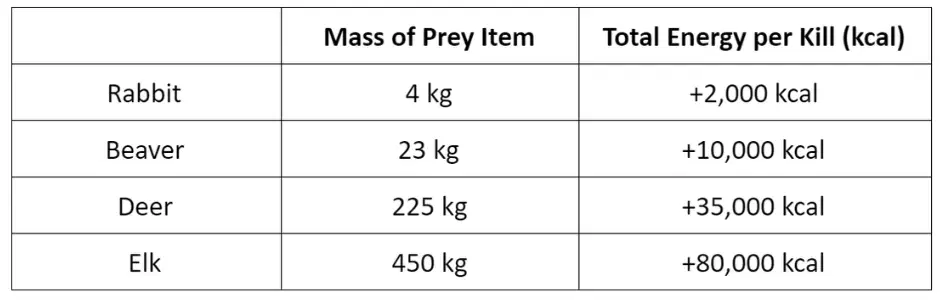
Coyotes require a net gain of approximately 3,500 kcal per day. Packs vary in size. This pack you are studying consists of 11 individuals.
What would be the best prey choice that would meet the daily energy needs of a pack consisting of 11 individuals?
Rabbit
Beaver
Deer
Elk

What feeding niche would this organism be considered part of?
A herbivore because of its sharp pointed premolars and developed canines
A carnivore because of its sharp pointed premolars and developed canines
A herbivore because of its flat premolars and molars and lack of developed canines
A carnivore because of its flat premolars and molars and lack of developed canines

What feeding niche would this organism be considered part of?
A herbivore because of its sharp pointed premolars and developed canines
A carnivore because of its sharp pointed premolars and developed canines
A herbivore because of its flat premolars and molars and lack of developed canines
A carnivore because of its flat premolars and molars and lack of developed canines

Would an elephant generally have a longer or shorter small intestine?
Longer, because they eat plants
Shorter, because they eat plants
Longer, because they eat meat
Shorter, because they eat meat

Since a lion has a shorter small intestine, how does that relate to their digestion time?
This varies by animal
The shorter the small intestine, the longer the digestion time
The shorter the small intestine, the shorter the digestion time
It does not relate

In the picture shown the rabbit has a more developed cecum than the human. What does that mean?
The well developed cecum means the rabbit is a carnivore
The well developed cecum means the rabbit is a herbivore
The well developed cecum means the rabbit is a omnivore
The well developed cecum means the rabbit is a decomposer
When bonds break during digestion, what does an organism get?
Protein
Sugar
Food
Energy
What kinds of bonds break amino acids AND are used to link amino acids?
Ionic bond
Covalent bond
Peptide bond
James bond

If there is 34,567 kcals of energy available at the producer level, how much energy can be made available for the tertiary consumers?
3,456 kcal
345 kcal
34 kcal
3 kcal

The more you move towards the top of the pyramid the __________ overall organisms there are
More
Less

Which organism is the primary consumer?
Grasshopper
Mouse
Snake
Hawk

