wayground logo

Free Printable Worksheets

NEW

Font size

S
M
L
XL
Worksheets

CA#4/Benchmark Review

Total questions: 76

Worksheet time: 1hrs 2mins

Name
Class
Date
1.
_____________ is the ability to work.
a)
Force
b)
Job
c)
Energy
d)
Motion
2.
Students wanted to investigate if a rubber ball dropped from different heights made larger bounces. This experiment is an example of what?
a)
Friction
b)
Temperature
c)
Mass
d)
Gravity
3.
What materials are needed to make a circuit?
a)
Wire, flashlight, lighbulb
b)
Copper wire, battery, lightbulb
c)
Ruler, beaker, battery
d)
Triple beam balance, wire, water
4.
A push or a pull that causes an object to move, slow down, stop or change direction is called a -
a)
Energy
b)
Gravity
c)
Mass
d)
Force
5.
Magnetism is a force that pushes and pulls.
a)
True
b)
False
6.
What is something that DOES NOT let heat or electricity go through easily?
a)
Conductor
b)
Insulator
7.
When riding your bike, what type of energy are you using?
a)
Thermal Energy
b)
Sound Energy
c)
Mechanical Energy
d)
Electrical Energy
8.
Which of the following would be an example of a CONDUCTOR?
a)
Rubber Eraser
b)
Wool Mittens
c)
Paperclips
d)
Plastic Cup
9.
Which of the following would be an example of an INSULATOR?
a)
Water
b)
Copper Wire
c)
Metal Nail
d)
Pencil
10.
True or False
An open circuit does NOT allow energy to flow through.
a)
False
b)
True
11.
The sun is an example of what type of energy?
a)
Mechanical Energy
b)
Thermal/Heat Energy
c)
Sound Energy
d)
None of these
12.
The texture of sand is _________.
a)
Gritty/Rough
b)
Smooth
c)
Sticky
d)
Brown
13.
The BREAKing down of rocks is called
_____________.
a)
Erosion
b)
Evaporation
c)
Weathering
d)
Deposition
14.
The movement of sediments is called
_____________.
a)
Erosion
b)
Condensation
c)
Deposition
d)
Weathering
15.
Which of the following is an example of weathering?
a)
River water carries sand and small rocks to the ocean
b)
Waves crash a cliff and break it down into sand and pebbles
c)
A landslide pulls mud and rocks down a hill
d)
Sand builds up in a desert and forms sand dunes
16.
Rain washing away soil from a hillside
a)
Weathering
b)
Erosion
c)
Deposition
17.
Deltas forming at the mouths of rivers
a)
Weathering
b)
Erosion
c)
Deposition
18.
Water getting into cracks, freezing, and breaking the rocks or pavement apart
a)
Weathering
b)
Erosion
c)
Deposition
19.
Which of the following is a landform?
a)
Water
b)
River
c)
Delta
d)
Ocean
20.
Which of the following is NOT a slow change to Earth's surface?
a)
Erosion
b)
Deposition
c)
Condensation
d)
Weathering
21.
Light bends when it is 
a)
refracted
b)
reflected
c)
absorbed
22.
How does light travel from a source?
a)
Around corners
b)
In circles
c)
Very slowly
d)
In a straight line
23.
A microscope makes objects under it appear bigger because the lens...
a)
bends the light passing through it.
b)
increases the strength of the light.
c)
decreases the light passing through it.
d)
changes the color of the light passing through it.
24.
Which of the following is the best model for how light is reflected?
a)
A truck traveling down a street.
b)
A baseball being hit by a bat.
c)
A ball bouncing off a wall.
d)
An acorn falling from a tree.
25.
A student place a ruler into a glass of water and observes that the ruler looks broken. What is occuring?
a)
The force of the water has broken the ruler.
b)
The ruler is broken before it is put in the water.
c)
Water in the cup reflects light around the ruler in a different direction than the air.
d)
Light is refracted as it enter the water, making the ruler look broken.
26.
This is an example of? 
a)
Absorb
b)
Reflect
c)
Refract
d)
Transmit
27.
When light passes through a prism it?
a)
Bounces back
b)
Reflects
c)
Refracts
d)
Absorbs
28.
Choose the corrrect sentence.
a)
This circuit will work because it is an open circuit
b)
This circuit will work because it is a closed circuit.
c)
This circuit will NOT work because it is an open circuit.
d)
This circuit will NOT work because it is a closed circuit.
29.
Choose the correct sentence.
a)
This circuit will work because it is an open circuit.
b)
This circuit will work because it is a closed circuit.
c)
This circuit will NOT work because it is an open circuit.
d)
This circuit will NOT work because it is a closed circuit.
30.
Would would best complete this circuit?
a)
A wire
b)
A switch
c)
A battery
d)
A light bulb
31.
If a material does not allow charges to move through it easily, what is it called?
a)
electrical insulator
b)
electrical conductor
c)
reistor
d)
capacitor
32.

Why electrical wiring usually are covered with a layer of plastic?

a)

To make it look pretty

b)

To help electricity flow along the wire

c)

To make it safe

d)

To add more energy

33.

Why is electrical wiring usually made from copper?

a)

Because copper is shiny

b)

Because copper conducts electricity

c)

Because copper is not magnetic

d)

Because copper insulate electricity

34.

A material that does NOT let electricity pass through it is called ...

a)

An electrical conductor

b)

An electrical insulator

c)

An electrical source

d)

An electric appliance

35.
What materials are needed to make a circuit?
a)
Wire, flashlight, lighbulb
b)
Copper wire, battery, lightbulb
c)
Ruler, beaker, battery
d)
Triple beam balance, wire, water
36.
_____________ is the ability to work.
a)
Force
b)
Job
c)
Energy
d)
Motion
37.
What is something that DOES NOT let heat or electricity go through easily?
a)
Conductor
b)
Insulator
38.
When riding your bike, what type of energy are you using?
a)
Thermal Energy
b)
Sound Energy
c)
Mechanical Energy
d)
Electrical Energy
39.
Which of the following would be an example of a CONDUCTOR?
a)
Rubber Eraser
b)
Wool Mittens
c)
Paperclips
d)
Plastic Cup
40.
Which of the following would be an example of an INSULATOR?
a)
Water
b)
Copper Wire
c)
Metal Nail
d)
Pencil
41.
Which of the following would be an example of an INSULATOR?
a)
Water
b)
Copper Wire
c)
Metal Nail
d)
Pencil
42.
True or False
An open circuit does NOT allow energy to flow through.
a)
False
b)
True
43.
The sun is an example of what type of energy?
a)
Mechanical Energy
b)
Thermal/Heat Energy
c)
Sound Energy
d)
None of these
44.
Which object requires only mechanical energy to perform its main function?
a)
A
b)
B
c)
C
d)
D
45.
The toy oven shown uses a lightbulb to bake small cakes. What types of energy does the toy oven use to bake the cakes?
a)
Light and sound
b)
Electrical and thermal
c)
Thermal and mechanical
d)
Mechanical and electrical
46.
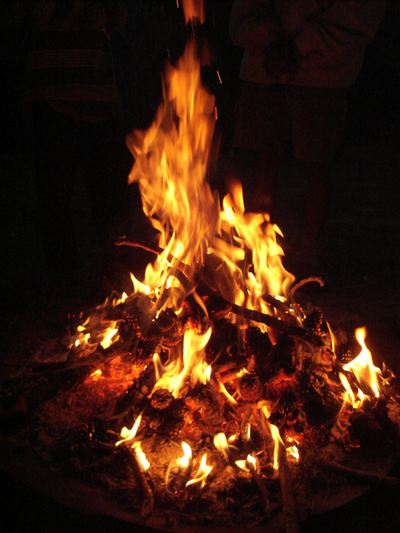
What kind of energy is represented in this picture?
a)
Thermal
b)
Chemical
c)
Electrical
d)
Sound
47.
What kind of energy is represented in this picture?
a)
Thermal
b)
Potential
c)
Nuclear
d)
Mechanical
48.
What kind of energy?
a)
Thermal
b)
Electrical
c)
Mechanical
d)
Radiant
49.
The type of energy that moves objects is...
a)
Thermal Energy
b)
Sound Energy
c)
Mechanical Energy
d)
Chemical
50.
Thermal energy is...
a)
electric charge through a conductor
b)
heat energy...usually measured with a thermometer
c)
vibration of matter in waves
d)
energy that travels in waves through empty space
51.
Sound energy is...
a)
heat energy
b)
electric current through a conductor
c)
vibrations; movement of energy through a substance in waves
d)
energy that moves in waves through empty space
52.
What object changes electrical energy into light energy?
a)
a candle
b)
a lamp
c)
a fire
d)
a radio
53.
What object changes mechanical energy into electrical energy?
a)
a candle
b)
a radio
c)
a lamp
d)
a spinning turbine
54.
What object changes mechanical energy into sound energy?
a)
a candle
b)
a electric radio
c)
a guitar
d)
a fire
55.
All of the following devices produce light energy EXCEPT –
a)
laser pointers
b)
air conditioners
c)
fluorescent lamps
d)
computer monitors
56.
A student observed that sugar in hot water dissolved more quickly than in cold water. The student was investigating the effects of what form of energy?
a)
thermal 
b)
light
c)
sound
d)
mechanical
57.
Heat energy is also called
a)
electrical energy
b)
chemical energy
c)
light energy
d)
thermal energy
58.
What machine changes electrical energy into light and sound energy?
a)
battery
b)
lightbulb
c)
alarm clock
d)
apple
59.
What is solubility?
a)
The ability to become invisible
b)
The ability to solve a problem
c)
The ability to dissolve
d)
The ability to break apart
60.
A glass beaker contains 100 milliliters of water into which 5 grams of salt was stirred.  Which item should be used to separate this particular mixture?
a)
triple beam balance
b)
hot plate
c)
paper filter
d)
magnet
61.
A fifth grade class has collected empty cans for recycling. They have several large bins with aluminum and steel cans, all mixed together. The two types of cans must be separated. Which of the following techniques could the students use to separate the two types of cans?
a)
Place the cans in water, and the aluminum cans will float
b)
Crush the cans to make them easier to carry
c)
Test the cans for their ability to conduct electricity
d)
Use a magnet to find and remove the steel cans
62.
Students collected data on the appearance of four substances and how they reacted when mixed with water. Which substances are not soluble when mixed with water?
a)
A and B
b)
B and C
c)
A and D
d)
C and D
63.
Sugar is added to water and stirred until it completely dissolves. Which of the following correctly describes something that has happened to the sugar?
a)
the mass of the sugar increased
b)
the mass of the sugar decreased
c)
the sugar disappeared and no longer exists
d)
the sugar is evenly distributed in the water
64.
Which of the following is a solution?
a)
sweet tea
b)
assorted legos
c)
water and sand
d)
paperclips, erasers, and pencils
65.
Which tools would I use to separate sand, water, and rocks
a)
filter and magnet
b)
magnet and tweezers
c)
you cannot separate them
d)
filter and sieve (strainer)
66.
If I added 15 grams of salt to 100 mL of water and separated the solution with a hot plate, what amount of salt would be left behind?
a)
100 grams
b)
0 grams
c)
15 grams
d)
10 grams
67.
Which list below shows objects in a mixture that could best be separated using the physical property of density?
a)
iron filings and sugar
b)
large plastic beads and small plastic beads
c)
paper clips and marbles
d)
pennies and corks
68.

Which one of the following solids is insoluble (not soluble) in water?

a)

sugar

b)

sand

c)

tea

d)

salt

69.
You know that a substance has dissolved when it-
a)
becomes a solid
b)
produces condensation and has water droplets 
c)
spreads evenly throughout a liquid
70.
Which of the following is a method of separating solutions?
a)
hand seperation
b)
filtering
c)
screening
d)
evaporation 
71.
What happens when sand and water are mixed together?
a)
sand will settle to the bottom
b)
water will change physical properties
c)
the cup will get really cold
72.

The guy is pushing a chair. Which path will the chair take?

a)

It will slide closer to him

b)

It will stop moving

c)

It will spin back and forth

d)

It will slide away from him

73.

What is the unit of force?

a)

grams

b)

Newton's

c)

milliliters

d)

centimeters

74.

Variables are parts of an experiment that change. When designing an experiment, scientists should test...

a)

Using no variable

b)

with only one variable that changes

c)

with 2 variables

d)

with 3 or more variables

75.

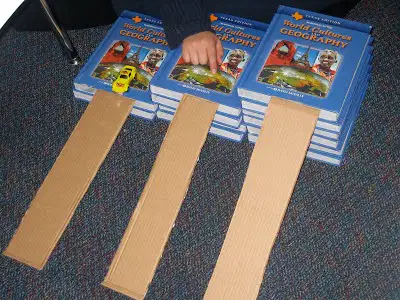
What is the variable of the experiment shown in the picture?

a)

Length of ramp

b)

height of ramp

c)

surface of ramp

d)

type of car

76.

Which material will slow the speed of the ball on a ramp the most?

a)

glass

b)

plastic

c)

wood

d)

sandpaper