
 Worksheets
Quantum model & Periodicity
Total questions: 152
Worksheet time: 7hrs 33mins


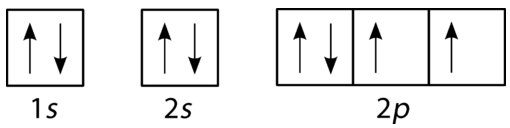


Which of the following statements regarding electronic orbitals is/are correct?
Each p-orbital can hold a maximum of six electrons.
The 3p-orbitals have a higher energy level than the 3s-orbital.
The three 3p-orbitals have slightly different energy levels.
The 1s-orbital has the same size and shape as the 2s-orbital.
What is the Aufbau principle?
Within an energy level, s orbitals are the lowest energy, followed by p, d and then f. F orbitals are the highest energy for that level.
The lower the principal quantum number (n) the lower the energy.
All three.
The Aufbau Principle states that electrons enter the lowest energy orbitals first.

Identify the rule that is being violated
Aufbau's Principle
Hund's Rule
Pauli's Exclusion Principle
Heisenberg uncertainty principle
What is incorrect about this orbital diagram?
Both arrows in the filled 2p box should be pointing the same direction
There is nothing incorrect with this diagram
In the there should only be 1 arrow in the first 2p box and one in the 2nd 2p box
All the arrows should be pointing the same direction.
All orbitals of equal energy (degenerate orbitals) are occupied by one electron before any single orbital is occupied by a second electron.
Aufbau Principle
Pauli's Exclusion Principle
Hund’s Rule
Core Notation
No two electrons in the same atom can have the same four quantum numbers.
Aufbau Principle
Pauli's Exclusion Principle
Hund’s Rule
Noble gas notation
Which rule is violated in the following orbital diagrams?
Hund's Rule
Aufbau Principle
Pauli's Exclusion Principle
Which rule is violated in the following orbital diagrams?
Aufbau Principle
Hund's Rule
Pauli's Exclusion Principle
Which of the following is NOT a possible pair of quantum numbers?
2p
2d
4p
4f
What does the 1 in "1s" stand for?
energy level
s orbitals
p orbitals
the number of electrons
What element has the electron configuration 1s2 2s2 2p6 3s2 3p5?
Chlorine
Argon
Fluorine
Sulfur
Bromine
How many electrons are in 1s2 2s2 2p4?
5
6
8
13
What is the noble gas configuration for Cobalt?
[Kr] 4s2 3d7
[Kr] 4s2 4d7
[Ar] 4s2 3d7
[Ar] 4s2 4d7
What is the noble gas configuration for 1s2 2s2 2p6 3s2?
[He] 3s2
[Ne] 3s2
[Ar] 3s2
[Ar] 4s2

The graph above shows the ionization energy values as the elements are arranged on the periodic table. Which conclusion cannot be drawn from the graph?
The ionization energy drops significantly as you move down a group because the valence electrons are in a shell further from the nucleus.
The ionization energy increases gradually as you move right across a period because the valence electrons are in a shell further from the nucleus.
The ionization energy increases gradually as you move right across a period because you are adding more protons.
The ionization energy increases when the valence electrons are more attracted to the nucleus.

As you look down a group, ionization energy and electronegativity
increases
decreases
As you look from left to right across a period, ionization energy and electronegativity both
increase
decrease

Which element has the greater ionization energy?
Magnesium (Mg)
Phosphorus (P)

Which element has the greater ionization energy?
Iodine (I)
Chlorine (Cl)

Which has the greater electronegativity:
N or C?
C
N

Which has the greater electronegativity:
Cl or Al?
Cl
Al
N or C?
H or F?
F, N, B
As you look down a group, ionization energy and electronegativity
increases
decreases
As you look from left to right across a period, ionization energy and electronegativity both
increase
decrease
Which element has the greater ionization energy?
Magnesium (Mg)
Phosphorus (P)
Which element has the greater ionization energy?
Iodine (I)
Chlorine (Cl)
P, Cs, Co, Sr
As you look from left to right across a period, electronegativity
increases
decreases
Who developed the Periodic Table?
Mendeleev, who was a chemist and teacher
Pavlov, who was a teacher and physchologist
Ladahoff, who was a teacher and biologist
As you look down a group, ionization energy and electronegativity
increases
decreases
Which element has the greater ionization energy?
Magnesium (Mg)
Phosphorus (P)
Which element has the greater ionization energy?
Iodine (I)
Chlorine (Cl)
As you look from left to right across a period, electronegativity
increases
decreases


The energy it takes to remove one electron from an atom
Atomic Radii
Ionization Energy
Electron Affinity
Ionic Radius
Electron affinity trends is . . . .
generally increases across a period, and a trend of decreasing electron affinity going down groups would be expected.
generally decreases across a period, and a trend of decreasing electron affinity going down groups would be expected.
generally increases across a period, and a trend of increasing electron affinity going down groups would be expected.
generally decreases across a period, and a trend of increasing electron affinity going down groups would be expected.
The amount of energy released when an electron is added to a neutral atom to form a negative ion
Atomic Radii
Ionization Energy
Electron Affinity
Oxidation Number
Ionization energy trends is . . . .
becomes greater down and to the right of the periodic table.
becomes greater up and to the right of the periodic table.
becomes greater up and to the left of the periodic table.
becomes greater down and to the left of the periodic table.
Which of the given atoms has the lowest electron affinity?
Sr
Be
Ca
Ra
List the following atoms in order of increasing ionization energy: Li, Na, C, O, F.
Li<Na<C<O<F
Na<Li<C<O<F
F<O<C<Li<Na
Na<Li<F<O<C
When the atomic radius increases, electron affinity
Decreases
Increases
Neutral
No effect
Which of the following atoms would have the largest second ionization energy?
Cl
S
Ca
Na
The distance between nucleus and outermost shell occupied electron
Atomic Radii
Ionization Energy
Electronegativity
Electron Afinity
Oxidation Number
The energy it takes to remove one electron from an atom
Atomic Radii
Ionization Energy
Electronegativity
Electron Afinity
Oxidation Number
The tendency of an atom to attract a shared pair of electrons
Atomic Radii
Ionization Energy
Electronegativity
Electron Afinity
Oxidation Number
The amount of energy released when an electron is added to a neutral atom to form a negative ion
Atomic Radii
Ionization Energy
Electronegativity
Electron Afinity
Oxidation Number
The degree of oxidation (loss of electrons) of an atom in a chemical compound
Atomic Radii
Ionization Energy
Electronegativity
Electron Afinity
Oxidation Number
Atomic radii trends is . . . .
generally decrease along each period of the table, from the alkali metals to the noble gases; and increase down each group.
generally increase along each period of the table, from the alkali metals to the noble gases; and increase down each group.
generally increase along each period of the table, from the alkali metals to the noble gases; and decrease down each group.
generally decrease along each period of the table, from the alkali metals to the noble gases; and decrease down each group.
Ionization energy trends is . . . .
becomes greater up and to the right of the periodic table.
becomes greater down and to the right of the periodic table.
becomes greater up and to the left of the periodic table.
becomes greater down and to the left of the periodic table.
Electronegativity trends is . . . .
increases on passing from left to right along a period, and decreases on descending a group.
increases on passing from left to right along a period, and increases on descending a group.
decreases on passing from left to right along a period, and decreases on descending a group.
decreases on passing from left to right along a period, and increases on descending a group.
Electron affinity trends is . . . .
generally increases across a period, and a trend of decreasing electron affinity going down groups would be expected.
generally decreases across a period, and a trend of decreasing electron affinity going down groups would be expected.
generally increases across a period, and a trend of increasing electron affinity going down groups would be expected.
generally decreases across a period, and a trend of increasing electron affinity going down groups would be expected.
Metallic character trends is . . . .
decrease going across a period and tends to increase going down a group.
increase going across a period and tends to increase going down a group.
decrease going across a period and tends to decrease going down a group.
increase going across a period and tends to decrease going down a group.
Which element has bigger atomic radii?
Beryllium is bigger than Fluorine
Oxygen is bigger than Sulphur
Litihium is bigger than Sodium
Phosphorus is bigger than Bromine
Which element has smaller atomic radii?
Beryllium is smaller than Fluorine
Sulphur is smaller than Oxygen
Litihium is smaller than Sodium
Potassium is smaller than Bromine
Which element has higher ionization energy?
Chlorine is higher than Sodium
Phosphorus is higher than Nitrogen
Silicon is higher than Carbon
Magnesium is higher than Aluminium
Which element has lower ionization energy?
Chlorine is lower than Sodium
Phosphorus is lower than Nitrogen
Carbon is lower than Silicon
Aluminium is lower than Magnesium
Which element has higher electronegativity?
Fluorine is higher than Oxygen
Potassium is higher than Sodium
Aluminium is higher than Boron
Phosphorus is higher than Chlorine
Which element has lower electronegativity?
Fluorine is lower than Oxygen
Potassium is lower than Sodium
Boron is lower than Aluminium
Chlorine is lower than Phosphorus
Which element has higher electron affinity?
Bromine is higher than Calsium
Chlorine is higher than Fluorine
Magnesium is higher than Beryllium
Sodium is higher than Aluminium
Which element has lower electron affinity?
Bromine is lower than Calsium
Chlorine is lower than Fluorine
Berylliumis lower than Magnesium
Aluminium is lower than Sodium
Which element is more metallic?
Sodium is more metallic than Aluminium
Fluorine is more metallic than Beryllium
Potassium is more metallic than Lithium
Chlorine is more metallic than Silicon
Which element is less metallic?
Sodium is less metallic than Aluminium
Beryllium is less metallic than Fluorine
Lithium is less metallic than Potassium
Chlorine is less metallic than Silicon
1s2 2s22p6 3s23p6 4s2



