
 Worksheets
QB 2 Review 2023
Total questions: 27
Worksheet time: 14mins
Which system of government shares power most evenly between national, state, and local governments?
unitary system
federal system
confederal system
dictatorship
How did colonists react when the British Parliament passed the Stamp Act?
by boycotting British goods
by dumping tea into Boston Harbor
by forming the Continental Congress
by attacking British soldiers
“We hold these truths to be self-evident, that all men are created equal, that they are endowed [provided] by their Creator with certain unalienable Rights, that among these are Life, Liberty and the pursuit of Happiness.”
In the excerpt above, “all men” refers to which group of people?
all free people, regardless of race or ethnicity
all free men, except Native Americans and Africans
all free men and women from Great Britain
all free men and women, except indentured servants
What was Baron de Montesquieu’s key belief about power in the government?
Power should be limited so the government is not all powerful.
Power should be concentrated in the federal government.
Power should be shared between the federal and state levels.
Power should be divided among different branches of government.
Which Enlightenment thinker argued that people have natural rights that should be protected by the government?
Thomas Hobbes
Jean-Jacques Rousseau
Voltaire
John Locke
Why did the United States switch from a confederal system to federalism?
The central government was too powerful and needed to be limited.
State and local governments needed more power to meet citizen needs.
State governments began to compete for control as the country grew.
The central government needed more power to unify the country.
What principle of democracy is found in Judaism?
Power should be distributed among leaders.
The majority make laws for all.
All people are equal under the law.
People should choose their leaders.
How does a direct democracy differ from a representative democracy?
The people elect leaders who make decisions for the community.
Rules place limits on the powers of the government.
Rulers are chosen from within the same family.
The people as a whole make decisions for the community.
What impact did the English Bill of Rights have on the government of Great Britain?
It gave Parliament more power than the king.
It made Great Britain a representative democracy.
It established the principle of limited government.
It gave equal rights to all citizens in Great Britain.
Which is the best description of the idea of a social contract?
People agree to give up some freedom to a government that provides security.
People agree that government powers should be divided among different groups.
People agree to a specific set of rules and procedures for their government.
People agree to specific rights and responsibilities for all citizens.
How did John Locke’s ideas influence the colonists’ views in the 1700s?
They grew angry about having fewer rights than people in England.
They demanded a new social contract with England.
They began to form independent local governments.
They began to write new charters for their colonies.
What did the Stamp Act require the colonists to do?
buy and place stamps on many documents they used
pay higher fees for the stamps needed to mail letters
get a stamp of approval from the governor to buy and sell goods
purchase stamps and use them to buy their food
Why did colonists call the Coercive Acts the “Intolerable Acts”?
They did not think it was fair to punish all of the colonies.
They thought the laws violated the English Bill of Rights.
They felt that England had no right to tax any of the colonies.
The laws aimed to limit cooperation between the colonies.
What Enlightenment ideas influenced the writing of the Declaration of Independence?
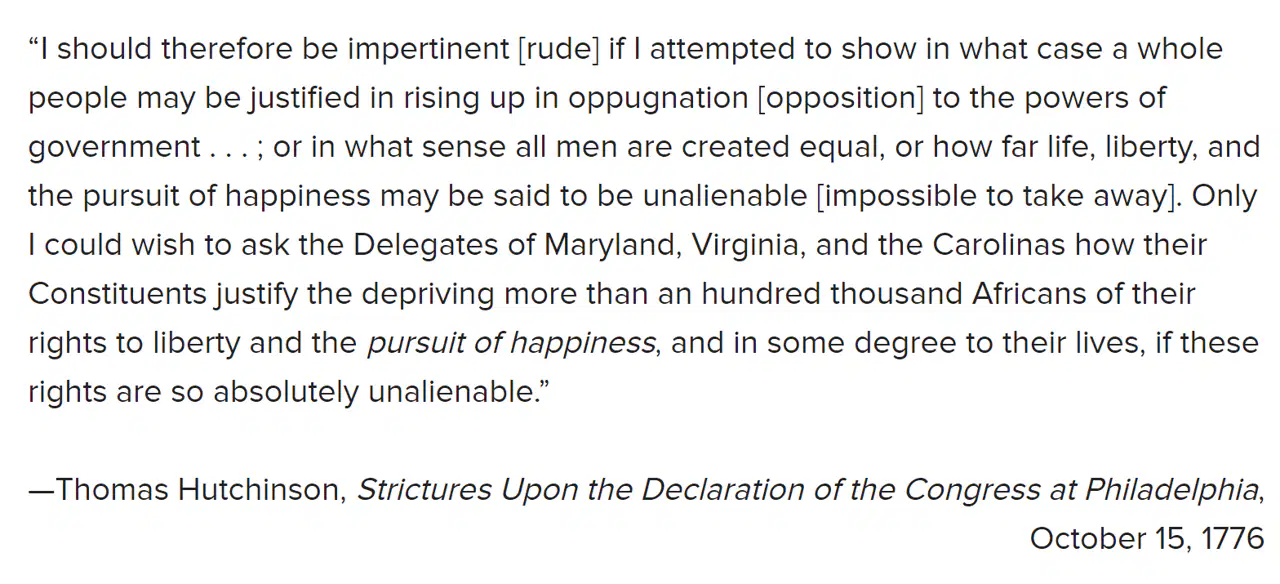
According to the passage, what problem does Hutchinson see with the Declaration of Independence?
It does not clearly define the terms “liberty” and “pursuit of happiness.”
Life, liberty, and the pursuit of happiness are not “unalienable” rights.
It claims all men are equal but denies “unalienable” rights to enslaved Africans.
It does not explain why the practice of slavery is permitted in southern colonies.
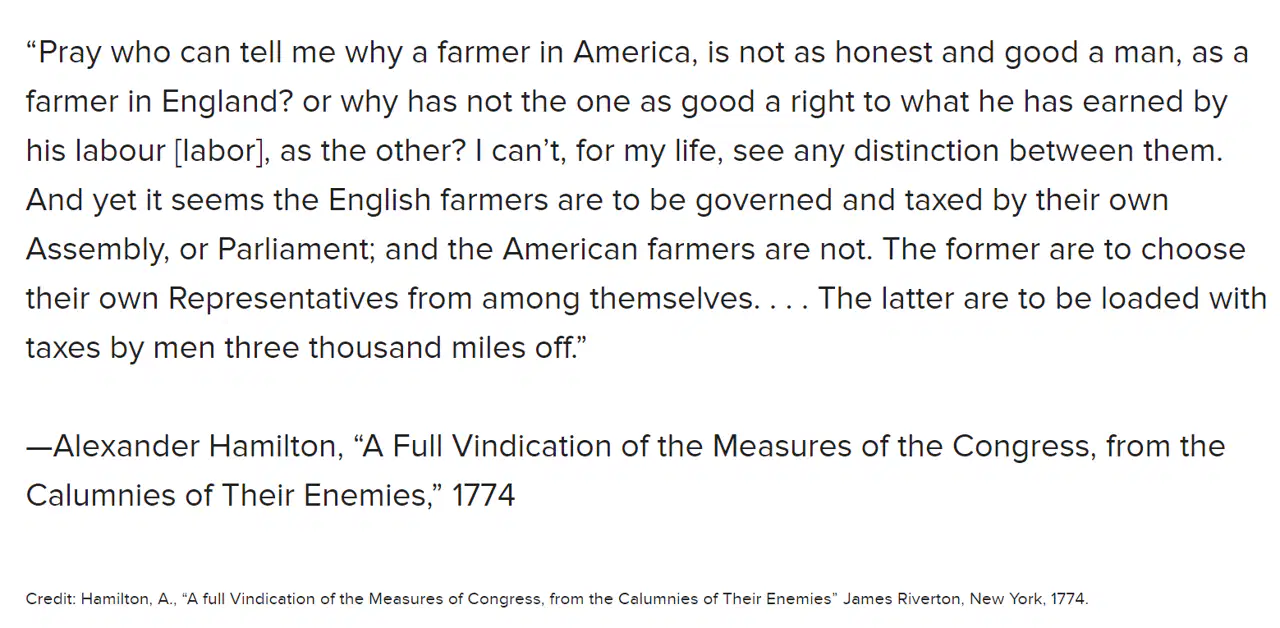
Which statement best summarizes Hamilton’s argument in this passage?
American colonists should not be treated differently than English citizens.
American colonies should be able to govern themselves independently.
American colonists are different and therefore should be treated differently.
American colonists should not be taxed without representation in Parliament.
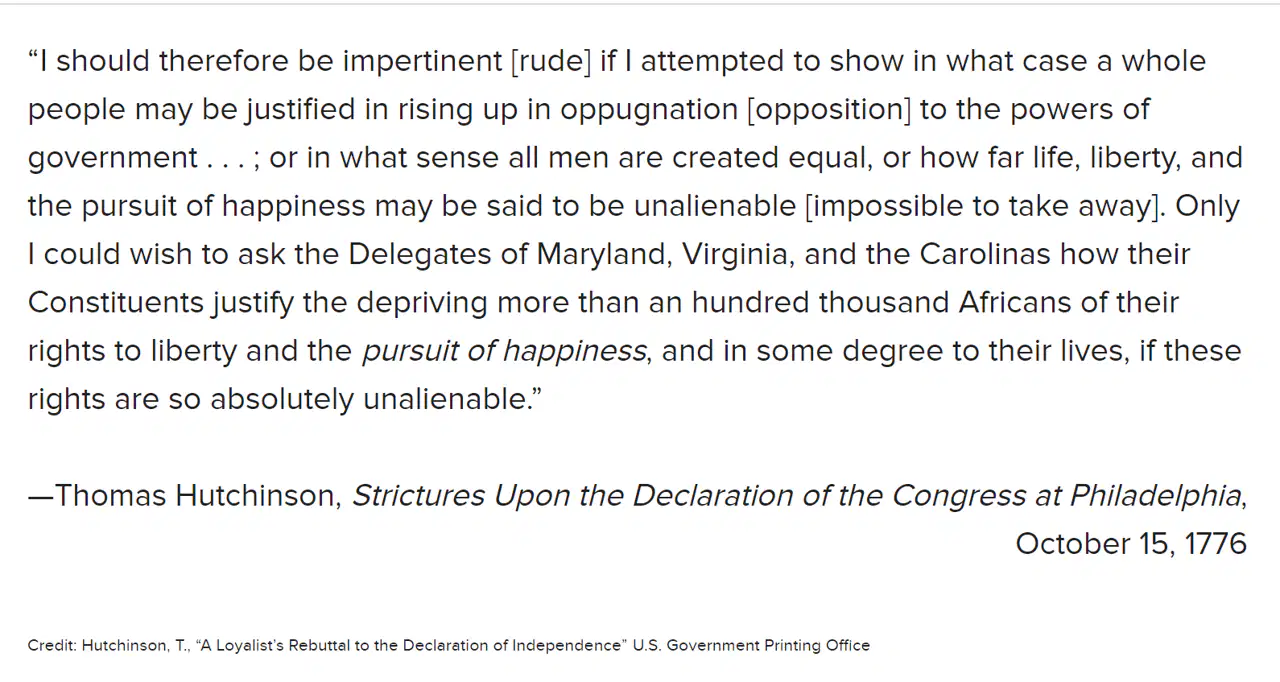
Which word best describes Hutchinson’s tone in the passage?
approving
worried
curious
critical
What was Thomas Paine’s main argument in Common Sense?
Colonists should declare independence from Great Britain.
The colonists should accept the rule of Great Britain.
Governments must guarantee the natural rights of citizens.
All men are created equal, including enslaved Africans.
How did the Fifteenth, Nineteenth, and Twenty-sixth Amendments affect democracy in the United States?
by more clearly defining civil liberties
by creating a more direct democracy
by expanding participation in the political process
by guaranteeing equality under the rule of law
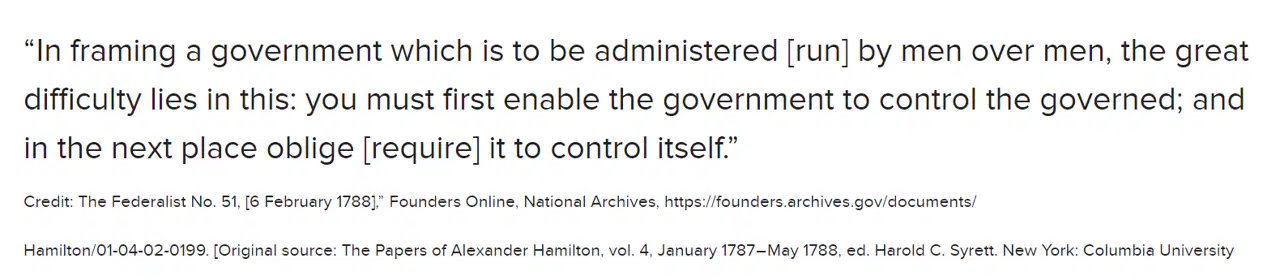
What principle of American democracy does James Madison refer to in this quote from The Federalist?
civil liberties
popular sovereignty
federalism
separation of powers
What principle of government does the phrase “We the People” in the Preamble establish?
popular sovereignty
separation of powers
rule of law
federalism

The right described in the quote is guaranteed by what document?
the Bill of Rights
the Articles of Confederation
the Civil Rights Act
the Nineteenth Amendment
Which of the following best explains why Congress’s power to “make all Laws which shall be necessary and proper” is called the elastic clause?
It forbids Congress from making any permanent changes to the Constitution.
It allows Congress to extend the term limits on senators and representatives.
It lets Congress stretch its powers to meet the changing needs of society.
It prevents both houses of Congress from overstepping their powers.
Why do the vice president, Speaker of the House, and president pro tempore of the Senate come before members of the president’s cabinet in the line of presidential succession?
because they are the president’s closest advisers
because they know the president better than cabinet members
because they are elected members of the government
because they are appointed by the president
Which of the following accurately states the qualifications for the office of president?
at least 35 years old, a native-born American citizen, and a U.S. resident for at least 14 years
at least 40 years old, an American citizen, and a U.S. resident for at least 15 years
at least 30 years old, a native-born American citizen, and a U.S. resident for at least 12 years
at least 50 years old, an American citizen, and a U.S. resident for at least 10 years

Which of the following best paraphrases Jefferson’s statement?
Citizens should trust that their leaders will honor the Constitution.
The Constitution should include harsh punishments for bad actions.
The Constitution should give broad and numerous powers to the president.
The Constitution should have tools to prevent leaders from committing harmful acts.
Which executive department is responsible for federal law enforcement?
the Department of State
the National Security Council
the Department of Justice
the presidential cabinet

