
 Worksheets
2023 Semester Exam Review
Total questions: 60
Worksheet time: 45mins
Three examples of physical change are ________.
boiling water, a nail rusting, a melting candle
melting ice, mowing the lawn, carving a statue
a pond freezing, breaking glass, a burning candle
applying lipstick, making lemonade, baking bread
The number of protons and neutrons in the nucleus of one atom of the element.
atomic mass
atomic number
neutron number
valence electrons
a horizontal row (left to right) in the periodic table
group
period
family
orbital
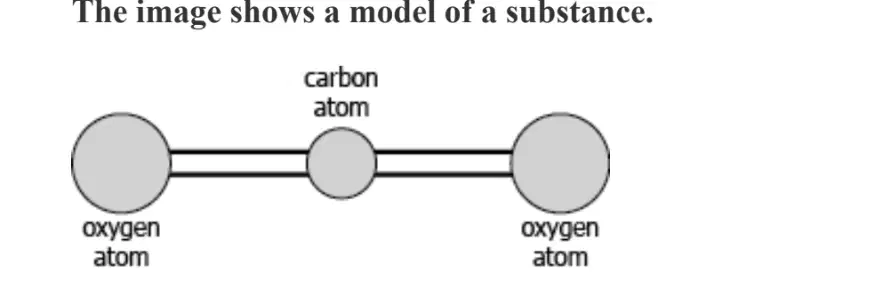
The image shows a model of a substance. How is the substance classified?
mixture
element
compound
atom
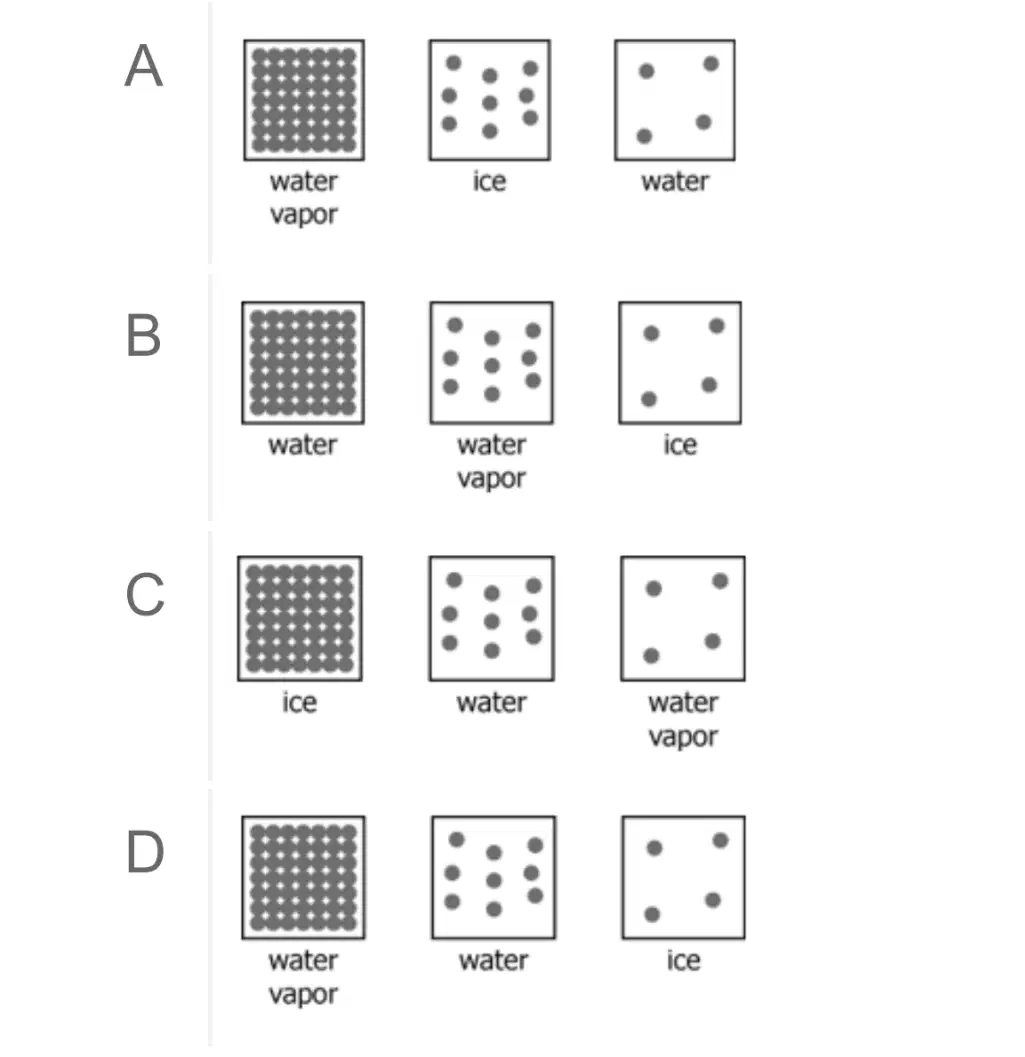
A student reads three statements from a science book.
1. The atoms or molecules in a solid state are closely packed and are fixed at their positions.
2. The particles in a liquid state slide past one another and have spaces between them,
3. The particles in a gaseous state move randomly in all directions and are the farthest apart.
The student uses the information to make a particle model representing the molecules of water in the three states: ice, water, and water vapor. Which model is correct?
A
B
C
D
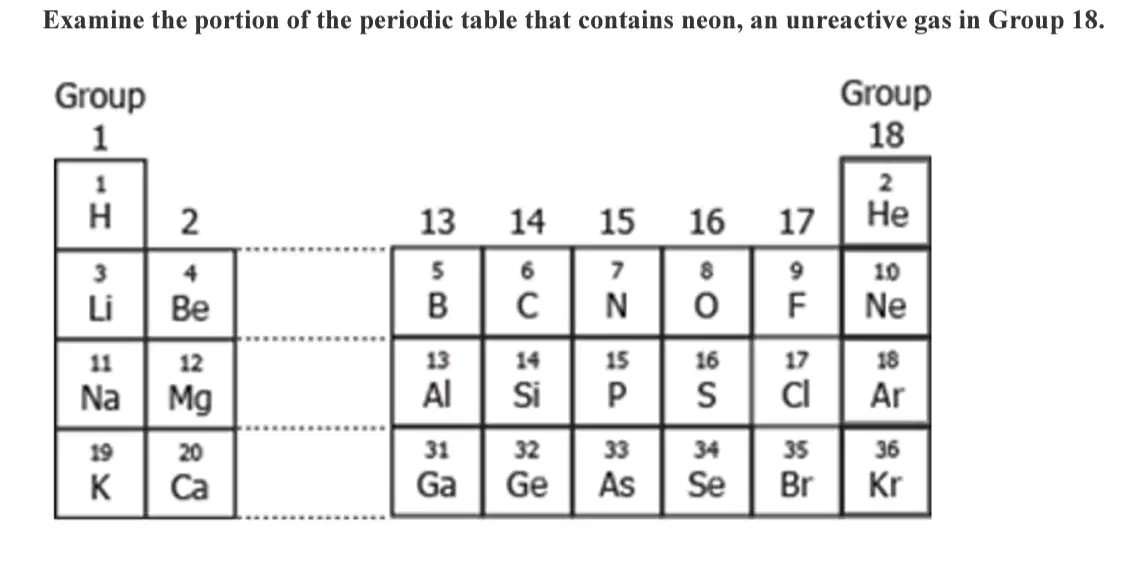
Examine the portion of the periodic table that contains neon, an unreactive gas in Group 18. Which element would have similar properties to neon, and why?
Ar; elements in the same family of the periodic table share the same characteristics.
Fl; elements in the same period of the periodic table share the same characteristics.
Fr; elements on opposite corners of the periodic table share the same characteristics.
Li; elements on opposite sides of the periodic table share the same characteristics.
It describes how likely an element is to form bonds with another element
elasticity
combustibility
flamibility
reactivity
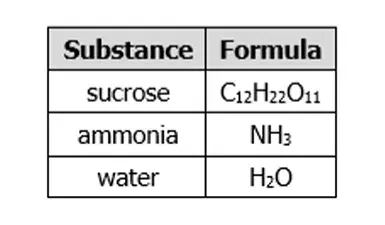
A teacher asks her students to classify the substances listed in the table shown as elements, compounds, or mixtures.
A student claims that all of the substances are compounds. Which statement correctly describes the student’s claim?
The student’s claim is correct because a substance that contains more than two of the same atom is a compound.
The student’s claim is incorrect because a substance that contains more than one element is always a mixture.
The student’s claim is incorrect because the atoms in the substances are physically combined to form a mixture.
The student’s claim is correct because the atoms in the substances are chemically combined to form a compound.
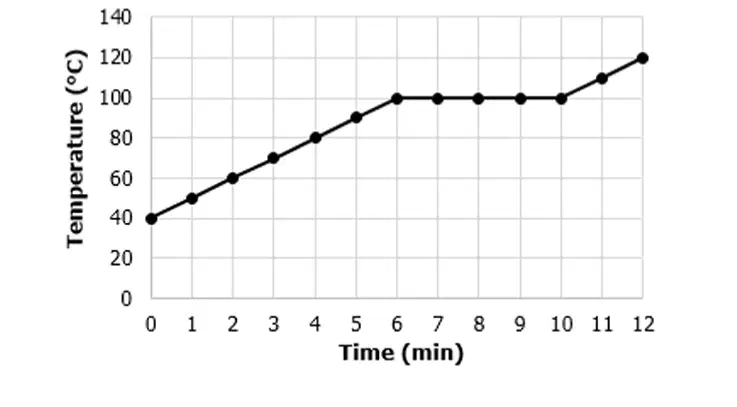
A student heats a beaker of water and constructs a graph based on the recorded observations.
What can be concluded from the portion of the graph where the temperature remains constant?
The water in the beaker is boiling.
The water in the beaker is melting.
The water in the beaker is freezing.
The water in the beaker is condensing.

A student examines a periodic table with two elements (X and Y) labeled. How can X and Y be classified?
Both X and Y are metals.
Both X and Y are metalloids.
X is a nonmetal, and Y is a metal.
X is a metal, and Y is a nonmetal.
a vertical column (up and down) on the periodic table.
period
orbital
group
valence
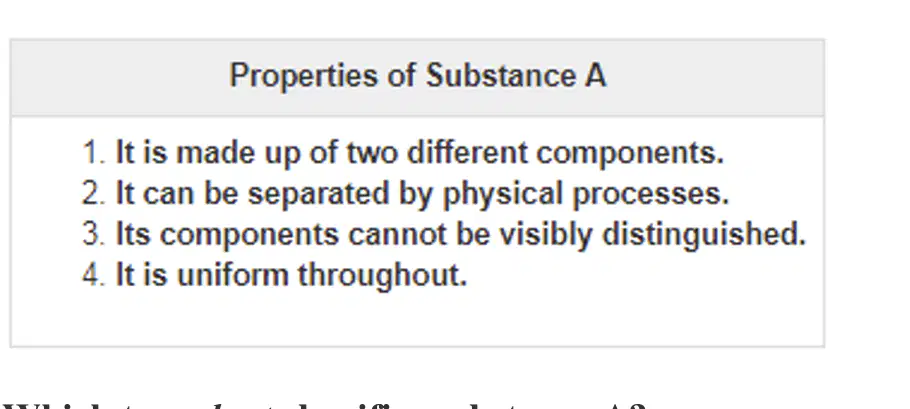
The table lists the properties of substance A.
Which term best describes substance A
compound
element
heterogeneous mixture
homogeneous mixture
An engineer attempts to pull two different materials, X and Y, into wires. Material X can easily be drawn into a wire, but material Y quickly breaks into pieces. The engineer concludes that material X is a metal, and material Y is a nonmetal. Which statement correctly supports the conclusion made by the engineer?
Metals are hard, and nonmetals are soft.
Metals are ductile, and nonmetals are brittle.
Metals are malleable, and nonmetals are brittle.
Metals are lustrous, and nonmetals are dull.
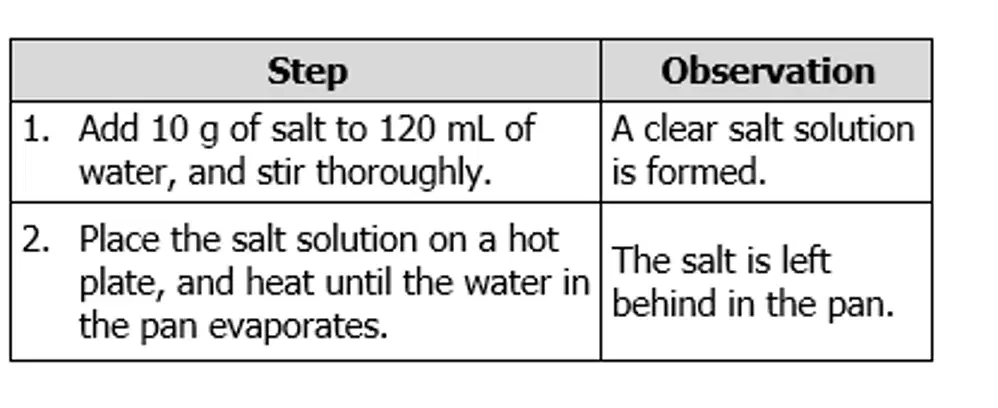
A student performs an investigation with water and table salt. The student lists the steps of the investigation and observations in a table. Which table correctly classifies the matter obtained in both steps of the investigation?
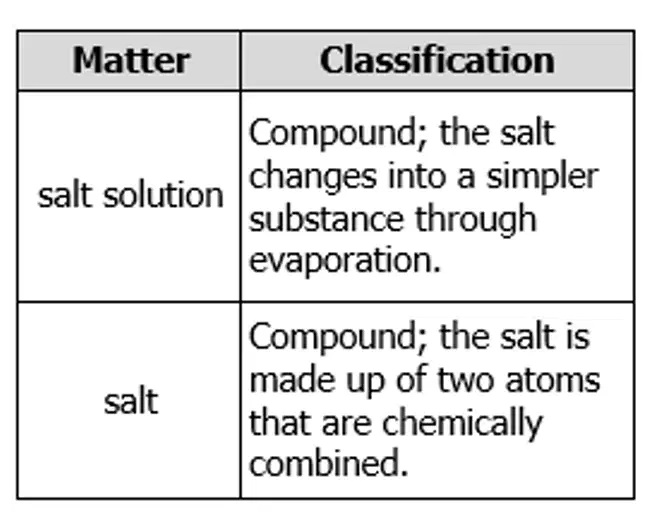

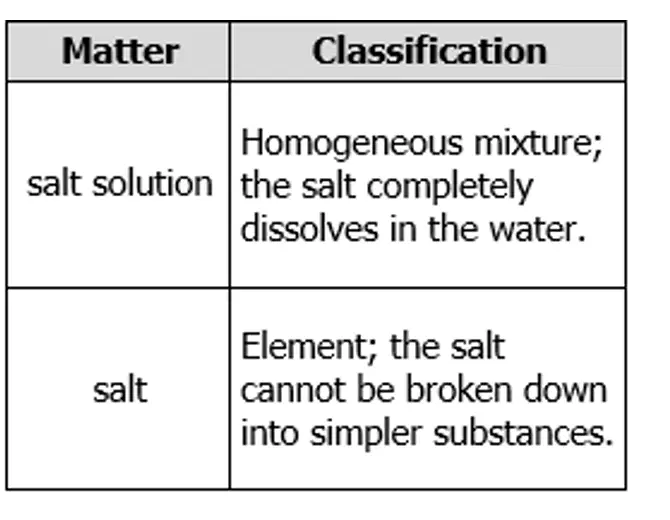
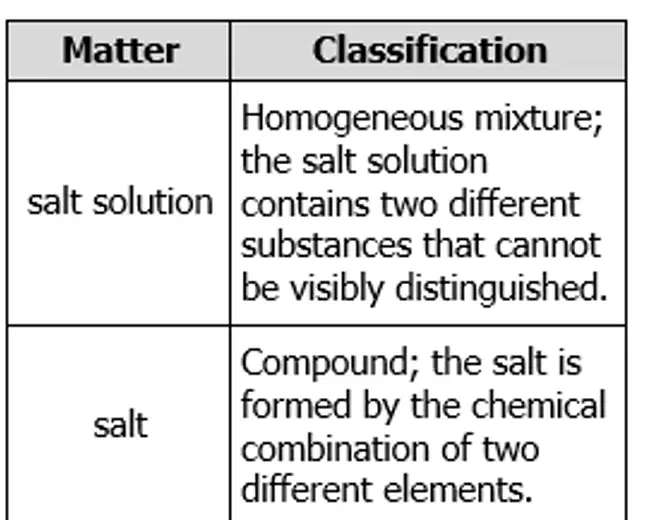
Where are nonmetals found on the periodic table?
Nonmetals are found throughout the periodic table.
Nonmetals are found on the left of the periodic table.
Nonmetals are found in the middle of the periodic table.
Nonmetals are found on the right of the periodic table.
A student adds 100 mL of water to three similar containers (1, 2, and 3) made of different materials and places the containers outside for two weeks. The student observes that no changes occur in container 1, but rust forms in containers 2 and 3. What can likely be inferred about the nature of the containers?
Containers 1, 2, and 3 are made of metals because no changes occur to any of the containers.
Containers 1, 2, and 3 are made of nonmetals because no changes occur to any of the containers.
Container 1 is made of a nonmetal, and containers 2 and 3 are made of metals because the chemical properties of those containers change.
Container 1 is made of a metal, and containers 2 and 3 are made of nonmetals because the chemical properties of those containers change.

A student compares the physical properties of two unknown substances, X and Y. The student’s observations are shown in the chart. Based on the student’s observations, which additional property can be included in the chart?
Substance X is a better insulator of electricity than substance Y.
Substance X has a lower boiling point than substance Y.
Substance X has greater ductility than substance Y.
Substance X is brittle compared to substance Y.
At its boiling point, a liquid becomes a_______.
solid
plasma
liquid
gas
Mass divided by volume is the formula for calculating----
Density
Mass
Matter
Volume
Which of these is a mixture?
Table salt
NaCl
Fruity Pebbles
Sodium Bicarbonate
Outermost electron of an atom and participates in chemical bonding.
valence electron
electron
electron dot diagram
electron cloud
Group of chemical symbols and numbers that represent elements and numbers of atoms of each element that make up a compound.
chemical formula
chemical property
chemical bond
compound
Forms when two atoms share one or more pairs of valence electrons.
covalent bond
ionic bond
metallic bond
chemical bond
Why do noble gases NOT form compounds readily?
Their outer energy levels have 8 valence electrons
They have empty outer energy levels
They have no electrons
They have seven electrons in the outer energy levels.
In general, metals are ___________.
good conductors of heat
poor conductors of heat
brittle
poor conductors of electricity
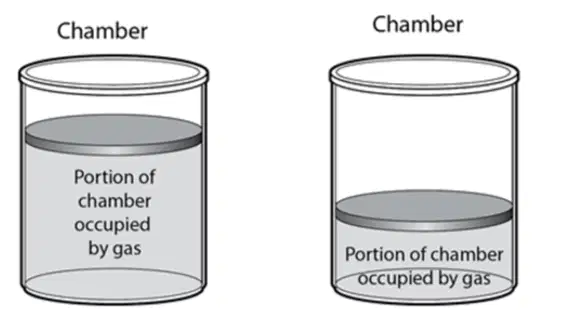
Students can introduce a sample of gas into a chamber with a moveable divider. The divider allows them to change the portion of the chamber occupied by the gas. When the volume of the gas is reduced, what change in property would be the most reasonable to expect?
The density will decrease,
The temperature will decrease.
The pressure will decrease.
The pressure will increase.
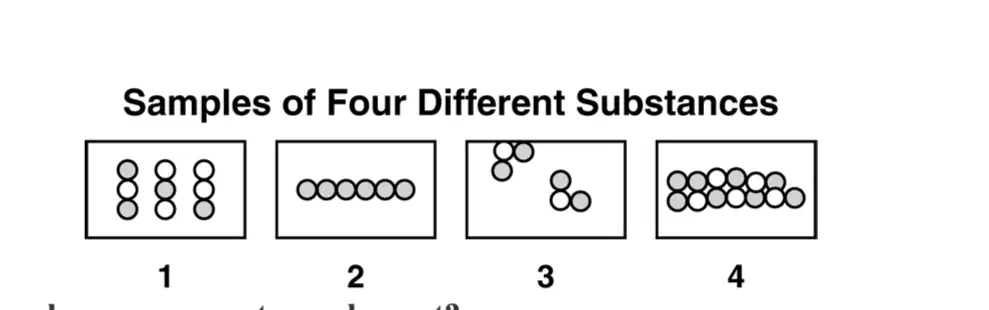
Which of the samples shown represents an element?
substance 1
substance 2
substance 3
substance 4
A bond is formed when an electron is transferred from a sodium atom to a chlorine atom. What happens to the sodium atom during this process?
The mass of the atom increases.
The atom becomes an isotope.
The atomic number decreases.
The atom becomes a positive ion.
An atom can best be described as
the smallest particle that has all the characteristics of a compound.
the smallest particle that has all the characteristics of an element.
a charged particle that is similar to a molecule.
a charged particle that is larger than a molecule.
The formation of an ionic bond involves the
transfer of electrons.
sharing of neutrons.
transfer of neutrons.
sharing of protons.

In the reaction shown, iron reacts with water to form iron oxide and hydrogen gas. Which of these best describes the iron (Fe) reactant?
molecule
ion
compound
element
Alyssa investigates properties of matter. The answer to which question would best determine whether a substance is an element or a compound?
What is the radius of each particle of the substance?
Does the substance contain more than one type of atom?
Was a chemical reaction necessary to create the substance?
What is the electrical charge of the particles of the substance?
Ice molecules take up more volume than liquid water molecules. Which of these conditions occurs when water in a pond freezes?
Water molecules solidify at the bottom and push the liquid water upward.
Water molecules solidify near the surface and float on the liquid water.
Water molecules break apart into solid oxygen and solid hydrogen.
Water molecules form solids when they combine with dissolved minerals.
When potassium and bromine atoms form chemical bonds, which of these is produced?
an element
a mixture
a compound
a new form of matter
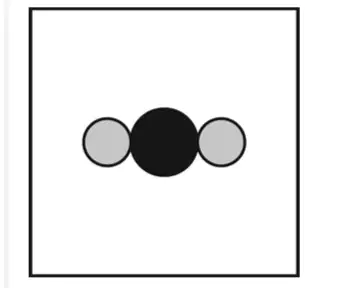
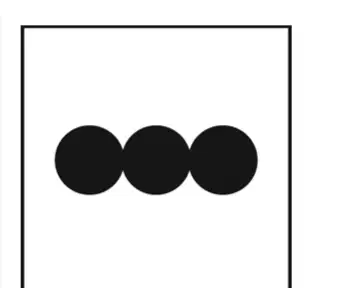
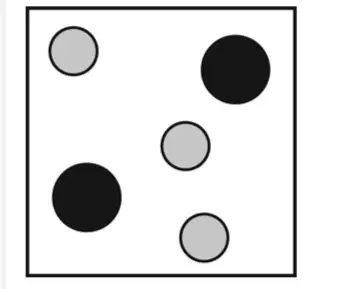
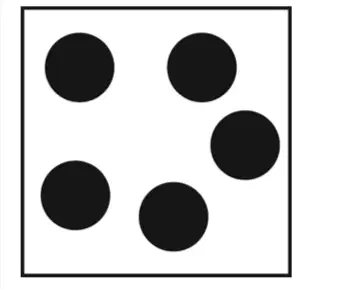
Structural differences between different chemicals can be represented in models of the particles. Which drawing best represents a compound?
A neutral chlorine (Cl) atom contains 17 protons and 18 neutrons. A chlorine ion (Cl-) has (a) electrons.
Calcium carbonate (CaCO3) is considered a compound because it is made up of two or more (a)
The formula for density is shown.
What is the density of a substance with a mass of 20.0g and volume of 4.0mL? (a) g/ml
the muffins baked for 20 minutes until done
Chemical property
physical property
How many atoms are in one formula unit of the compound FeC5O5?
5
11
15
26
It is made up of two or more compounds.
Its components keep their own properties.
a solution
These statements describe an
element
compound
mixture
molecule
The products of a reaction have the same ________as the reactants.
molecule
atoms
subscripts
coefficients
2H2 + O2 --> 2H2O
2H2 + O2 --> 2H2O

Number IN FRONT of reactants or products
product
reactant
coefficient
subscript

Number BELOW on an element
product
reactant
subscript
coefficient

Which chemical formula accurately represents the provided model?
pink-Na. green-Cl. yellow-S. blue-H
H2S + 2NaCl ---------->Na2S + 2NaCl
Na2S + 2NaCl ---------> Na2S + 2NaCl
2NaCl + H2S -----------> Na2S + 2NaCl
Is the following equation, balanced or unbalanced? 4 Fe + 3 O2 --> 2 Fe2O3
Balanced
Unbalanced
Is the following equation, balanced or unbalanced? SnO2 + 2 H2 --> Sn + 2 H2O
Balanced
Unbalanced
Balance the following equation--> What coefficient would need to be put in front of HCl to balance this equation. CH4 + 4 Cl2 → CCl4 + _____ HCl
2
3
4
5
How does the concept of conservation of mass apply to chemical reactions?
The change in the amount of matter is only a small percentage of the total mass.
The change in the amount of matter is equal to the change in energy.
The reactants and products have exactly the same molecules.
The reactants and products have exactly the same atoms.
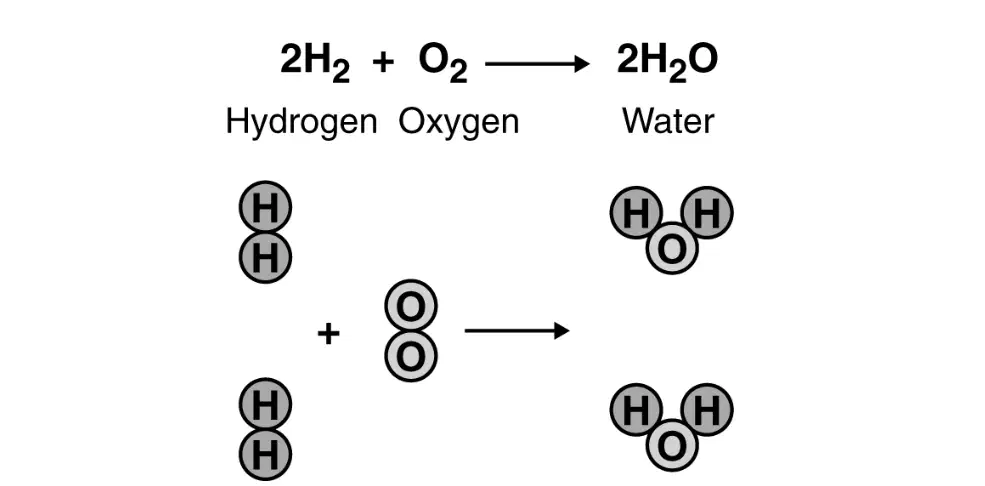
Which scientific law is best demonstrated by the reaction shown in the diagram?
law of angular momentum
law of universal gravitation
law of conservation of energy
law of conservation of mass

A student mixes baking soda with acetic acid in a test tube. The student observes the formation of a gas and records the two reactions that occur.
The student concludes that the combination of the two reactions follows the Law of Conservation of Matter. Which statement supports the student’s conclusion?
The number of atoms in the reactants of each reaction is greater than the products.
Sodium bicarbonate is converted into sodium acetate.
Carbonic acid is unstable and decomposes to form different products.
The number of atoms in the reactants and the products of each reaction are the same.

