
Font size
 Worksheets
Civics Midterm Exam Study Guide 2023
Total questions: 188
Worksheet time: 4hrs 28mins
Our Founding Fathers invented all the ideas that shaped the American system of government.
True
False
Most of the ideas and traditions that influenced the American government came from the colonist's British heritage.
True
False
Definition: The people are the source of any and all governmental power.
Limited Government
Rule of Law
Consent of the Governed
Representative Government
Definition: Government is not all-powerful and may do only those things the people have given it the power to do.
Rule of Law
Limited Government
Democracy
Consent of the Governed
Definition: The government and those who govern are bound by the law, as are those who are governed.
Rule of Law
Republic
Democracy
Representative Government
Definition: System of government in which power rests with the people.
Consent of the Governed
Federalism
Representative Government
Democracy
Definition: In a representative system of government, the people elect public officeholders to make laws and conduct government on the people’s behalf.
Consent of the Governed
Representative Government
Federalism
Democracy
Definition: The authority is divided between a central government and its political units (states).
Federalism
Democracy
Representative Government
Consent of the Governed
Which principle best matches the quote? Use the clues.
“The powers delegated by the proposed Constitution to the federal government are few and defined. Those which are to remain in the State governments are numerous and indefinite.” James Madison, The Federalist 45
Rule of Law
Democracy
Limited Government
Which principle best matches the quote? Use the clues.
“WE THE PEOPLE of the United States...do ordain and establish this Constitution for the United States of America.” Preamble to the Constitution, 1787
Self Government
Federalism
Representative Government
Which principle best matches the quote? Use the clues.
“This Constitution and the laws of the United States ... shall be the supreme law of the land.” All government officials “shall be bound by an oath to support this constitution.” U.S. Constitution, Article VI
Democracy
Representative Government
Rule of Law
Which principle best matches the quote? Use the clues.
“The House of Representatives, like that of one branch at least of all the State legislatures, is elected immediately by the great body of the people." James Madison, The Federalist 39
Limited Government
Representative Government
Rule of Law
This document established the idea of self-government (that government is created by the people for the people).
Articles of Confederation
Mayflower Compact
VA Statute of Religious Freedom
This document limited the power of the King of England.
Magna Carta
Declaration of Independence
Mayflower Compact
This document written by Thomas Paine supported the cause of independence.
Common Sense Pamphlet
VA Declaration of Rights
Declaration of Independence
In English history, the Magna Carta (1215) and the English Bill of Rights (1689) both reinforced the concept of
universal suffrage
a limited monarchy
religious toleration
a laissez-faire economy

How did the English Bill of Rights influence the principles of the American government?
The document granted citizen's a specific list of civil rights similar to the First Ten Amendments of the US Constitution
The document created a legislative branch known as Parliament that had political control over the actions of the monarch
The document prevented the return of a Puritan leader and promoted religious freedoms to Catholics.
The document made Henry VIII the Supreme Leader of the Anglican Church and instituted the divine right of kings.

How did the religious conflicts in English history influence the principles of the American government?
The founding fathers of America wanted to provide religious freedom to prevent conflicts or war.
The founding fathers wanted to declare a religious state to prevent conflicts among cultures.
The founding fathers wanted to base the colonization of America on religious principles so they made Protestantism the national religion.
The parliament in England would be similar to our...
congress
Supreme Court
president
The Mayflower Compact is the first example in America of _____.
divine oversight of government
popular sovereignty
democratic self-government
constitutional monarchy

The Magna Carta influenced US government because it created
monarchy
limited government
dictatorship
Reorder the following from the first thing to happen to the last thing.
Magna Carta
English Bill of Rights
US Constitution
Why is the Magna Carta an important document in history?
It was the first document to place limits on the king's power
It outlawed feudalism and gave voting rights to all citizens
It established Parliament as the nation's legislative body.
It determined England's physical boundaries


(Examples: The Vatican, Egyptians, etc..)
- Basic rights of citizens
- Rule of law
- Representative assemblies

1. an overthrow and replacement of an established government by the people governed
2. a sudden, complete, or marked change in something
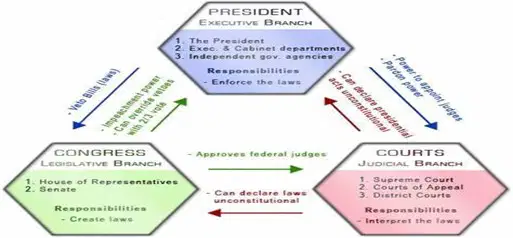
The legislative branch can check the judicial branch by its power to
declare executive actions unconstitutional.
approve federal judges.
override a presidential veto.
veto an act of Congress.
The legislative branch can check the executive branch by its power to
declare executive actions unconstitutional.
name federal judges.
override a presidential veto.
veto an act of Congress.
The Constitution provides that Congress may override a presidential veto by which of the following votes in each house?
majority
three-fourths
two-thirds
unanimous
The formal amendment process of the Constitution
shows the concept of federalism.
occurs in the changing of the wording of the constitution.
has occurred only 27 times.
all of these
In what ways do members of the House differ from members of the Senate?
in number, terms, and required qualifications.
in voting records, preferences, and career choices.
in values, age, and constituencies.
in benefits, legal rights, race, and gender.
Congress has been able to expand the powers of the federal government based largely on its authority to
coin money
govern the District of Columbia
declare war
make all laws necessary to perform its duties
The United States Congress is which type of legislature?
unicameral
bicameral
unified
nonfederal
How many total members are there in Congress?
100
235
400
535
In Federalist No. 10 James Madison argued _______________.
in favor of counting slaves as three-fifths a person for purposes of apportioning representation among the states.
that the addition of a Bill of Rights to the Constitution would dangerously imply that all rights not listed could be infringed.
that a bicameral national legislature promoted the security of the people by constraining the branch of government that has historically most powerful.
that the people were better protected in a large republic against the evils of “factions” because in such a republic it was more difficult for any one narrow interest to exercise unjust power.
The classic discussion in The Federalist Papers of the Constitution’s approach to checks and balances can be found in _________.
No.23
No.51
No.70
No.71
The claim that the judiciary has “no influence over either the sword or the purse” and thus will always be “the least dangerous branch” can be traced back to ______________.
James Madison’s defense of the Virginia Plan during the Philadelphia Convention
Alexander Hamilton’s argument in Federalist No. 78
Thomas Jefferson’s defense of “inalienable rights” in the Declaration of Independence
James Wilson’s founding lectures on law at the University of Pennsylvania
Measures brought before the houses of Congress in order to be made into laws are called
proposals
bills
resolutions
rules
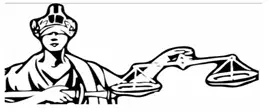
This representation of Lady Justice shows a woman with a scale and a blindfold. How does this symbolize the American judicial system?
The Judicial System should include more female members.
Judges are meant to weigh cases and be blind to people.
The picture suggests that the judicial system is ignorant.
Judges are not capable of performing more than one action.
What is the MAIN responsibility of the judicial branch?
to print money
to create the military
to interpret laws
to elect the President
What are the qualifications listed in Article II of the Constitution for a person to become president?
At least 30 years old, born a U.S. citizen, and lived in the country for 10 years
At least 35 years old, born a U.S. citizen, and lived in the country for 14 years
At least 25 years old, born a U.S. citizen, and lived in the country for 7 years
At least 40 years old, born a U.S. citizen, and lived in the country for 20 years
"When two [people] come into [the Supreme] Court, one may say : "an act of Congress means this." The other may say it means the opposite. We [ the Court] then say it means one of the two or something else in between. In that way we are making the law, aren't we?" -Earl Warren, Chief Justice of the Supreme Court
According to the above passage, what is the function of the court that Chief Justice Warren described?
judicial restraint
advise and consent
judicial review
impeachment
Why was the Supreme Court decision in Marbury v. Madison important?
It granted the Federal Government implied powers.
It firmly established the principle of judicial review.
It institutionalized the federal central bank.
It made slavery illegal in theory though not in practice
"...the interior structure of the government as that its several constituent parts may, by their mutual relations, be the means of keeping each other in their proper places."-Federalist 51, James Madison, 1788
According to the passage, which constitutional principle does Madison describe in the passage?
popular sovereignty
judicial review
checks and balances
separation of powers
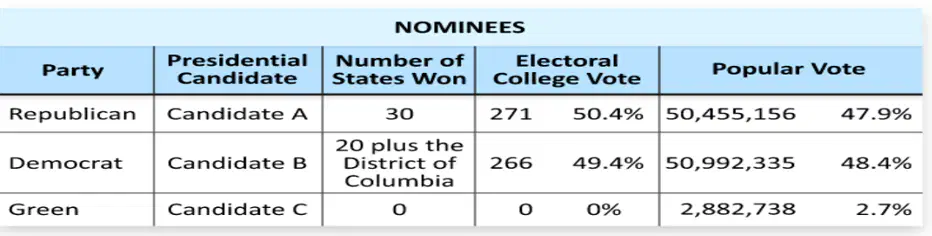
According to the data, which of the following statements about the election is true?
Candidate A became president because he won the most states.
Candidate A became president because he won the Electoral College vote.
Candidate B became president because he won the popular vote.
Candidate B became president because he won the vote in the District of Columbia.

Which branch may declare actions of the other two branches as unconstitutional?
Executive Branch
Judicial Branch
Legislative Branch

Which of the following is a check that the legislature has over the executive branch? (Click all that apply)
Confirming presidential appointees.
Impeaching the president.
Overriding a presidential veto
This branch can declare war.
Legislative Branch
Executive Branch
Judicial Branch
Which of the following is not a power of the president?
Pardon people from federal crimes
Nominate Supreme Court Justices
Sign or veto laws
Declare laws unconstitutional
How long is the term for a Supreme Court justice?
4 years
6 years
10 years
Life
The legislative branch can check the judicial branch by its power to
declare executive actions unconstitutional.
approve federal judges.
override a presidential veto.
veto an act of Congress.
The legislative branch can check the executive branch by its power to
declare executive actions unconstitutional.
name federal judges.
override a presidential veto.
veto an act of Congress.
The Constitution provides that Congress may override a presidential veto by which of the following votes in each house?
majority
three-fourths
two-thirds
unanimous
The formal amendment process of the Constitution
shows the concept of federalism.
occurs in the changing of the wording of the constitution.
has occurred only 27 times.
all of these
In what ways do members of the House differ from members of the Senate?
in number, terms, and required qualifications.
in voting records, preferences, and career choices.
in values, age, and constituencies.
in benefits, legal rights, race, and gender.
Congress has been able to expand the powers of the federal government based largely on its authority to
coin money
govern the District of Columbia
declare war
make all laws necessary to perform its duties
The United States Congress is which type of legislature?
unicameral
bicameral
unified
nonfederal
How many total members are there in Congress?
100
235
400
535
In Federalist No. 10 James Madison argued _______________.
in favor of counting slaves as three-fifths a person for purposes of apportioning representation among the states.
that the addition of a Bill of Rights to the Constitution would dangerously imply that all rights not listed could be infringed.
that a bicameral national legislature promoted the security of the people by constraining the branch of government that has historically most powerful.
that the people were better protected in a large republic against the evils of “factions” because in such a republic it was more difficult for any one narrow interest to exercise unjust power.
The classic discussion in The Federalist Papers of the Constitution’s approach to checks and balances can be found in _________.
No.23
No.51
No.70
No.71
The claim that the judiciary has “no influence over either the sword or the purse” and thus will always be “the least dangerous branch” can be traced back to ______________.
James Madison’s defense of the Virginia Plan during the Philadelphia Convention
Alexander Hamilton’s argument in Federalist No. 78
Thomas Jefferson’s defense of “inalienable rights” in the Declaration of Independence
James Wilson’s founding lectures on law at the University of Pennsylvania
Measures brought before the houses of Congress in order to be made into laws are called
proposals
bills
resolutions
rules
This representation of Lady Justice shows a woman with a scale and a blindfold. How does this symbolize the American judicial system?
The Judicial System should include more female members.
Judges are meant to weigh cases and be blind to people.
The picture suggests that the judicial system is ignorant.
Judges are not capable of performing more than one action.
What is the MAIN responsibility of the judicial branch?
to print money
to create the military
to interpret laws
to elect the President
What are the qualifications listed in Article II of the Constitution for a person to become president?
At least 30 years old, born a U.S. citizen, and lived in the country for 10 years
At least 35 years old, born a U.S. citizen, and lived in the country for 14 years
At least 25 years old, born a U.S. citizen, and lived in the country for 7 years
At least 40 years old, born a U.S. citizen, and lived in the country for 20 years
"When two [people] come into [the Supreme] Court, one may say : "an act of Congress means this." The other may say it means the opposite. We [ the Court] then say it means one of the two or something else in between. In that way we are making the law, aren't we?" -Earl Warren, Chief Justice of the Supreme Court
According to the above passage, what is the function of the court that Chief Justice Warren described?
judicial restraint
advise and consent
judicial review
impeachment
Why was the Supreme Court decision in Marbury v. Madison important?
It granted the Federal Government implied powers.
It firmly established the principle of judicial review.
It institutionalized the federal central bank.
It made slavery illegal in theory though not in practice
"...the interior structure of the government as that its several constituent parts may, by their mutual relations, be the means of keeping each other in their proper places."-Federalist 51, James Madison, 1788
According to the passage, which constitutional principle does Madison describe in the passage?
popular sovereignty
judicial review
checks and balances
separation of powers
According to the data, which of the following statements about the election is true?
Candidate A became president because he won the most states.
Candidate A became president because he won the Electoral College vote.
Candidate B became president because he won the popular vote.
Candidate B became president because he won the vote in the District of Columbia.
Which branch may declare actions of the other two branches as unconstitutional?
Executive Branch
Judicial Branch
Legislative Branch
Which of the following is a check that the legislature has over the executive branch? (Click all that apply)
Confirming presidential appointees.
Impeaching the president.
Overriding a presidential veto
This branch can declare war.
Legislative Branch
Executive Branch
Judicial Branch
Which of the following is not a power of the president?
Pardon people from federal crimes
Nominate Supreme Court Justices
Sign or veto laws
Declare laws unconstitutional
How long is the term for a Supreme Court justice?
4 years
6 years
10 years
Life
The introduction to the Constitution is called the ___.
Articles of Confederation
Declaration of Independence
Bill of Rights
Preamble
The promise from the Preamble that describes peace in our country is ___.
establish justice
provide for the common defense
promote the general welfare
insure domestic tranquility
The Preamble lists the ___ of the United States Constitution.
grievances
unalienable rights
purposes
weaknesses
What does the following phrase from the preamble mean?
"Do ordain and establish this Constitution"
gain and keep safe the gifts of freedom and independence
encourage the condition of health and happiness for everyone
The delegates and people living in the United States
do make official and begin this written document of basic laws.
The introduction to the United States Constitution.
Reorder the following to match the appropriate amendment number on the bottom
Religion, Assembly, Petition, Press, Speech
The right to bear arms
No forced housing of soldiers
No illegal search and seizures, and the right to privacy
Due Process, Eminent Domain, Grand Jury, No self Incrimination, No Double Jeopardy
According to the (a) you cannot have (b) nor may you receive punishment that is (c)
Legislative Branch
Makes the Laws
Executive Branch
Enforces the Laws
Judicial Branch
Interprets the Laws
Our nations First Government System
Articles of Confederation
Each branch has the ability to check the others to keep one branch from becoming too powerful
Check and Balances

(a) is a system of government in which power is shared between the national and state governments.
Which clause in the Constitution establishes the superiority of federal laws over state laws?
The Supremacy Clause
The Equality Clause
The Preemption Clause
Reserved powers are
powers belonging only to the national government
powers belonging only to the states
powers belonging only to the cities
powers that are used when there is a war
The people are the source of all governmental authority.
Federalism
Popular Sovereignty
Checks and Balances
Judicial Review
Government may exercise only those powers given to it.
Federalism
Separation of Powers
Limited Government
Judicial Review
Government is divided into 3 branches: Legislative, Executive & Judicial branches.
Federalism
Limited Government
Separation of Powers
Checks & Balances
The Preamble to the Constitution begins with "We the People." This is an example of which of the principles of government?
Republicanism
Federalism
Popular Sovereignty
Individual Rights
Which constitutional principle is identified with the concept of consent of the governed?
rule of law
checks and balances
separation of powers
popular sovereignty

Which principle of the Constitution deals with the rights that every citizen is guaranteed and cannot be violated?
Bill of Rights
States Rights
Individual Rights
Right to remain Silent

Which principle of the Constitution allows citizens to elect representatives to serve in government?
Federalism
Limited Government
Republicanism
Popular sovereignty
Which principle of the Constitution is guaranteed through the first ten amendments?
Separation of Powers
Federalism
Popular Sovereignty
Individual Rights
To give official approval to
ratify
precedent
bicameral
impeachment
The introduction to the Constitution is called the ___.
Articles of Confederation
Declaration of Independence
Bill of Rights
Preamble
The promise from the Preamble that describes peace in our country is ___.
establish justice
provide for the common defense
promote the general welfare
insure domestic tranquility
The Preamble lists the ___ of the United States Constitution.
grievances
unalienable rights
purposes
weaknesses
What does the following phrase from the preamble mean?
"Do ordain and establish this Constitution"
gain and keep safe the gifts of freedom and independence
encourage the condition of health and happiness for everyone
The delegates and people living in the United States
do make official and begin this written document of basic laws.
The introduction to the United States Constitution.
Reorder the following to match the appropriate amendment number on the bottom
Religion, Assembly, Petition, Press, Speech
The right to bear arms
No forced housing of soldiers
No illegal search and seizures, and the right to privacy
Due Process, Eminent Domain, Grand Jury, No self Incrimination, No Double Jeopardy
According the the (a) you have the right to a (b) and a (c) trial in all criminal cases
Accord to the (a) you cannot have (b) nor may you receive punishment that is (c)
According to the (a) amendment you are entitled a (b) in all (c) cases
According to the 9th Amendment
All rights listed in the bill of rights are your only rights
All rights not listed in the Constitution are still protected
All rights not listed in the Constitution are left up the states to determine
All rights listed in the Constitution must approved by the states
The (a) amendment says all (b) not given to the (c) government are left for the (d) thus creating the system of (e)
Legislative Branch
Makes the Laws
Executive Branch
Enforces the Laws
Judicial Branch
Interprets the Laws
Our nations First Government System
Articles of Confederation
Each branch has the ability to check the others to keep one branch from becoming too powerful
Check and Balances
(a) is a system of government in which power is shared between the national and state governments.
Which clause in the Constitution establishes the superiority of federal laws over state laws?
The Supremacy Clause
The Equality Clause
The Preemption Clause
Reserved powers are
powers belonging only to the national government
powers belonging only to the states
powers belonging only to the cities
powers that are used when there is a war
The people are the source of all governmental authority.
Federalism
Popular Sovereignty
Checks and Balances
Judicial Review
Government may exercise only those powers given to it.
Federalism
Separation of Powers
Limited Government
Judicial Review
Government is divided into 3 branches: Legislative, Executive & Judicial branches.
Federalism
Limited Government
Separation of Powers
Checks & Balances
The Preamble to the Constitution begins with "We the People." This is an example of which of the principles of government?
Republicanism
Federalism
Popular Sovereignty
Individual Rights
Which constitutional principle is identified with the concept of consent of the governed?
rule of law
checks and balances
separation of powers
popular sovereignty
Which principle of the Constitution deals with the rights that every citizen is guaranteed and cannot be violated?
Bill of Rights
States Rights
Individual Rights
Right to remain Silent
Which principle of the Constitution allows citizens to elect representatives to serve in government?
Federalism
Limited Government
Republicanism
Popular sovereignty
Which principle of the Constitution is guaranteed through the first ten amendments?
Separation of Powers
Federalism
Popular Sovereignty
Individual Rights

