Worksheets
Mod 2 Test
Total questions: 54
Worksheet time: 1hrs 4mins
Humans can change an organism’s _____ by choosing which organisms will reproduce.
food
traits
genes
sex
How does selective breeding work?
When humans breed organisms, they are selecting variations that occur naturally in populations
True
False
Breeders can choose a trait and only breed specific organisms to have offspring with that trait. _______________
True
False
Products of selective breeding have and phenotypes that are very different from the original ancestor.
(a)
Gene therapy is used to treat patients with cancer.
true
false
How is selective breeding related to physical and behavioral traits?
Type question here including an What traits are selectively bred into fruits and vegetables?
Species can change over time and adapt to their environment. ____________________
True
False
Adaptations that help an organism survive appear quickly. ____________________
True
False
A population of beetles changing from yellow to brown and surviving better is an example of _____
genes
mutations
natural selection
selective breeding
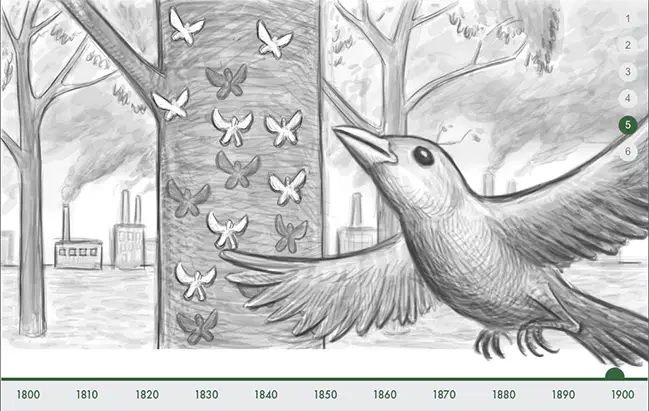
Which of the following could be illustrated by the bird eating the white moth?
reproduction
differentiation
competition
selection

Which of the following could be illustrated by the Bohemian Wax Wings fighting over an apple?
reproduction
differentiation
competition
selection
Which of the following is an example of artificial selection?
Peppered moths changing color due to industrial pollution
Wolves evolving into different breeds of dogs
Finches beaks changing size on Galapagos Islands
Antibiotic resistance in bacteria
In 1986, a meltdown of a nuclear reactor in the city of Chernobyl, in Ukraine, released highly radioactive chemicals into the atmosphere. As a result, people suffered various forms of cancer because of exposure to these radioactive chemicals. Cancerous cells divide much more often than noncancerous cells and form tumors in the body. A scientist claims that these cancers were caused by harmful mutations. He wants to make a model to support his claim. Which statement best describes what the scientist’s model needs to represent in order to support his claim?
The radioactive chemicals burned people’s skin, which increased cell division rates in the people who developed cancer
The radioactive chemicals polluted people’s food, which changed some people’s ability to digest proteins and caused cancer.
The radioactive chemicals caused structural changes in people’s genes, which changed how proteins functioned in cell division.
The radioactive chemicals polluted people’s drinking water, which caused cells to divide more quickly in the people’s bodies and form tumors.
Which of the following is NOT a way that humans can influence the traits of a species?
Selective breeding
Genetic engineering
Artificial selection
Natural selection
True or False: Genetic mutations can sometimes be beneficial and lead to evolution.
True
False
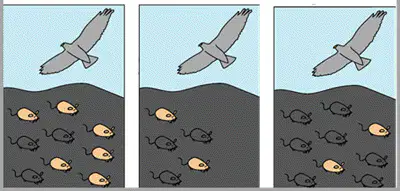
What does this sequence illustrate?
how variation results in an adaptation
how camouflage results in variation
how selective breeding results in an adaptation
how mimicry results in variation
involves the reproduction of organisms best suited to their environment in greater numbers than the reproduction of less well-suited organisms.
(a)
Although Darwin did not know about genes, he could see that animals of the same species who had slight variations that helped them to survive longer could produce more offspring than animals who were not as well equipped. Which of the following could be an example of a variation that would help a group of animals survive?
black bears in a region that was always covered with snow
turtles with long necks on an island where the food source was elevated
choosing a cat to take home from an animal shelter
planting a certain kind of flower to attract butterflies
A population of tree frogs lives in an area that has many types of plants and trees. The skin of most of the frogs is gray, which blends in better with the bark of trees than with the leaves of plants. Some of the frogs have skin that is greener in color, which blends in better with grasses and leaves. Snakes and birds are predators of the frog. Humans have come to the area and are beginning to cut down the trees. Describe the probability of survival for the tree frogs of each genetic variation of skin color if most of the trees are cut down. Use evidence in the paragraph to support your answer.
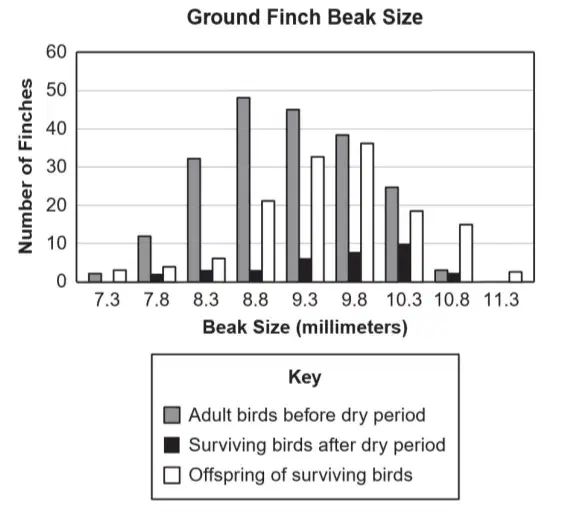
The medium ground finch is a seed-eating bird species that lives on a tiny volcanic island in the Pacific Ocean. Scientists measured the beak size of the adult birds on the island twice in the same year—before and after six months of no rain. The birds that survived the dry period reproduced and had offspring. Scientists returned the next year and measured the beak size of the surviving offspring. All of the birds the scientists measured were adults. The graph shows the scientists’ results.
Some of the seeds that medium-ground finches eat are soft, small, and easy to eat. Other seeds are large, hard, and difficult to break open. Explain why the beak size pattern changed in the surviving population after six months of no rain. Provide evidence to support your answer
The medium-ground finch is a seed-eating bird species that lives on a tiny volcanic island in the Pacific Ocean. Scientists measured the beak size of the adult birds on the island twice in the same year—before and after six months of no rain. The birds that survived the dry period reproduced and had offspring. Scientists returned the next year and measured the beak size of the surviving offspring. All of the birds the scientists measured were adults. The graph shows the scientists’ results.
Explain the pattern of beak size in the offspring shown in the graph. Provide evidence to support your answer
The ground level of a forest is quite dark because the leaves of the tall trees block out most of the sunlight. Plants at the ground level compete for sunlight as well as for water and mineral resources. One population of plants growing under the trees has a variation in its leaves. Which statement explains a variation in the leaves that affects the plants’ probability of surviving at the ground level of this forest?
Plants with round leaves are more likely to survive than plants with oval leaves, because round leaves gather water better.
Plants with thick leaves are more likely to survive than plants with thin leaves, because more minerals are stored in the plants’ leaves.
Plants with large leaves are more likely to survive than plants with small leaves, because more solar energy is captured in the plants’ leaves.
Plants with few leaves are more likely to survive than plants with many leaves, because all of the chloroplasts are concentrated.
A dog breeder prefers very pointy noses for his dogs. So, he breeds dogs with the most pointed noses he can find in hopes of getting puppies with very pointy noses. This process is called .
(a)
What is an example of an environmental extreme that an organism might need to adapt to in order to survive?
Compare and contrast natural selection and selective breeding.
A mutation cannot be inherited.
true
false
Small changes in traits that cause variation are frequently caused by _____.
natural selection
competition
mutations
migration
Animals with that benefit them, allowing them compete better for food, live longer than other animals in the same species.
(a)
(a) involves the reproduction of animals best suited to their environment in greater numbers than the reproduction of less well-suited animals.
Reorder the following: A protein called keratin71 affects what kind of hair dogs have. One variation of keratin71 results in straight hair. A variation of keratin71 results in curly hair. This curly-hair variation of keratin71 has a different protein structure than the straight-hair variation. a. Write the steps to complete a flow chart to describe how straight hair is produced in dogs.
Genes for straight dog hair (located on the chromosomes within the cell)
Proteins needed to produce the straight dog hair
Observable trait of straight hair in the dog
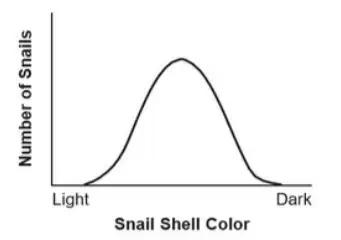
A scientist studied a snail population that had a variation of shell colors. The number of each differently colored snail shell was recorded. The graph shows the data the scientist collected. Over time, the rocks on which the snails lived became covered with dark-colored seaweed. Which graph best represents the range of colors in the snail population that resulted from natural selection after the dark-colored seaweed covered the rocks?


Natural Selection and Selective Breeding
Natural selection and selective breeding are both processes that lead to the development of specific traits in organisms. In natural selection, organisms with advantageous traits are more likely to survive and reproduce, passing on those traits to their offspring. On the other hand, selective breeding involves humans choosing specific traits to breed in plants and animals for desired outcomes.
Artificial selection in selective breeding involves humans intentionally breeding organisms with specific traits to produce offspring with those traits. This has been used for centuries in agriculture to develop crops with higher yields and animals with desirable characteristics. Inherited traits play a crucial role in selective breeding, as the traits that are passed down from one generation to the next determine the success of the breeding process.
Adaptation is a key concept in natural selection, as it refers to the process by which organisms develop traits that allow them to better survive in their environment. Over time, these advantageous traits become more common in the population as organisms with those traits are more likely to survive and reproduce. This process is essential for the survival and evolution of species in changing environments.
Adaptation is a key concept in (a) selection, as it refers to the process by which organisms develop traits that allow them to better survive in their environment.
What is the process of intentionally choosing specific traits to breed in plants and animals for desired outcomes called?
Natural Selection
Genetic Modification
Artificial Selection
Random Breeding
What process leads to the development of specific traits in organisms by favoring advantageous traits for survival and reproduction?
Mutation
Genetic drift
Selective breeding
Natural selection
How do inherited traits impact the success of selective breeding?
What is the purpose of artificial selection in selective breeding?
To develop crops with higher yields
To develop animals with desirable characteristics
To increase genetic diversity
To decrease crop productivity
A difference in beak shape among members of the same finch species is an example of variation.
true
false
Food we eat has NOT been modified through selective breeding.
True
False
Which of the following is a behavioral adaptation?
blue whales migrating to mate and give birth
tree frogs having long, sticky tongues
alligators’ eyes being on top of their heads to help them see above the water
hedgehogs having stiff spines sticking out of their bodies
Which of the following is an inherited trait that increases an organism’s chance of survival and reproduction?
adaptation
mutation
natural selection
selective breeding
An adaptation _____.
is an inherited trait
increases a species’ chances of surviving
increases a species’ chances of reproducing
all of these
Selective Breeding and Natural Selection
Inherited traits play a crucial role in selective breeding and natural selection. These traits are passed down from one generation to the next, shaping the characteristics of the offspring. Through selective breeding, humans have been able to manipulate these inherited traits to create desired outcomes in plants and animals.
Genetic variation is another key aspect of selective breeding and natural selection. It refers to the diversity of genes within a population, which allows for adaptation to changing environments. Genetic variation is essential for the survival of a species, as it increases the likelihood of some individuals possessing traits that are advantageous for their survival.
Survival of the fittest is a fundamental concept in natural selection. It refers to the process by which organisms with traits that are well-suited to their environment are more likely to survive and reproduce. Over time, this leads to the accumulation of advantageous traits in a population, as those with less favorable traits are less likely to survive and pass on their genes.
What process have humans used to create desired outcomes in plants and animals?
Natural Selection
Genetic Engineering
Artificial Selection
Random Mutation
How do inherited traits impact selective breeding and natural selection?
Why is genetic variation essential for the survival of a species?
To increase the likelihood of advantageous traits
To decrease the likelihood of advantageous traits
To reduce the population size
To limit the gene pool
Genetic variation refers to the diversity of (a) within a population, allowing for adaptation to changing environments.
What is a fundamental concept in natural selection?
Adaptation
Mutation
Survival of the fittest
Competition