wayground logo

Free Printable Worksheets

NEW

Font size

S
M
L
XL
Worksheets

Ancient India Test PRACTICE

Total questions: 44

Worksheet time: 22mins

Name
Class
Date
1.
What separates the subcontinent of India from the rest of Asia?
a)
Indian Ocean
b)
Bay of Bengal
c)
Deccan Plateau
d)
Himalaya Mountains
2.
Where did the first civilization of India arise?
a)
along the Ganges River
b)
near the coast of the subcontinent
c)
on the central plateau
d)
along the Indus River
3.
What do Winter Monsoons bring?
a)
drought
b)
rain
c)
famine
d)
sun
4.
Why did early farming villages in India depend on Summer Monsoons?
a)
Summer Monsoons brought drought
b)
Summer Monsoons brought rain
c)
Summer Monsoons brought snow
d)
Summer Monsoons made warmer weather
5.
Which was the first Indus Valley city to be discovered?
a)
Harappa
b)
Kalibangan
c)
Thebes
d)
Babylon
6.
What does “Mohenjo-daro” mean?
a)
Land Between Two Rivers
b)
The Great Adventure
c)
Mound of the Dead
d)
The First City
7.
Which crop did Indus Valley people use to make cloth?
a)
Wheat
b)
Barley
c)
Flax
d)
Cotton
8.
The Indus Valley Civilization had the world’s first ______________.
a)
Sewer system
b)
Water clock
c)
Plow
d)
sailboat
9.
Where did the people of this civilization store their surplus crops?
a)
citadels
b)
the Great Bath
c)
granaries
d)
pyramids
10.
Which of the following is NOT an advancement of Indus Valley Civilization?
a)
Dice
b)
Indoor Toilets
c)
Sewer systems
d)
coal burning fireplace
e)
all of the above
11.
Why do scholars still have many questions about the Indus Valley Civilization?
a)
Scholars have no yet discovered how to read the writing of the Indus Valley Civilization
b)
Indus rulers were buried in massive tombs within pyramids
c)
Clay seals have been found and scholars have decoded the text to show a civilization far more advanced than possible
d)
Trade routes indicate that early Indus Valley people could only access areas in Southern Asia, making cultural diffusion impossible
12.
What caused the ancient Indus Valley civilization to disappear?
a)
heavy flooding
b)
drought
c)
foreign invaders
d)
disease
e)
no one knows why
13.
What is the major religion of India?
a)
Hinduism
b)
Judaism
c)
Buddhism
d)
Islam
14.
The Hindu god Shiva is known as the:
a)
Preserver
b)
Creator
c)
Destroyer
d)
Perceiver
15.
The Hindu god Vishnu is known as the:
a)
Preserver
b)
Creator
c)
Destroyer
d)
Perceiver
16.
The Hindu god Brahma is known as the:
a)
Preserver
b)
Creator
c)
Destroyer
d)
Perceiver
17.

The people at the very top of India's social caste system:

a)
untouchables
b)
priests
c)
warriors
d)
farmers
18.
The people at the very bottom of India's social caste system:
a)
untouchables
b)
warriors
c)
rulers
d)
merchants
19.
The cycle of life, death, and rebirth in Hinduism is called Samsara.
a)
True
b)
False
20.

In ancient India, members of different castes often socialized and even married.

a)
True
b)
False
21.
In ancient India, you were born into your caste and stayed in it your entire life.
a)
True
b)
False
22.
The Ganges River is the most sacred river in India.
a)
True
b)
False
23.
The religions of Christianity and Islam began in India.
a)
True
b)
False
24.
Deities is another name for gods and goddesses.
a)
True
b)
False
25.
A strong, fortified building in the cities of the Indus Valley Civilization was a granary.
a)
True
b)
False
26.
In Hinduism, Moksha is your duty or responsibility to do what is right.
a)
True
b)
False
27.
In Hinduism, Karma is your consequence or the effect of your actions in life.
a)
True
b)
False
28.

The Hindu Trinity includes Brahma, Vishnu, and Shiva

a)
True
b)
False
29.

Which ancient Indian text is considered the oldest religious scripture?

a)

Upanishads

b)

Mahabharata

c)

Vedas

d)

Ramayana

30.

Which of the following statements about modern Buddhism is accurate?

a)

Millions of Buddhists live in the USA

b)

Most Buddhists live in monasteries.

c)

Few Buddhists live in Asia.

d)

Buddhism is the most widely practiced belief system in India.

31.

In Hinduism, which god is known as the creator?

a)

Vishnu

b)

Shiva

c)

Brahma

d)

Krishna

32.

What strategy did Chandragupta Maurya use to keep the Maurya Empire strong?

a)

He gave food to the areas he conquered.

b)

total power and authority of the ruler

c)

He trusted those who pledged their loyalty.

d)

He lived simply and did not burden the people with taxes.
33.

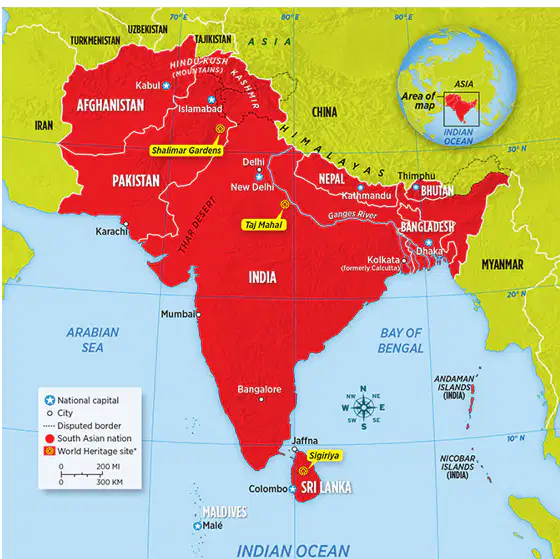
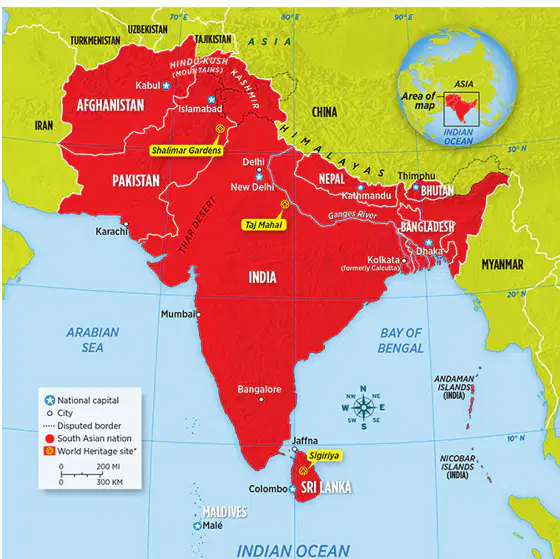
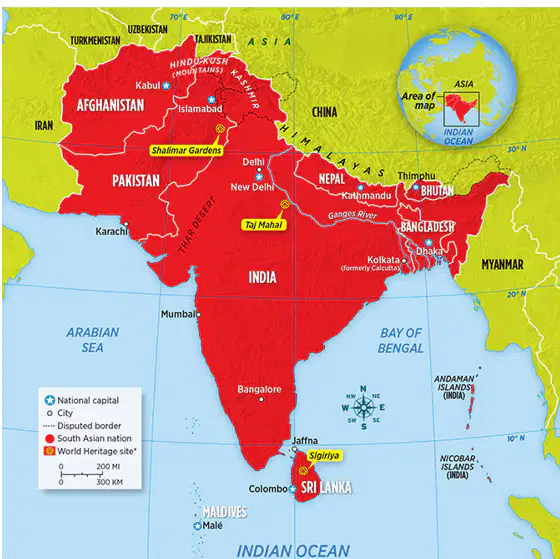
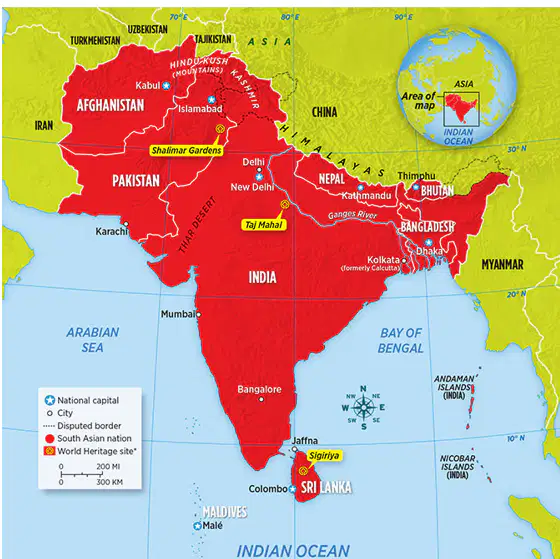
What is the capital of India?

a)
New Dehli
b)
Kabul
c)
Thimphu
d)
Islamabad
34.

What country is located on the Western border of Afghanistan and Pakistan

a)

Iran

b)

China

c)

Nepal

d)

Himalayas

35.

What major Indian River is the Taj Mahal located near

a)
Arabian Sea
b)
Indus River
c)
Ganges River
d)
Bay of Bengal
36.

Give the approximate coordinates (lines of LATITUDE and LONGITUDE) for Dhaka

a)

25'N and 90'E

b)
80'N and 5'E
c)
25'N and 20'E
d)
100' N and 50'E
37.
New Dehli is North of what city?
a)
Dehli
b)
Kabul
c)
Kathmandu
d)
Bangalore
38.

2000 BCE marked the:

a)

Birth of Buddha

b)

Rise of the IRV

c)

Decline of the IRV

d)
Age of Enlightenment
39.

Who founded Buddhism during the 500s b.c.?

a)

the Dalai Lama

b)

Sarawati

c)

Lakshmi

d)

Siddhartha Gautama

40.
According to Buddhism, the end of suffering in life is called _______.
a)
The Noble Truth
b)
Nirvana
c)
Dharma
d)
Reincarnation
41.
In 500 BCE, what language were the holy scriptures written in?
a)
Gurus
b)
Vedas
c)
Upanishads
d)
Sanskrit
42.

The lowest __________, or social grouping based on skill, identified in the Vedas was the __________.

a)

jati; Vaishyas

b)

varna; Brahmins

c)

varna; Brahmins

d)

varna; Sudras

43.

"The soul is not slain [killed] when the body is slain.” This quote illustrates the belief in:

a)

ahimsa

b)

reincarnation

c)

karma

d)

dharma

44.

Which of the following is NOT an advancement of Ancient India?

a)

Dice

b)

Indoor Toilets

c)

Sewer systems

d)

coal burning fireplace