
 Worksheets
Unit 2 Earth Science
Total questions: 47
Worksheet time: 26mins
Independent variables are variables that the scientist....?
Changes/controls
keeps the same

Dependent variables are variables that the scientist....?
Changes/controls
keeps the same
A botanist wants to see how different colored light waves influence the growth of pea plants. She puts the same number of seeds into three identical pots with the same kind and amount of soil. She then gives them the same amount of water every three days for the length of the experiment. One pot is placed into a dark windowless closet, another pot is left on the windowsill, and the third is placed under a lamp with a green bulb. She observes & records the height of each plant every day for 3 months.
What is the independent variable in this experiment?
Different colored light waves given to the plant

An experiment with rats was done where they were fed four different types of cheeses; cheddar, mozzarella, gouda, & brie. They did this for two weeks. Throughout the two weeks, they measured & recorded the mass/weight of the rats.
What is the dependent variable of this experiment?
Number of rats in the experiment

Determine the independent variable from the following hypothesis: The more grams of salt a person eats, the higher their blood pressure.

While graphing where does the independent variable go? Where does the Dependent variable go?

Which types of waves travel both liquids and solids?
P waves
S waves

Define The following term- Crust
Made of oceanic and continental crust. The least dense layer

Define oceanic crust
Made of basalt, thinner, but more dense
Made of granite, thicker, but less dense

Define lithosphere
The outer most layer of the earth's atmosphere
Outer most layer of the mantle. Rocky/Stone

Define asthenosphere
Semi-fluid layer of the Earth's mantle beneath the lithosphere and above the mesosphere
Outer most part of the mantle. Rocky/Stone

Define mesosphere
Lower part of the mantle. Solid, rigid, does not flow
The messiest sphere
The outer most part of the mantle. Rocky/Stone
The layer between the lithosphere and the asthenosphere

Define outer core
Liquid layer of the Earth's core. Convection currents happen here, and produce the magnetic field

Define inner core
Solid nickel and iron due to the pressure. As hot hot as the surface of the sun
The only liquid layer. Where convection happens, and produces magnetic field
Where Mr. Mills was born and raised

Define mantle
Solid; thickest layer of the Earth
The only liquid layer

This is where heat is transferred from a high concentration to low and spreads out, Transfer of heat through touch.

Heat causes materials to speed up which spreads apart the molecules making them less dense, they rise cool off and gravity pulls them back down. Conduction heats them up and it cycles over and over. It is called what?

Alfred Wegener proposed a hypothesis for Pangea. Why was his hypothesis mocked by his peers and colleagues in his day?
People were meaner back then. They called him a weatherman
He was wrong, there is no evidence for Pangea today
He incorrectly proposed that the continents were plowing through the ocean and couldn't explain how
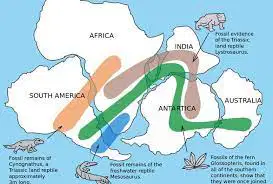
What is the mechanism for Continental Drift?
Laser beams inside the Earth
Sea Floor Spreading
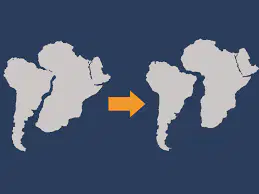
Which of the following is NOT evidence of Pangea as given by Alfred Wegener?
The groves left by ancient glaciers fit together on opposite sides of the Atlantic
The continents fit together as if they are a puzzle
The continents plowed through the ocean leaving deep scars known as trenches
Fossils found in rocks on opposite side of the Atlantic are the same age and type
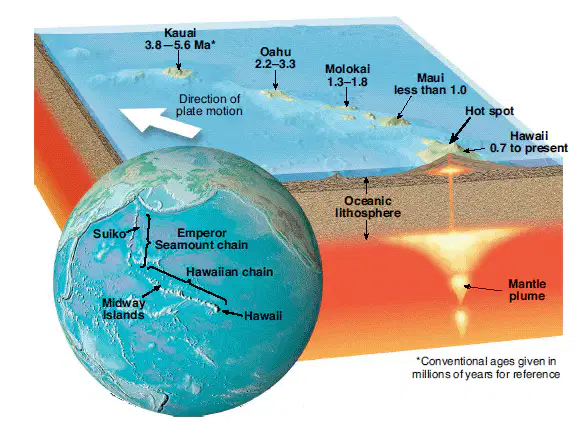
Look at the diagram; which of the following is evidence that the plates are moving?
Hot spots (Islands of Hawaii)
Plate boundary
The volcanic ash
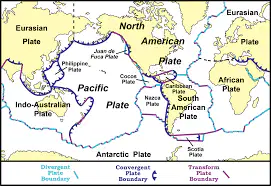
What type of evidence could scientists use to locate the boundaries of plates and interpret what type of boundary is present?

The earth's crust is broken into pieces called plates. These plates interact with each other at boundaries. Which of the following is the best data to use when classifying plate boundaries?
Movement of the plates to each other at the boundaries
Size of the plates
How fast the plates are moving
Color of the plates

What kind of movement on a plate boundary causes mountain building?
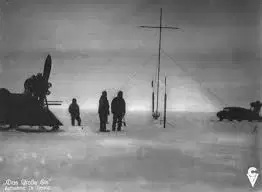
Which of the following explains the role of Alfred Wegener's hypothesis of continental drift and the development of the theory of plate tectonics?
Evidence over the years has filled in the gaps in the continental drift hypothesis
Wegener is the only scientist who has ever worked on the theory of plate tectonics
A hypothesis has more evidence for it than a theory does
Wegener's hypothesis was contridicted by recent scientific information
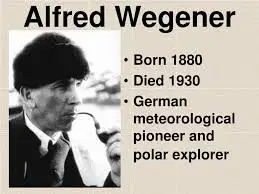
Wegener's hypothesis of continental drift was not accepted until the mid-1900's. Which of the following are technological advance that led to the acceptance of the the hypothesis and led to the groundwork for the theory of plate tectonics?
Advancements in seafloor mapping, radiometric dating techniques, and magnetometers

The youngest rocks are located where in the ocean?
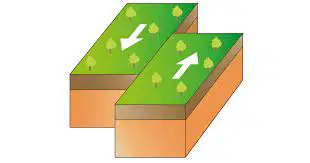
Which of the following Earth's processes act like a conveyor belt - dragging the plates of the lithosphere?
Convection currents
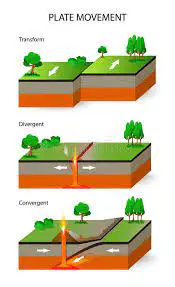
Define a transform boundary
A type of plate boundary where two tectonic plates slide past each other horizontally, creating Earthquakes
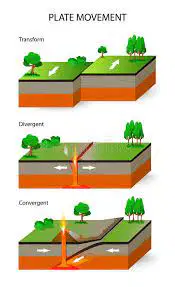
Define divergent boundary

Define Convergent Boundary (Ocean-Continent)

Define Convergent Boundary (Continent-Continent)
When two continental plates collide, they create mountain ranges because the plates are the same density.

What is the process called where the more dense oceanic plate sinks into the mantle while the less dense continental plate rises above, forming a volcano and/or volcanic mountain ranges?
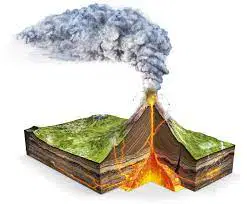
Places like Hawaii and Yellowstone both have volcanoes that have formed in the middle of giant tectonic plates. What geological formation causes these volcanoes to form in unlikely places?
Mantle plumes

Earth's internal heat comes from which sources?
Radioactive decay, residual heat from formation

If you were to take a sample of each of the layers of the Earth based on physical composition, which would be the most heavy (dense)?
Core
Lithosphere

Which layer of the earth is in a plastic like state? (not quite liquid, not quite solid) hint: It's a mantle layer and moves by convection!
Asthenosphere
Lithosphere

What causes magnetic stripes on the ocean floor?
Changes in Earth's magnetic field
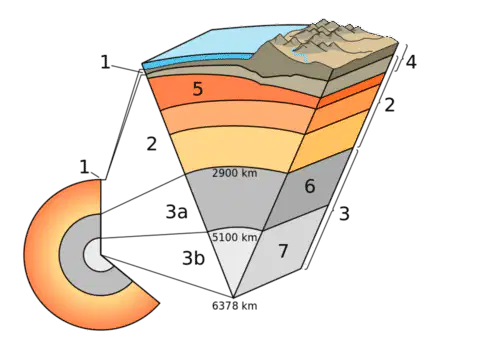
Which layer is # 4
Crust
Lithosphere
Mantle
Asthenosphere
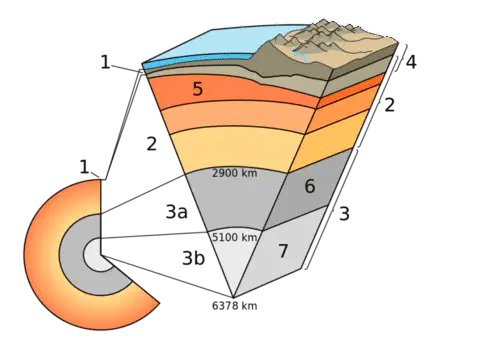
Which layer is # 5
Asthenosphere
Mantle
Lithosphere
Outer core
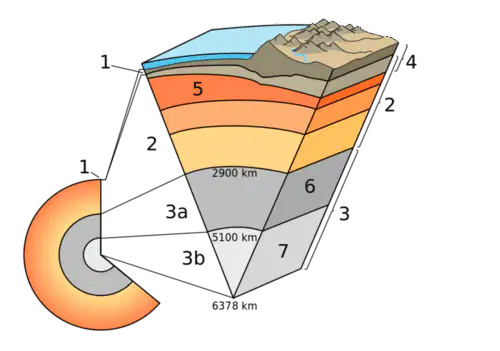
Which layer is # 2
Asthenosphere
Outer core
Lithosphere
Mantle
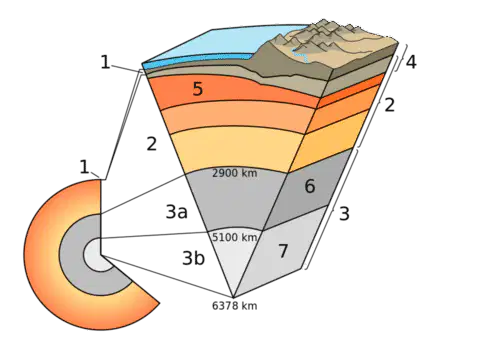
Which layer is # 7
Mantle
Outer core
Lithosphere
Inner core

A rock sample originally started with 100 micrograms of uranium 238, now it contains only 6.25 micrograms of uranium 238. How many half lives has this uranium gone through?
4
3

Carbon 14 has a half life of 5730 years. If a specific sample of carbon 14 has gone through 5 half lives, how many years have passed?
910,330 years

When a radioactive element decays, it decays from a "parent" atom into a different "daughter" atom. If we had a rock sample that had 25% of the parent atom remaining, how much of the daughter atom would have formed?
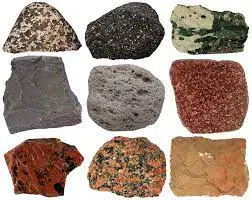
What type of rocks is it NOT useful to use radiometric dating on?
Dwayne Johnson

Which one of these engineering designs is most likely to reduce the damage a building takes during an Earthquake?

